

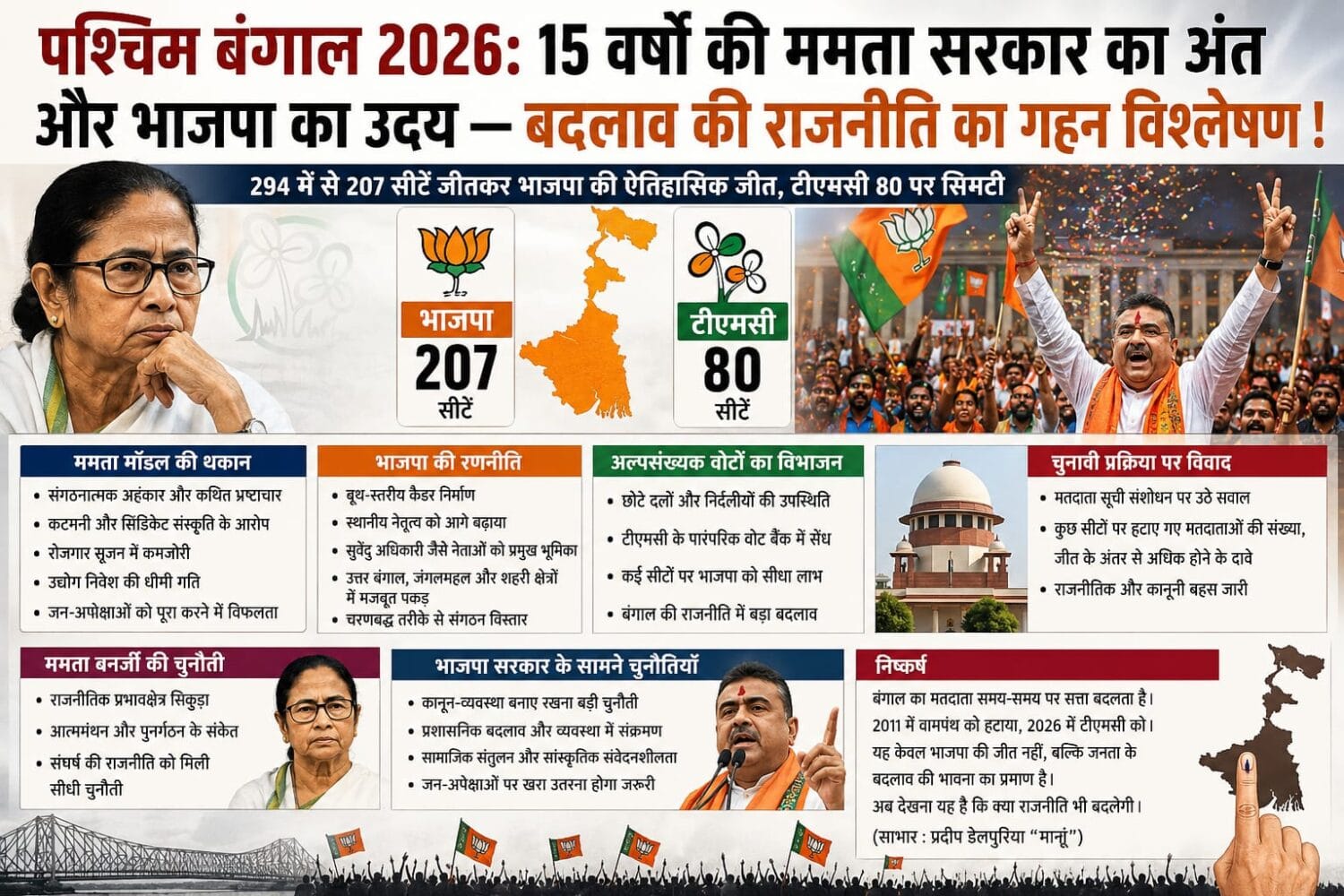
The political landscape of West Bengal witnessed a historic transformation in May 2026. After ruling the state for 15 years, Mamata Banerjee and the All India Trinamool Congress (TMC) lost power as the Bharatiya Janata Party (BJP) secured a decisive majority by winning 207 out of 294 seats in the West Bengal Assembly Elections 2026, while TMC was reduced to just 80 seats.
This was not merely a change of government. It signaled a structural shift in Bengal’s political culture, voter psychology, and long-standing electoral dynamics.
The Fatigue of the “Mamata Model” and Growing Anti-Incumbency
Any government that remains in power for over a decade eventually faces the challenge of managing rising public expectations.
During her tenure, Mamata Banerjee introduced several welfare schemes and maintained strong support among women voters and rural communities. However, over time, dissatisfaction began emerging across multiple levels of governance and society.
Several concerns repeatedly surfaced during the election campaign:
- Allegations of corruption at the local level
- Complaints regarding “cut money” and syndicate culture
- Weak industrial investment and limited job creation
- Organizational arrogance within sections of the ruling structure
Political observers believe that the very energy of “change” that brought Mamata Banerjee to power in 2011 gradually began losing momentum.
Historically, Bengal’s voters are known for giving governments long mandates, but once the desire for change intensifies, they deliver decisive verdicts — exactly as seen in 1977, 2011, and now again in 2026.
BJP’s Victory Was Not Sudden — It Was Built Step by Step
The BJP’s massive victory in Bengal was not the result of a single election wave.
The foundation was laid gradually over several years.
After making major gains in the 2019 Lok Sabha elections, BJP emerged as the principal opposition force in 2021 despite failing to form the government. Over the next five years, the party focused heavily on strengthening its grassroots organization.
1. Booth-Level Cadre Expansion
In a cadre-driven state like West Bengal, organizational depth matters more than temporary popularity. BJP expanded its network aggressively across villages, semi-urban regions, and local political units.
2. Promoting Local Leadership
By placing leaders such as Suvendu Adhikari at the forefront, BJP gradually shifted the political narrative away from the “outsider vs local” debate. His rise and eventual oath as Chief Minister became symbolic of BJP’s localized political strategy in Bengal.
3. Reworking Social and Regional Equations
The party successfully built strong support among urban middle-class voters, North Bengal regions, and the Junglemahal belt, creating a stable electoral base that TMC struggled to counter.
Minority Vote Division Became a Decisive Factor
One of the most significant developments of the 2026 election was the partial fragmentation of the minority vote bank.
On several seats, smaller regional parties and independent candidates weakened TMC’s traditional support base. Political analysts suggest that this division helped BJP secure victories in constituencies where direct one-on-one contests may have produced different outcomes.
For decades, minority votes in Bengal largely remained politically consolidated. The 2026 election indicated early signs of change in that pattern.
Controversies Around the Electoral Process
Following the election results, TMC raised serious concerns regarding voter list revisions and alleged voter deletions.
Reports suggested that in certain constituencies, the number of removed voters exceeded the final victory margin. These allegations are expected to remain part of political and legal debates in the coming months.
However, considering the scale of BJP’s victory — 207 seats against TMC’s 80 — it becomes difficult to explain the entire mandate solely through procedural controversies.
The result appeared to be a combination of large-scale anti-incumbency and BJP’s highly effective electoral strategy.
The Symbolic Decline of Mamata Banerjee’s Political Dominance
If one image from this election is remembered historically, it will likely be the shrinking political influence of Mamata Banerjee.
Her political identity was always built around struggle, street-level resistance, and aggressive opposition politics. Ironically, BJP challenged her using a similarly aggressive political style.
Changes in her public communication strategy and internal signals of party restructuring suggest that TMC may now be entering a phase of political introspection and reorganization.
Challenges Before the New BJP Government
Winning Bengal may have been historic, but governing it will be far more difficult.
West Bengal’s political and social structure remains deeply complex. The new BJP government faces immediate challenges on multiple fronts:
Law and Order
Post-election violence concerns have already drawn judicial attention. Maintaining stability will be the government’s first major test.
Administrative Transition
After 15 years of TMC rule, transitioning bureaucratic and administrative systems smoothly will not be easy.
Cultural and Political Acceptance
For BJP, electoral victory alone is not enough. The party must establish itself within Bengal’s unique cultural, intellectual, and social landscape.
Is This the Beginning of a New Political Era in Bengal?
The 2026 mandate sends a clear message:
The Bengali voter may be emotional and ideological, but not permanently loyal to any political force.
In 2011, voters removed the Left Front after 34 years. In 2026, they removed TMC after 15 years.
This transformation is not just BJP’s victory; it reflects Bengal’s long-standing political tendency to periodically redefine power structures.
The real test now begins for BJP.
If the new government successfully delivers governance, development, and social balance, Bengal may witness a long-term political restructuring.
If not, history suggests Bengal’s voters will not hesitate to engineer another political reversal in the future.
West Bengal has changed its government. The coming years will determine whether its politics changes as well.
(Reference & Political Inputs: Pradeep Delpuriya “Manu”)