

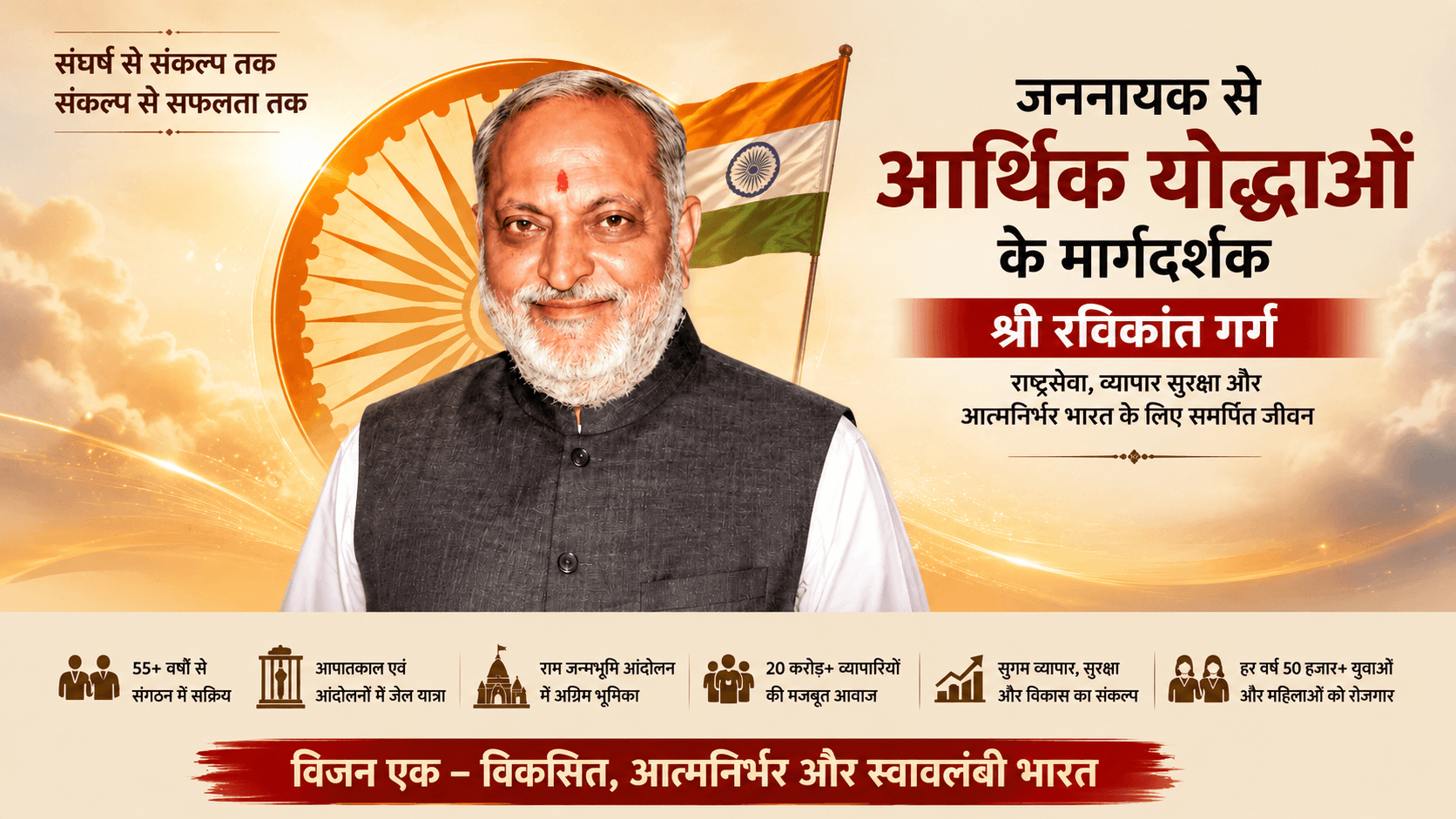
In Indian public life, certain personalities rise beyond political identity and become symbols of organization, ideological commitment, social influence, and economic leadership. Ravikant Garg is widely regarded as one such figure whose political and organizational journey has remained closely connected with nationalism, trader welfare, social activism, and public service.
A former Minister of State in the Government of Uttar Pradesh, senior Bharatiya Janata Party leader, National Executive Member of the BJP, National President of Bharatiya Udyog Vyapar Mandal, and International Executive Chairman of the International Vaishya Mahasammelan, Ravikant Garg today continues to be recognized as an influential voice representing traders, entrepreneurs, and the Vaishya community across India.
His public life is not limited to electoral politics alone. Over several decades, he has remained associated with ideological movements, organizational expansion, social initiatives, economic advocacy, and campaigns connected with trader rights and national development.
Ravikant Garg’s association with public life reportedly began at a young age during the political atmosphere surrounding the 1967 elections. Influenced by nationalist thought early in life, he became associated with the Rashtriya Swayamsevak Sangh (RSS), which played an important role in shaping his ideological foundation.
During his student years, he became associated with the Akhil Bharatiya Vidyarthi Parishad (ABVP) and later participated in social and political activities through the Bharatiya Yuva Sangh, the youth wing connected with the Bharatiya Jana Sangh.
Over the years, he remained actively associated with numerous social, religious, educational, and trade organizations connected with Mathura and Uttar Pradesh. These included Shri Ramlila Sabha Mathura, Nagar Udyog Vyapar Mandal, Shri Agrawal Sabha, Shri Tilak Dwar Agrawal Dharamshala Committee, Akhil Bharatiya Vaishya Mahasammelan, International Vaishya Mahasammelan, and several community-based organizations.
Political observers often describe Ravikant Garg as a leader shaped by movements and organizational struggles rather than only electoral politics. During the Emergency period in India, he reportedly participated in activities connected with the protection of democratic rights and was associated with protest movements during that phase.
He also remained connected with movements related to the Ram Janmabhoomi campaign, Gau Raksha initiatives, language-related protests, and various public-interest demonstrations over the years. According to publicly shared accounts, several legal cases and detentions emerged during periods of political activism, contributing to his image as a grassroots organizational leader.
Ravikant Garg’s political rise in Mathura-Vrindavan is considered an important chapter in regional BJP history. He played a significant role in strengthening the party’s local organizational structure at the booth and grassroots levels.
In 1989, he was elected as MLA from the Mathura-Vrindavan Assembly constituency, a victory considered politically significant during that period. He was re-elected again in 1991 with a strong mandate and later served as Minister of State for Energy in the Uttar Pradesh Government. He was also assigned responsibilities related to Institutional Finance.
Political analysts note that his ministerial tenure remained connected with public outreach and organizational engagement in addition to administrative responsibilities.
Alongside electoral politics, Ravikant Garg continued expanding his role in trader organizations and economic advocacy groups. In 1997, he became General Secretary of the BJP Trade Cell in Uttar Pradesh. Later, in 2000, he was appointed Chairman of the Uttar Pradesh Fisheries Development Corporation with the status of Minister of State.
In 2004, he became President of the BJP Trade Cell in Uttar Pradesh and continued holding important positions in several business and social organizations. Over time, he also served in leadership roles connected with Deendayal Upadhyay Seva Pratishthan, Bharatiya Udyog Vyapar Mandal, Uttar Pradesh Udyog Vyapar Mandal, and the International Vaishya Federation.
At present, Ravikant Garg remains active as the International Executive Chairman of the International Vaishya Mahasammelan, where he continues working toward trader welfare, community organization, and economic awareness initiatives.
He has repeatedly emphasized that traders and small business owners represent the economic backbone of India rather than merely being taxpayers. According to his public speeches and organizational statements, creating a secure and corruption-free environment for traders is essential for India’s long-term economic strength.
Supporters associated with trader organizations often describe him as a strong advocate for MSMEs, local industries, startups, and small business entrepreneurship. He has also publicly supported the broader idea of “Atmanirbhar Bharat” or self-reliant India.
Ravikant Garg has also remained associated with educational and social development initiatives. He has been connected with Maharaja Agrasen Educational Society and other community-driven institutions working in the fields of education and social welfare.
In various public forums, he has highlighted the importance of employment generation for youth and economic participation for women through startups, self-employment initiatives, and local enterprise development.
Observers of Uttar Pradesh politics believe his long public journey reflects a combination of ideological commitment, organizational networking, trader leadership, and regional political influence.
For readers interested in regional leadership profiles, political history, trader movements, and public personalities connected with Mathura and Uttar Pradesh, more stories and analysis can also be explored at MathuraNow.
Source: Public profile details and information shared for editorial reference.