

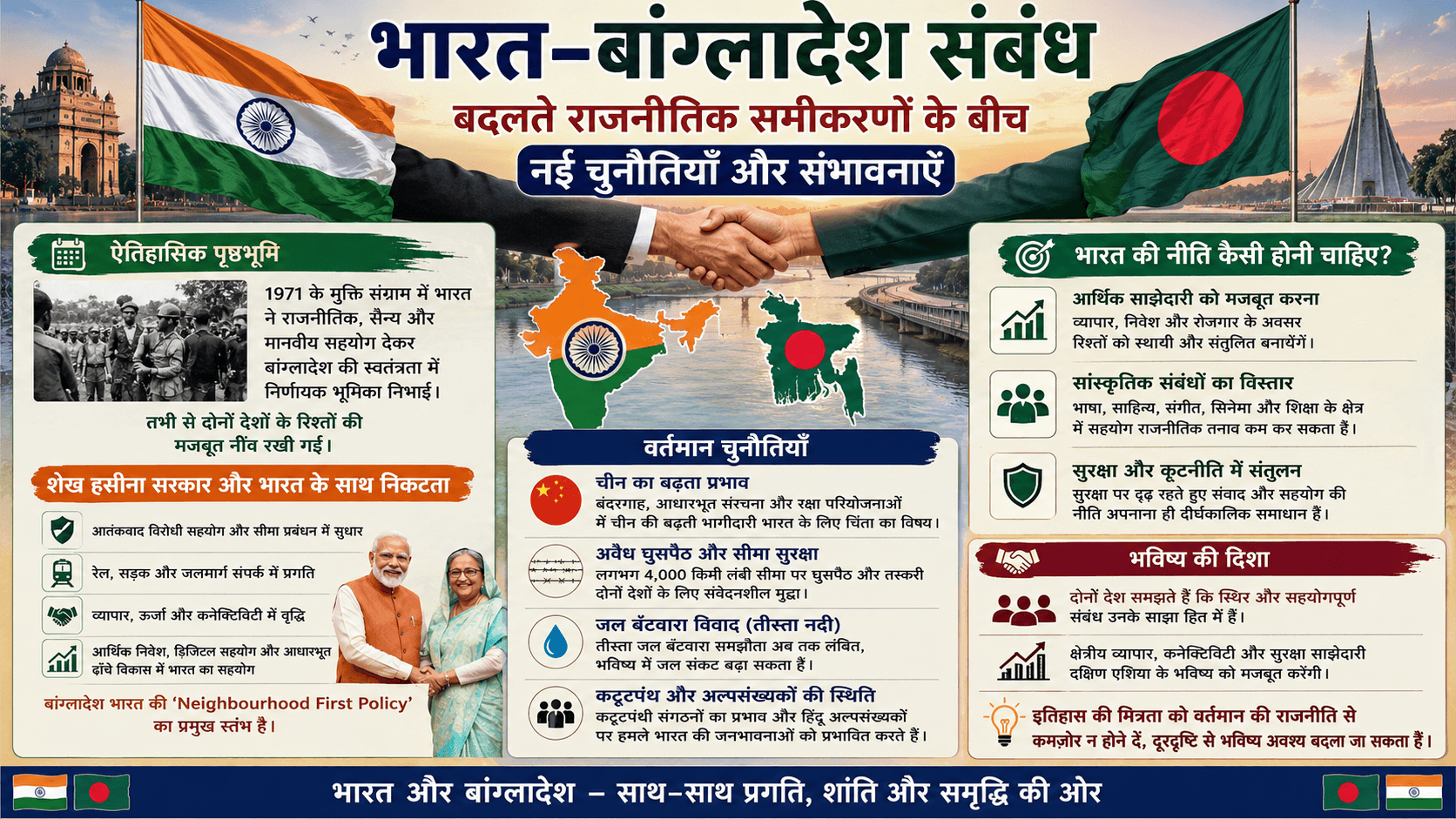
India and Bangladesh share far more than a geographical border. Their relationship is deeply connected through history, culture, language, trade, migration, and the shared memory of the 1971 Bangladesh Liberation War. However, changing political equations in South Asia, China’s expanding regional influence, border security concerns, and internal political shifts inside Bangladesh are now creating a more complex diplomatic environment for both nations.
Today, India–Bangladesh relations are increasingly being viewed not only as a bilateral partnership but also as a key strategic pillar affecting the future stability of South Asia.
Historical Foundations: A Relationship Built During the 1971 Liberation War
The foundation of India–Bangladesh relations was established during the Bangladesh Liberation War of 1971. India played a decisive political, military, and humanitarian role during the conflict. Nearly 10 million refugees reportedly crossed into India during that period, while the Indian government under Prime Minister Indira Gandhi provided diplomatic and military support that ultimately contributed to the creation of Bangladesh.
Following Bangladesh’s independence, both countries initially shared strong emotional and strategic ties. However, over the decades, changes in Bangladesh’s domestic politics, military influence, ideological shifts, and evolving regional geopolitics introduced periods of tension and uncertainty into the relationship.
Sheikh Hasina Era and Strategic Cooperation with India
Over the last fifteen years, the government led by Sheikh Hasina strengthened cooperation with India across multiple sectors including security, trade, connectivity, infrastructure, and regional diplomacy.
Counter-terrorism coordination between both countries significantly improved, particularly concerning security challenges in India’s northeastern region. Cross-border railway services were revived, inland waterway agreements expanded, and economic cooperation steadily increased.
India also invested in energy projects, infrastructure connectivity, digital cooperation, and transportation links connected with Bangladesh. For New Delhi, Bangladesh became an important pillar of India’s “Neighbourhood First Policy” and broader regional connectivity strategy.
New Challenges Emerging in the Relationship
Despite positive cooperation, recent political developments and growing geopolitical competition in South Asia are creating new uncertainties.
1. China’s Expanding Presence in Bangladesh
China has rapidly expanded its economic and strategic footprint across South Asia through infrastructure investments, ports, transportation projects, and defense cooperation.
In Bangladesh, Chinese involvement in infrastructure and development projects has increased significantly over the past decade. Strategic analysts in India closely monitor these developments because similar patterns of Chinese investment have previously influenced regional dynamics in countries such as Sri Lanka and Pakistan.
Indian policymakers remain concerned that excessive strategic dependence on China could eventually complicate South Asia’s geopolitical balance.
2. Border Security and Illegal Migration Concerns
The India–Bangladesh border stretches nearly 4,000 kilometers and remains one of the longest land borders in the world. States such as West Bengal, Assam, Meghalaya, and Tripura have historically witnessed political debates related to illegal migration, smuggling, demographic changes, and border security.
In India, this issue is often discussed not only from a security perspective but also in relation to employment, cultural identity, and political representation.
3. Teesta Water Sharing Dispute
The Teesta River water-sharing agreement continues to remain one of the most sensitive unresolved bilateral issues between India and Bangladesh.
Bangladesh has repeatedly expressed expectations regarding a long-term agreement, while political complexities between India’s central government and state-level stakeholders continue affecting progress.
Climate change and future water scarcity may further intensify the importance of water diplomacy across South Asia.
4. Religious Extremism and Minority Concerns
Bangladesh was founded as a secular nation, but over time concerns related to radical organizations and religious extremism have periodically emerged.
Reports regarding attacks on Hindu minorities and communal tensions often generate public reactions inside India and influence bilateral political discourse.
For Indian policymakers, this issue carries diplomatic, political, and social significance simultaneously.
What Should India’s Long-Term Policy Be?
Strategic experts increasingly argue that India’s Bangladesh policy should remain pragmatic, balanced, and forward-looking rather than relying only on historical goodwill.
Economic Integration and Employment Cooperation
Strengthening trade partnerships, industrial cooperation, investment opportunities, and employment generation for Bangladeshi youth may contribute toward long-term regional stability and economic interdependence.
India and Bangladesh already share expanding trade ties, and future economic integration could become one of the strongest stabilizing factors in bilateral relations.
Cultural and Linguistic Connectivity
Bangladesh shares deep linguistic and cultural connections with Indian states such as West Bengal, Tripura, and Assam.
Experts believe cooperation in literature, cinema, education, tourism, music, and cultural exchanges can help reduce political tensions and strengthen people-to-people trust.
Balancing Security and Diplomacy
India faces the challenge of protecting its security interests while simultaneously maintaining constructive diplomatic engagement with Bangladesh.
Strategic analysts often warn that excessive public pressure or aggressive diplomatic positioning can sometimes push neighboring countries toward rival geopolitical powers.
The Future of South Asian Stability
Both India and Bangladesh understand that long-term regional stability depends heavily on cooperation, economic growth, security coordination, and diplomatic maturity.
If both nations manage political differences with strategic patience, the relationship could evolve into one of South Asia’s most important regional partnerships.
At a time when global geopolitics is rapidly changing, India–Bangladesh relations may significantly influence the future direction of regional trade corridors, connectivity projects, migration policies, and security frameworks across South Asia.
Ultimately, geography cannot be changed, but political vision and diplomatic wisdom can shape the future.
This article is also available in Hindi, Bengali, Gujarati, Tamil, Telugu, and Urdu. Readers can use the language selector available at the top-right corner of MathuraNow.
Source Inspiration: Political analysis and regional commentary shared for editorial adaptation.