

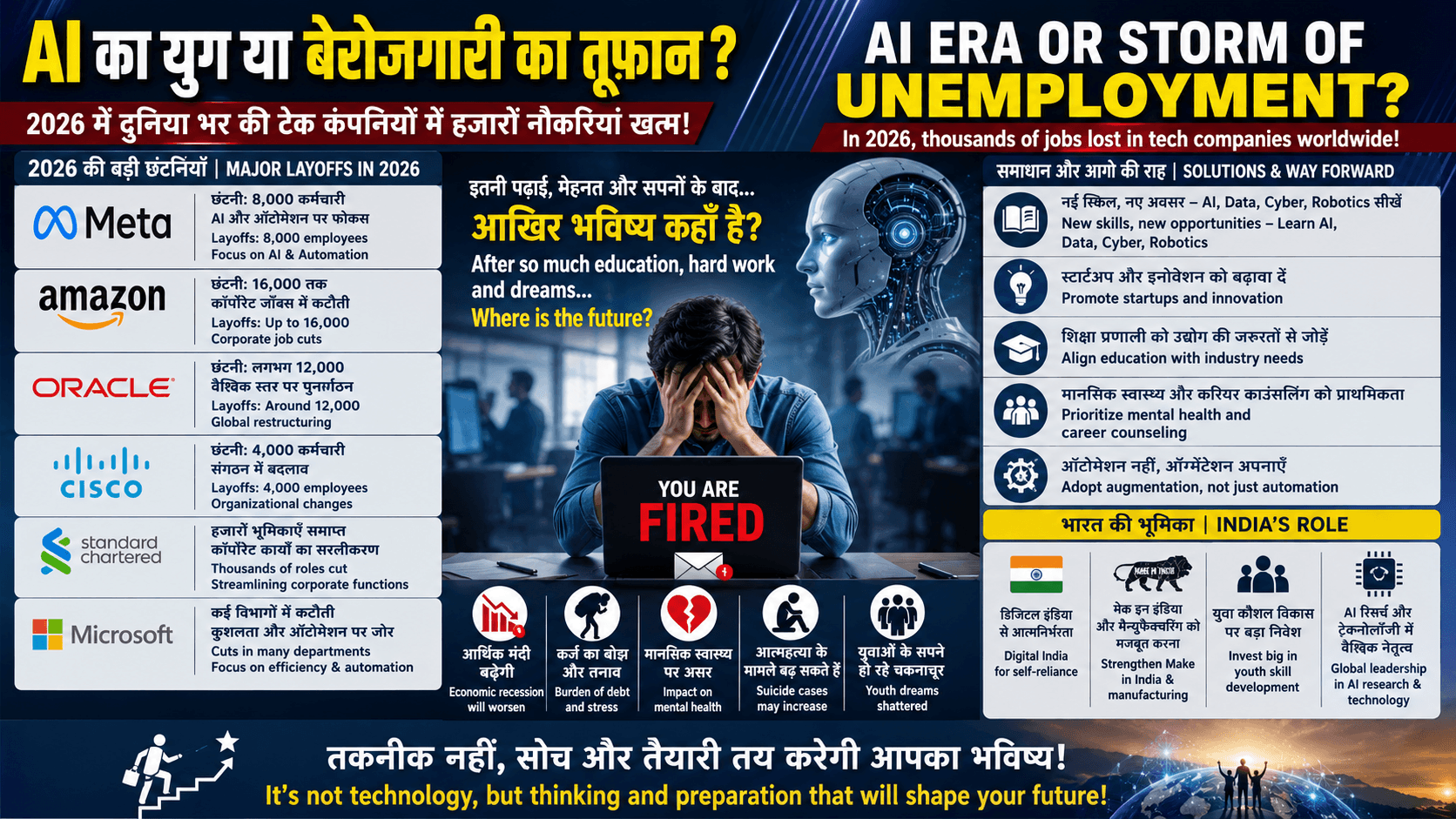
The world is witnessing a strange and deeply uncomfortable reality in 2026.
On one side, governments and corporations continue speaking about artificial intelligence, innovation, digital transformation, and the “future economy.” On the other side, thousands of highly educated young professionals are waking up at 4 AM to emails informing them that their jobs no longer exist.
What was once considered the safest career path — working inside global technology companies — is now becoming uncertain, emotionally exhausting, and financially unstable.
And perhaps the most frightening part is this:
These layoffs are no longer temporary corporate adjustments. Experts increasingly believe this is the beginning of a permanent structural shift in the global workforce.
The Global Layoff Wave of 2026
Several major multinational companies have already announced or executed large-scale layoffs during 2026.
- Meta Platforms: Around 8,000 employees affected as the company aggressively shifts toward AI infrastructure and automation-focused teams.
- Amazon: Reports suggest nearly 16,000 corporate jobs were reduced during early 2026 as the company streamlined operations.
- Oracle: Global restructuring reportedly impacted thousands of employees across multiple countries.
- Cisco Systems: Nearly 4,000 jobs cut during recent restructuring measures.
- Standard Chartered: The bank announced role reductions while simplifying corporate functions.
- Microsoft, Disney, ASML and others: Workforce optimization, voluntary exits, and automation-focused restructuring continue across industries.
But beyond the numbers lies a more disturbing pattern.
Employees across several countries claimed they were first instructed to work from home. Then, early morning emails quietly informed them that their positions had been eliminated.
No office meetings. No emotional conversations. No farewell moments.
Just silence… followed by automated emails.
Many employees believe remote work instructions were intentionally used to avoid public resistance, emotional reactions, or workplace unrest.
For millions of young professionals watching this unfold online, one terrifying question is growing louder every day:
“If even world-class companies cannot guarantee stability after years of education, skills, and experience… then where exactly is the future?”
This Is Not Just an Economic Slowdown
Experts increasingly argue that the current situation is not merely a temporary recession or market correction.
Instead, it represents a deep structural transformation driven by Artificial Intelligence, Generative AI systems, autonomous workflows, and aggressive productivity automation.
For decades, companies measured growth through workforce expansion. More employees often meant larger operations and greater output.
But in 2026, that equation is rapidly breaking apart.
Today, AI systems can already assist with:
- Customer support operations
- Basic software coding
- Content generation
- Data analysis
- Design workflows
- Marketing automation
- Administrative tasks
As a result, many traditional white-collar roles are slowly becoming vulnerable.
Corporate value is now shifting away from simply “completing tasks quickly.”
Instead, companies increasingly seek professionals who can:
- Design complex AI-driven systems
- Understand architecture-level thinking
- Manage intelligent workflows
- Integrate human judgment with automation
In simple words:
The future may belong not to people who merely use AI tools — but to those who can build, control, and strategically guide AI ecosystems.
The Emotional Crisis Nobody Is Discussing Properly
Behind every layoff statistic is a real human story.
A home loan EMI.
A family depending on one salary.
Student education expenses.
Medical responsibilities.
A young professional who believed that a stable corporate career would secure the future.
Global uncertainty and economic pressure are now creating emotional exhaustion across younger generations.
Psychologists and social observers increasingly warn that financial instability, rising debt, career insecurity, and social comparison pressure may contribute to serious mental health challenges if societies fail to respond responsibly.
The world is slowly realizing that technological disruption is not only changing economies — it is changing human psychology itself.
Where Does India Stand in This Global Transition?
India currently stands at a very important turning point.
Unlike many Western economies, India still possesses one major advantage:
A young population with growing digital ambition.
However, India also faces enormous pressure.
Every year, millions of students graduate expecting stable employment opportunities. If global corporations continue reducing traditional workforce hiring, India must rapidly prepare for a completely new economic reality.
How Can India Handle This AI-Era Crisis?
Experts believe India cannot depend only on outsourcing and traditional IT service models anymore.
The country may need to focus on:
- AI education and advanced technical training
- Semiconductor and hardware ecosystems
- Startup innovation and local entrepreneurship
- Cybersecurity and AI governance
- Research-driven engineering culture
- Manufacturing and deep-tech industries
- Skill adaptation programs for young professionals
India’s greatest challenge will not simply be creating jobs.
It will be creating future-proof jobs.
A Harsh Reality the World Must Accept
The AI revolution is not waiting for governments, universities, or societies to emotionally prepare themselves.
It is already changing the rules of employment.
The painful truth is that degrees alone may no longer guarantee stability.
The next generation may need to continuously evolve, learn new systems, understand AI collaboration, and adapt faster than any previous workforce in human history.
Still, history also teaches one important lesson:
Every technological revolution destroys some professions — but also creates entirely new industries that earlier generations could never imagine.
The real question is whether governments, companies, and educational systems can move fast enough before millions of young people lose hope in the future itself.
Because an economic slowdown can eventually recover.
But a generation that stops believing in opportunity becomes a far more dangerous global crisis.
This article is also available in Hindi, Bengali, Gujarati, Tamil, Telugu, and Urdu. Readers can use the language selector available at the top-right corner of MathuraNow.
Disclaimer: This article is an editorial analysis based on publicly discussed corporate restructuring reports, economic trends, technology developments, and expert commentary available in global media discussions during 2026.