

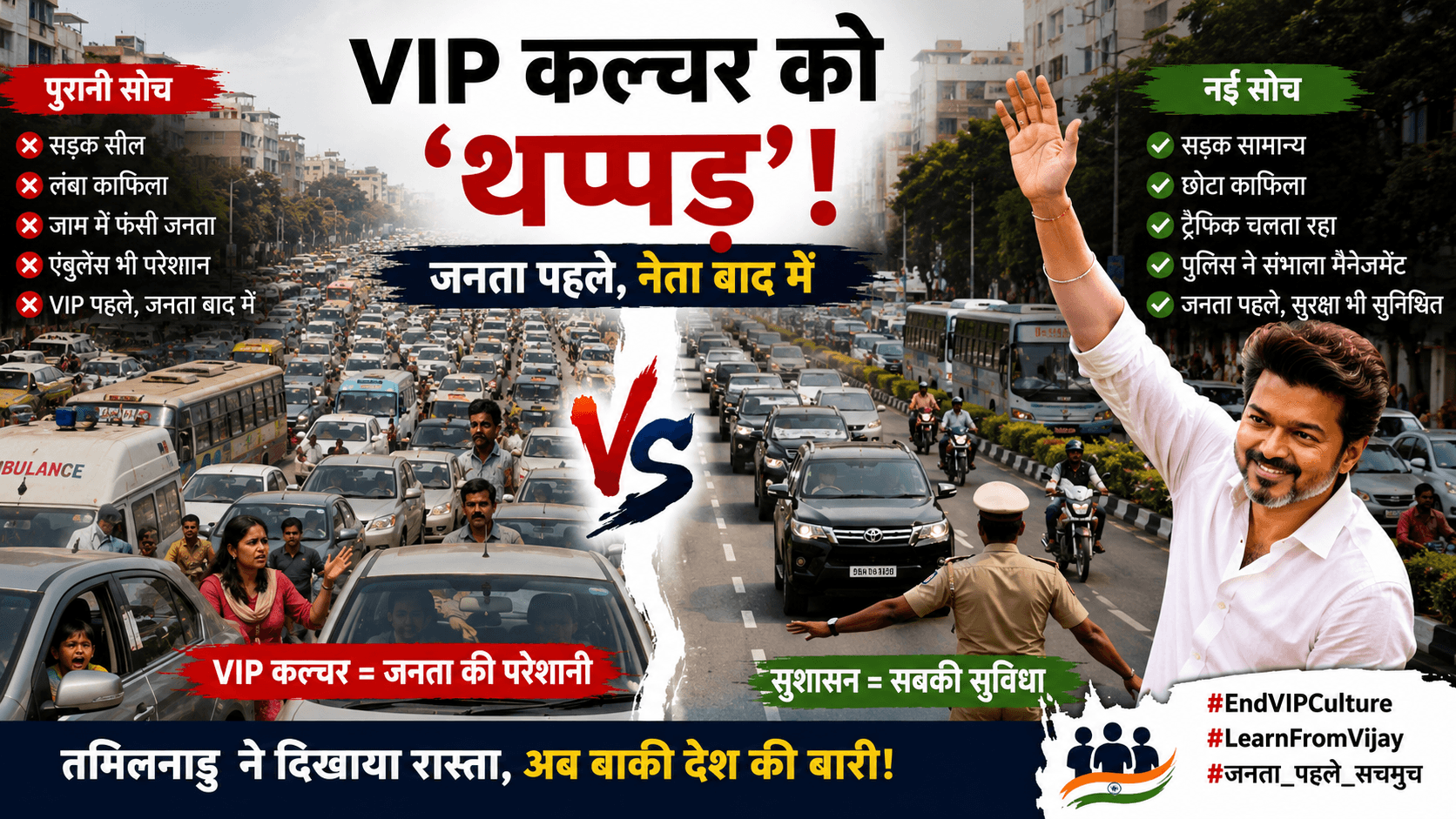
Imagine a typical weekday morning in India.
People are rushing to offices. School buses are running late. Patients are heading toward hospitals. Delivery workers are navigating traffic to earn their daily income.
Then suddenly, sirens begin screaming through the streets.
Traffic police stop everything.
Roads are sealed.
Dozens of SUVs appear.
Black security vehicles. Pilot cars. VIP escorts. Flashing lights. Wireless communication. Roadblocks.
And sitting somewhere in the middle of this grand mechanical parade is a politician who often speaks publicly about “public service” and “simplicity.”
Meanwhile, the public waits.
An ambulance gets trapped.
A child cries inside a school van.
A pregnant woman panics.
Office employees silently watch their attendance timings disappear.
But in India, this has become so normal that people barely react anymore.
Then came a viral video from Tamil Nadu.
A convoy associated with Tamil Nadu Chief Minister and actor-turned-politician Vijay Thalapathy began circulating heavily across social media platforms.
What surprised people was not the convoy itself.
It was the absence of chaos.
No citywide traffic lockdown.
No endless road barricades.
No complete stoppage of public movement.
Cars, buses, autos, and bikes continued moving normally while police managed lane coordination without turning ordinary citizens into temporary prisoners of “VIP movement.”
Social media immediately exploded:
#PeopleFirst
#EndVIPCulture
#LearnFromVijay
And suddenly, a dangerous national question returned:
If one state can balance security and public convenience together… why can’t the rest of India?
India’s Most Expensive Daily Habit?
India’s VIP culture has slowly evolved into something much larger than security management.
For many citizens, it now represents the visible gap between rulers and ordinary people.
Traffic disruptions caused by political movements waste enormous amounts of fuel, working hours, public patience, and emergency response time.
In major cities like Delhi, Mumbai, Lucknow, Hyderabad, and Bengaluru, even short-duration VIP movements can create large traffic bottlenecks affecting thousands of commuters.
Yet political culture across India continues to operate as though public inconvenience is simply part of governance.
Ironically, many leaders who speak passionately about democracy and equality often travel with convoys large enough to resemble military operations.
The Satirical Reality India Understands Too Well
Across India, the reactions have become predictable.
- Delhi: “National security concerns.” (Followed by a 40-vehicle convoy.)
- Uttar Pradesh: “The public is our family.” (Meanwhile, entire roads disappear under VIP movement.)
- Mumbai: “We believe in simplicity.” (Yet traffic stops at midnight for political movement.)
- Everywhere else: Public speeches about “serving the people,” followed by heavily protected road domination.
The deeper issue is psychological.
Many political systems unconsciously begin treating power not as responsibility, but as privilege.
Special lanes.
Special signals.
Special treatment.
Special silence from the public.
And eventually, ordinary citizens start believing that inconvenience is simply the price of democracy.
Tamil Nadu’s Viral Moment Is Bigger Than One Convoy
Whether this was a newly designed protocol or simply better traffic coordination, the symbolism matters.
The viral Tamil Nadu footage created impact because it showed something emotionally powerful:
A Chief Minister can move through a city without making citizens feel powerless.
That single visual challenged decades of political conditioning.
It reminded people that security arrangements do not necessarily require complete public suffering.
Police can manage routes intelligently.
Convoys do not always need excessive length.
Cities do not need to freeze for one individual.
The Bigger Question for India’s Future
India is rapidly modernizing.
Smart cities.
Digital governance.
AI infrastructure.
Bullet trains.
But citizens increasingly ask:
Can governance truly become modern if political culture still behaves like royal privilege?
The younger generation especially appears less willing to glorify visible political superiority.
Social media has made comparison unavoidable.
Every convoy, every traffic lockdown, every unnecessary road closure is now instantly recorded, uploaded, criticized, and compared globally.
Conclusion
The viral Tamil Nadu moment may appear small on the surface.
But psychologically, it struck a national nerve.
Because deep down, many Indians no longer want rulers who merely speak about simplicity.
They want leaders who behave like fellow citizens.
Perhaps that is why this video spread so rapidly online.
Not because people were shocked by one leader behaving responsibly…
But because they suddenly realized how abnormal “normal VIP culture” has become across the rest of the country.
And somewhere between sirens, barricades, and endless convoys, India’s frustrated middle class quietly asked one final question:
“If power truly comes from the people… why are the people always the ones forced to stop?”
This article is also available in Hindi, Bengali, Gujarati, Tamil, Telugu, and Urdu. Readers can use the language selector available at the top-right corner of MathuraNow.