

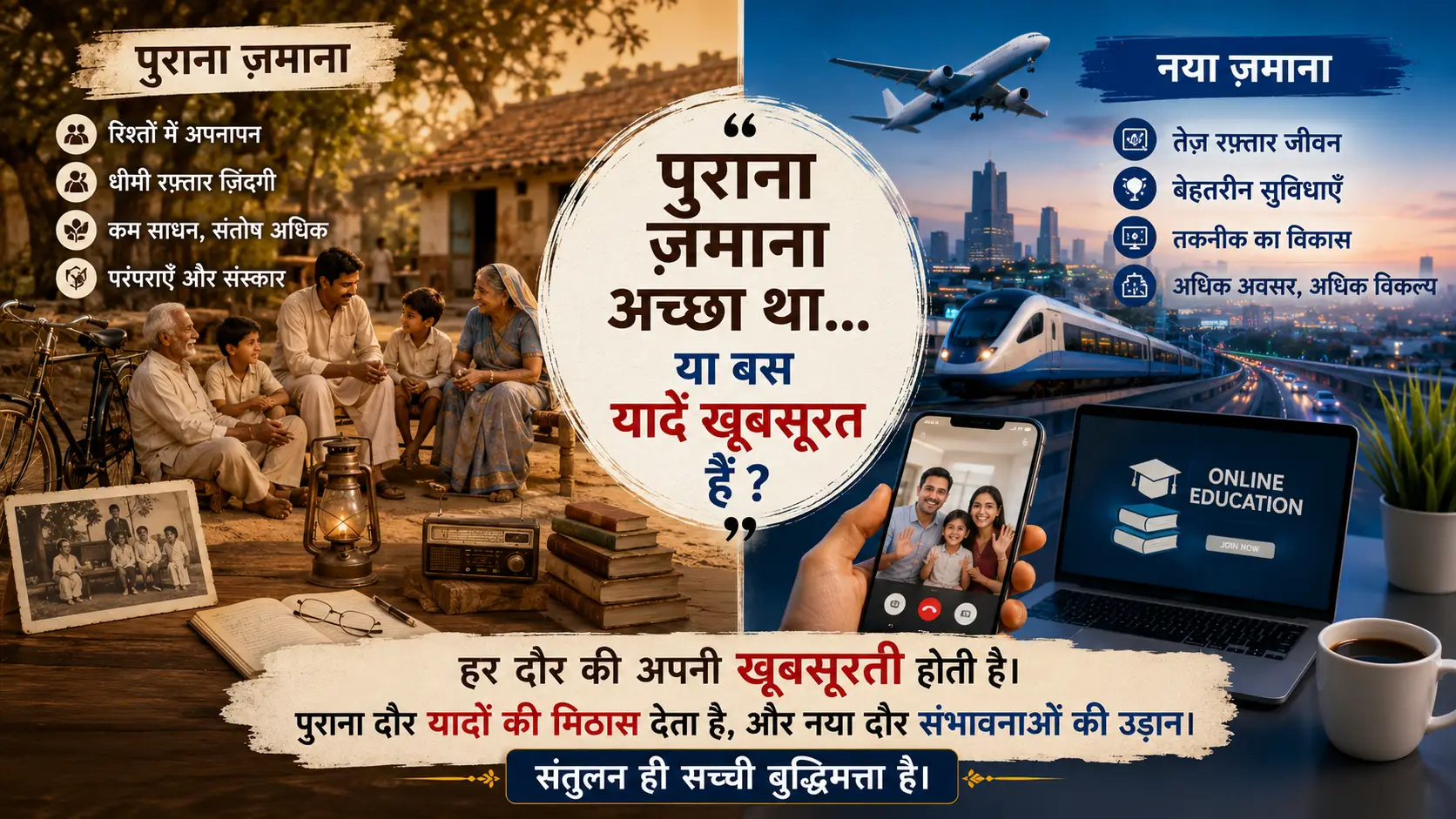
“The old days were much better.”
This sentence is heard almost everywhere today — especially from people around the age of 50 and above. Whether it is during family gatherings, tea-shop discussions, WhatsApp forwards, or evening walks, nostalgia has become a permanent emotional companion for an entire generation.
But an important question deserves honest reflection:
Was the old era truly better… or do our memories simply make it look beautiful?
In psychology, this emotional attachment toward the past is called nostalgia — a natural human tendency to remember earlier years with warmth and affection.
Yet reality is often more complicated.
If every old system was truly ideal, then why did society itself gradually replace those systems with new ones?
The truth is that every era carries its own strengths, struggles, beauty, and imperfections. Human civilization constantly evolves because people naturally seek:
- Better comfort
- More safety
- Faster communication
- Greater opportunity
- Simpler daily life
Perhaps the debate is not about “old versus new.”
Perhaps it is about understanding what humanity gained… and what it unintentionally lost during progress.
📨 Communication: From Letters to Instant Video Calls
There was a time when messages traveled through handwritten letters, telegrams, messengers, or even pigeons in ancient societies.
People waited days, sometimes weeks, to hear from loved ones.
Today, a person sitting in Mathura can instantly video call someone in London, Dubai, or New York within seconds.
If the older communication system was truly more practical, the world would still be depending on postal pigeons instead of smartphones.
Technology did not replace old methods without reason — it solved human limitations.
📚 Education: Knowledge Is No Longer Reserved for the Privileged
Earlier generations depended mostly on limited books, libraries, local teachers, or traditional gurukuls.
For many rural families, higher education itself felt like an impossible dream.
Today, the internet, digital libraries, online courses, and artificial intelligence tools have democratized knowledge.
A student from a small village can now access the same educational content once available only in major metropolitan cities.
Of course, distractions have increased too.
But access to learning has expanded in ways older generations could hardly imagine.
🏥 Healthcare: The Silent Revolution That Saved Millions
In earlier decades, even small infections or common illnesses often became life-threatening due to limited medical facilities.
Today, vaccines, MRI scans, robotic surgery, emergency medicine, and advanced diagnostics save millions of lives every year.
Modern hospitals may feel commercialized at times, but few people would willingly exchange today’s healthcare for the medical limitations of the past.
Progress in medicine happened because human beings constantly searched for ways to reduce suffering.
✈️ Travel & Transportation: Time Itself Has Changed
There was once a time when bullock carts, horses, and walking were primary means of transportation.
Long journeys took weeks or even months.
Today:
- Expressways connect cities rapidly
- Flights shrink continents
- Metro systems move millions daily
- High-speed rail networks redefine mobility
The same journey that once exhausted generations can now be completed in hours.
Modern life became faster because humans valued time more deeply.
🏠 Domestic Life: Convenience Was Earned Through Innovation
Older generations often describe simpler lifestyles with emotional affection.
But simplicity also came with hardship.
Daily tasks once included:
- Fetching water from far distances
- Cooking on smoke-filled stoves
- Washing clothes manually
- Preserving food without refrigeration
Today, washing machines, refrigerators, RO systems, gas stoves, and countless home appliances have dramatically reduced physical burden — especially for women.
Modern convenience exists because people wanted life to become less exhausting.
🌍 Social Opportunities: A More Open World
In older times, opportunities were often limited by gender, caste, geography, or social status.
Many talented individuals never received the chance to study, travel, or build careers.
While modern society still struggles with inequality, there has undeniably been progress toward:
- Women’s education
- Career opportunities
- Social awareness
- Digital entrepreneurship
- Global exposure
Today’s world is imperfect — but it is also more accessible than many previous eras.
💭 Then Why Does the Past Feel So Beautiful?
Because people are usually not remembering the hardships of the past.
They are remembering:
- The warmth of relationships
- Childhood innocence
- Family gatherings
- Slower evenings
- Emotional simplicity
- A time when responsibilities felt lighter
Human memory naturally softens pain and highlights emotional comfort.
That is why old songs sound magical.
Old streets feel emotional.
Old friendships appear deeper.
And old times seem purer.
But every generation carries invisible struggles that the next generation often forgets.
⚖️ A Balanced Truth Between Two Worlds
The real wisdom perhaps lies somewhere between blind nostalgia and blind modernity.
The old era offered:
- Emotional depth
- Stronger community bonds
- Patience
- Human warmth
The modern era offers:
- Opportunity
- Technology
- Speed
- Medical safety
- Global connectivity
Maybe the ideal future is not about returning backward.
Maybe it is about carrying the emotional values of the old world into the technological possibilities of the new one.
🌹 Conclusion
“Every era has its own beauty.”
The old world gives us the sweetness of memories.
The new world gives us the possibility of transformation.
One teaches emotional belonging.
The other teaches human progress.
Perhaps the wisest society is not the one that blindly worships the past or blindly celebrates modernity — but the one that learns from both.
Courtesy:
Pradeep Delpuria “Manu”
This article is also available in Hindi, Bengali, Gujarati, Tamil, Telugu, and Urdu. Readers can use the language selector available at the top-right corner of MathuraNow.