

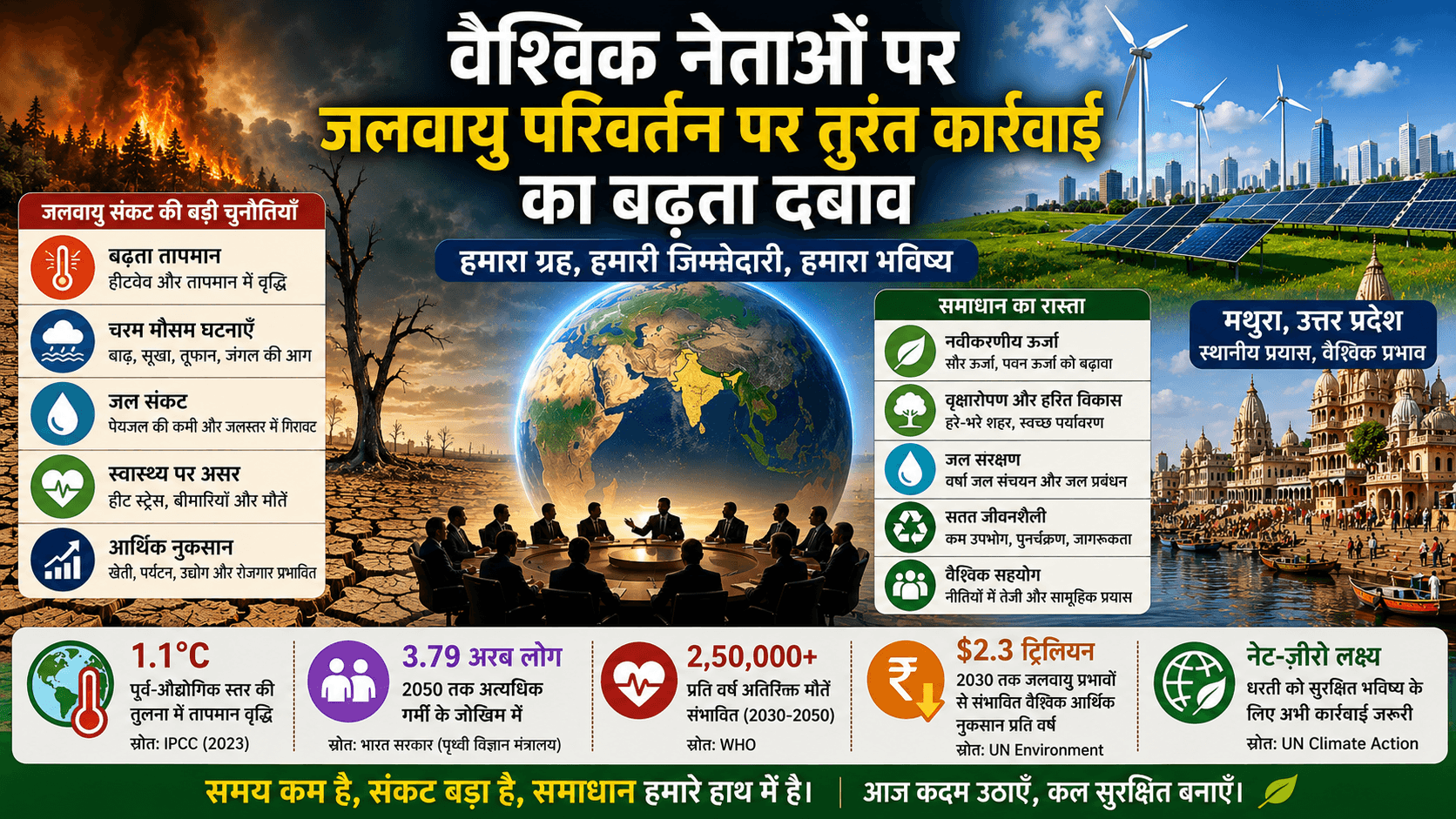
Climate change is no longer a distant scientific warning. It has become an immediate global crisis affecting economies, public health, agriculture, water resources, infrastructure, and daily life across continents. From Europe’s heatwaves and wildfires to flooding in Asia and rising temperatures in Indian cities like Mathura, pressure is rapidly increasing on global leaders to take stronger and faster climate action.
International climate organizations, environmental scientists, and public health experts are warning that the world is approaching a critical tipping point. According to the Intergovernmental Panel on Climate Change (IPCC), global temperatures have already increased by approximately 1.1°C compared to pre-industrial levels, and the possibility of crossing the 1.5°C warming threshold in the coming decades is becoming increasingly likely unless immediate emissions reductions are implemented. :contentReference[oaicite:0]{index=0}
The United Nations Environment Programme (UNEP) has repeatedly warned that current global climate pledges remain insufficient to meet the targets of the Paris Agreement. Environmental experts believe that every additional fraction of warming above 1.5°C could significantly worsen droughts, floods, food insecurity, sea-level rise, and public health emergencies worldwide. :contentReference[oaicite:1]{index=1}
Across the world, governments are facing growing public demands for urgent environmental reforms. Major cities in Europe, North America, Asia, and Africa are already witnessing the effects of extreme weather events. Heatwaves, water shortages, unpredictable rainfall patterns, and climate-related migration are becoming increasingly common.
India is also experiencing rising climate challenges. According to information presented in the Indian Parliament and climate-related studies referenced by the Ministry of Earth Sciences, nearly 3.79 billion people globally could face extreme heat conditions by mid-century if warming trends continue. South Asia, including India, is expected to remain among the most vulnerable regions. :contentReference[oaicite:2]{index=2}
In northern Indian cities such as Mathura, changing weather patterns are already becoming noticeable. Residents frequently experience longer summers, rising heat intensity, irregular rainfall, dust pollution, and increasing pressure on water resources. During peak summer months, temperatures in Mathura and nearby regions of Uttar Pradesh often cross dangerous levels, affecting outdoor workers, elderly populations, street vendors, pilgrims, and local tourism activities.
Mathura’s growing urbanization, traffic congestion, and increasing construction activities have also contributed to environmental stress. Experts believe that if sustainable urban planning, tree plantation drives, water conservation, and heat-resilient infrastructure are not prioritized, medium-sized Indian cities could face major climate-related health and infrastructure risks in the coming decades.
According to the World Health Organization (WHO), climate change is expected to cause approximately 250,000 additional deaths per year globally between 2030 and 2050 from heat stress, malnutrition, malaria, and water-related diseases alone. Health experts also warn that rising temperatures may place additional pressure on already vulnerable healthcare systems in developing nations. :contentReference[oaicite:3]{index=3}
Climate scientists are particularly concerned about urban heatwaves. A recent climate study analyzing future heatwave-related mortality across Indian cities suggested that rapidly urbanizing regions could witness substantial increases in heat-related deaths under high-emission scenarios. Researchers argue that climate mitigation policies and sustainable city planning can significantly reduce future health risks. :contentReference[oaicite:4]{index=4}
Global climate politics is now becoming one of the most important diplomatic issues of the decade. International summits including COP climate conferences continue debating carbon emissions, renewable energy targets, fossil fuel dependency, and climate financing for developing countries.
According to the Climate Change Performance Index 2026, although renewable energy adoption is increasing globally, most major economies are still not moving fast enough to meet Paris Agreement climate goals. The report notes that several G20 nations continue struggling with fossil fuel dependence and slow emissions reduction policies. :contentReference[oaicite:5]{index=5}
Environmental experts also emphasize that climate change is not only an environmental issue but a major economic challenge. Floods, crop failures, heatwaves, storms, and water scarcity directly affect tourism, agriculture, transportation, insurance systems, healthcare spending, and industrial productivity.
In India, sectors connected to pilgrimage tourism and local economies, including Mathura and Vrindavan, may also face future climate-related disruptions. Rising temperatures during peak pilgrimage seasons could impact tourism flows, public health management, crowd control systems, and urban infrastructure planning.
International organizations are increasingly encouraging “climate-resilient cities” through sustainable construction, rooftop cooling, urban forests, wetland restoration, public transportation improvements, and renewable energy investments. UNEP officials recently highlighted that climate-smart urban planning is becoming essential for protecting populations from extreme heat and flooding risks. :contentReference[oaicite:6]{index=6}
Climate activism among younger generations is also growing worldwide. Students, scientists, environmental groups, and policy experts are demanding stronger accountability from governments and corporations. Many activists argue that delayed climate action today will create far greater economic and humanitarian costs in the future.
India has already taken several climate-related initiatives including renewable energy expansion, electric mobility promotion, solar infrastructure growth, and heat action plans in multiple states. However, environmental experts believe implementation speed remains critical.
For cities like Mathura, long-term climate adaptation may require a combination of sustainable tourism management, greener public infrastructure, river conservation, pollution reduction, rainwater harvesting, and heat management systems.
Ultimately, the climate debate is no longer limited to scientists or environmental conferences. It has become a global governance challenge directly connected to economic stability, public health, migration, food security, and future generations.
As global temperatures continue rising, world leaders are facing mounting pressure to move beyond speeches and commitments toward immediate and measurable climate action.
Readers interested in international affairs, environmental policy, and regional developments can also explore more global analysis stories at MathuraNow.