

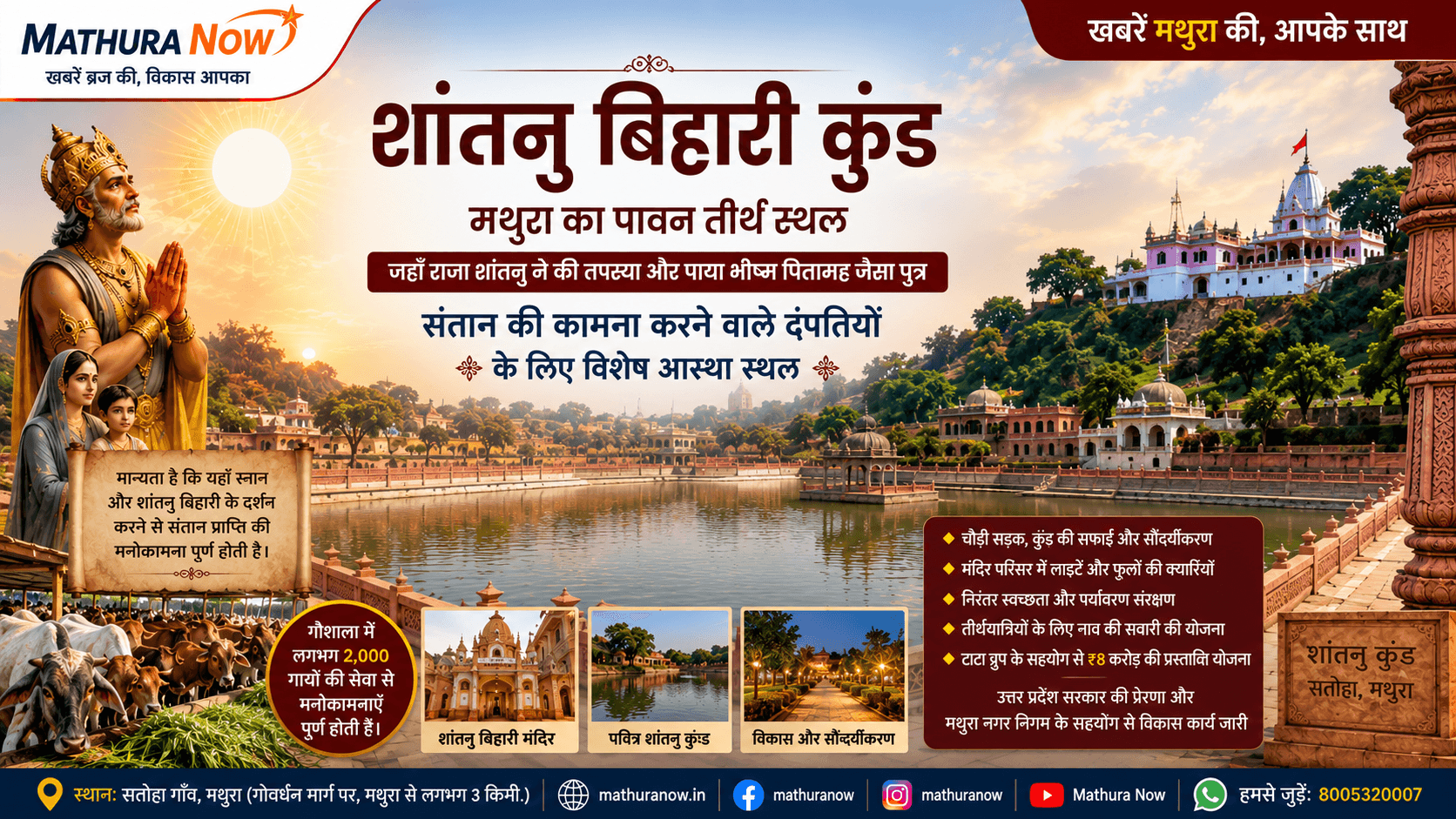
Shantanu Bihari Kund: The Sacred Pilgrimage Site in Mathura Associated with King Shantanu and the Blessing of Progeny
Mathura, Uttar Pradesh: Nestled in the serene surroundings of Satoha Village near Mathura, Shantanu Kund stands as one of the most revered pilgrimage sites of Braj. Rich in mythology, devotion, and historical significance, this sacred water reservoir attracts thousands of devotees every year, particularly couples seeking blessings for childbirth.
A Sacred Stop on the Braj Chaurasi Kos Parikrama
Shantanu Kund is considered an important halt on the famous Braj Chaurasi Kos Yatra, the traditional 84-kos pilgrimage circuit encompassing the divine land associated with Lord Krishna. The site is regarded as part of the third sacred forest (Van) of Braj and is deeply connected to both the Mahabharata tradition and Krishna’s pastoral pastimes.
Local traditions believe that Lord Krishna and Balram grazed their cows in this region, making the area spiritually significant for Vaishnav devotees.
The Legend of King Shantanu
The kund derives its name from King Shantanu of Hastinapur, one of the prominent figures of the Mahabharata era. According to ancient belief, King Shantanu performed intense penance and worship of Surya Narayan (the Sun God) on a hill overlooking the kund. His prayer was simple yet profound—to be blessed with an extraordinary son who would bring glory to his lineage.
Moved by his devotion, the divine powers granted his wish. Later, King Shantanu married the river goddess Ganga, and from this union was born Devavrata, who would become the legendary Bhishma Pitamah, one of the greatest warriors and spiritual personalities of the Mahabharata.
How Devavrata Became Bhishma
After the departure of Goddess Ganga, King Shantanu fell in love with Satyavati, the daughter of a fisherman named Dasharaja. However, Satyavati’s father imposed a condition: only the son born to Satyavati should inherit the throne of Hastinapur.
To fulfill his father’s wish, Devavrata voluntarily renounced his claim to the kingdom. When the fisherman argued that Devavrata’s future children might still seek the throne, the prince took an extraordinary vow of lifelong celibacy.
The severity of this vow astonished the gods. Flowers showered from the heavens, and celestial beings proclaimed, “Bhishma! Bhishma! Bhishma!” meaning one who has undertaken a terrible and difficult vow. From that day onward, Devavrata became known to the world as Bhishma.
Today, Bhishma is revered as one of the great spiritual authorities and among the celebrated Mahajanas described in Vedic literature.
Why Childless Couples Visit Shantanu Kund
For centuries, local residents of Braj have maintained a strong belief that couples facing difficulties in conceiving children can seek blessings at Shantanu Kund. Devotees traditionally take a holy bath in the kund, climb the nearby hill, and offer prayers at the Shantanu Bihari Temple.
Many pilgrims pray for a virtuous son or daughter, inspired by the story of King Shantanu and the birth of Bhishma. During the Braj Chaurasi Kos Yatra and major religious festivals, large numbers of devotees visit the site seeking divine grace.
The Temple, Gaushala, and Local Traditions
Another cherished local tradition holds that after offering prayers at Shantanu Bihari Temple, devotees should feed fodder to cows in the nearby gaushala. The shelter houses nearly 2,000 cows, and it is widely believed that serving the cows with devotion helps fulfill heartfelt wishes.
The temple and gaushala have long been served by Mahant Narsinghdas Maharaj, who continues to preserve the spiritual heritage of the site.
Locals share a deep bond with the ashram of the late Baba Shri Suresh Upadhyay in Bakalpur, Mathura, popularly known as “Bagichi.” Surrounded by fragrant rose and *mogra* (jasmine) plants, the ashram has become renowned for its serene atmosphere. Many devotees recall how Baba Ji used to advise childless couples to first seek blessings at the nearby Shantanu Maharaj Temple. Later, numerous families reported that their prayers were answered, further cementing the site’s reputation as a beacon of hope and faith. Accessible via a walking path from the temple, this ashram is a must-visit; it is said that Baba Ji still wanders here and grants people’s wishes.
Modern Development, Conservation, and Future Vision for Shantanu Kund
In recent years, Shantanu Kund has received renewed attention as an important religious, cultural, and tourism destination within the Braj region. Recognizing the site’s historical and spiritual significance, the Mathura Municipal Corporation (Mathura Nagar Nigam), along with local public representatives, has initiated several efforts aimed at preserving and enhancing the sacred environment for pilgrims.
According to local representatives, significant developmental work has already been undertaken around the kund and temple complex. These initiatives include the widening of approach roads to improve accessibility, regular cleaning and rejuvenation of the sacred water reservoir, beautification of the temple surroundings through decorative lighting and flower beds, and the establishment of continuous sanitation arrangements to maintain cleanliness throughout the year.
Local Councillor Laxman Singh Saini has been actively associated with the promotion and development of the area. Under the guidance of Mathura Nagar Nigam and with support from various government agencies, efforts have been made to transform the site into a cleaner, safer, and more welcoming destination for devotees arriving from across India.
Future development plans are also being explored to enhance the pilgrimage experience while preserving the site’s religious character. Among the proposals under consideration is the introduction of controlled boating facilities for pilgrims and visitors, allowing them to experience the beauty of the sacred kund while maintaining environmental safeguards.
A major aspect of the long-term vision for Shantanu Kund involves water conservation and ecological restoration. Local officials have expressed hope that the Tata Group, one of India’s most respected industrial conglomerates, will contribute approximately ₹8 crore toward water purification, rejuvenation, and beautification efforts at the kund. The initiative is understood to be inspired by the broader vision of the Government of Uttar Pradesh under the leadership of the Chief Minister Yogi Adityanath and is being pursued in coordination with the municipal administration.
If implemented, the proposed restoration project could significantly improve water quality, strengthen environmental sustainability, and help preserve the sacred reservoir for future generations of pilgrims and residents alike. Such efforts would further reinforce Shantanu Kund’s position as one of Braj’s important heritage and pilgrimage destinations.
Alongside these development initiatives, the spiritual traditions associated with the site continue to flourish. Devotees believe that after receiving the blessings of Shantanu Bihari, offering fodder to cows in the nearby gaushala is an act of great religious merit. The gaushala is home to nearly 2,000 cows, and local tradition holds that serving these sacred animals with devotion helps fulfill heartfelt wishes and brings divine blessings to devotees and their families.
This unique combination of heritage conservation, civic development, environmental restoration, cow protection, and living faith continues to make Shantanu Kund a remarkable example of Braj’s enduring spiritual culture.
A Living Heritage of Braj
Today, Shantanu Kund remains a remarkable blend of mythology, devotion, natural beauty, and living tradition. Whether one arrives as a pilgrim seeking divine blessings, a student of the Mahabharata, or a traveler exploring Braj’s sacred geography, the site offers a unique connection to India’s spiritual past.
More than just a historic water body, Shantanu Kund continues to symbolize faith, sacrifice, parental devotion, and the timeless hope for future generations—values that have inspired devotees for centuries.
How to Reach Shantanu Kund
Shantanu Kund and its temple are located near Satoha village, situated between Mathura and Govardhan. It lies approximately 3 kilometers from Mathura city (specifically, the Govardhan intersection). The site is accessible by road using local transport (such as ‘Tiri’ or ‘Tam-Tam’—three-wheeled shared taxis—costing ₹10 per person), private vehicles, or the pilgrimage routes associated with the Braj Chaurasi Kos Parikrama. Tourists often visit Shantanu Kund while touring other significant pilgrimage sites in the Braj region (the Mathura-Govardhan area).