

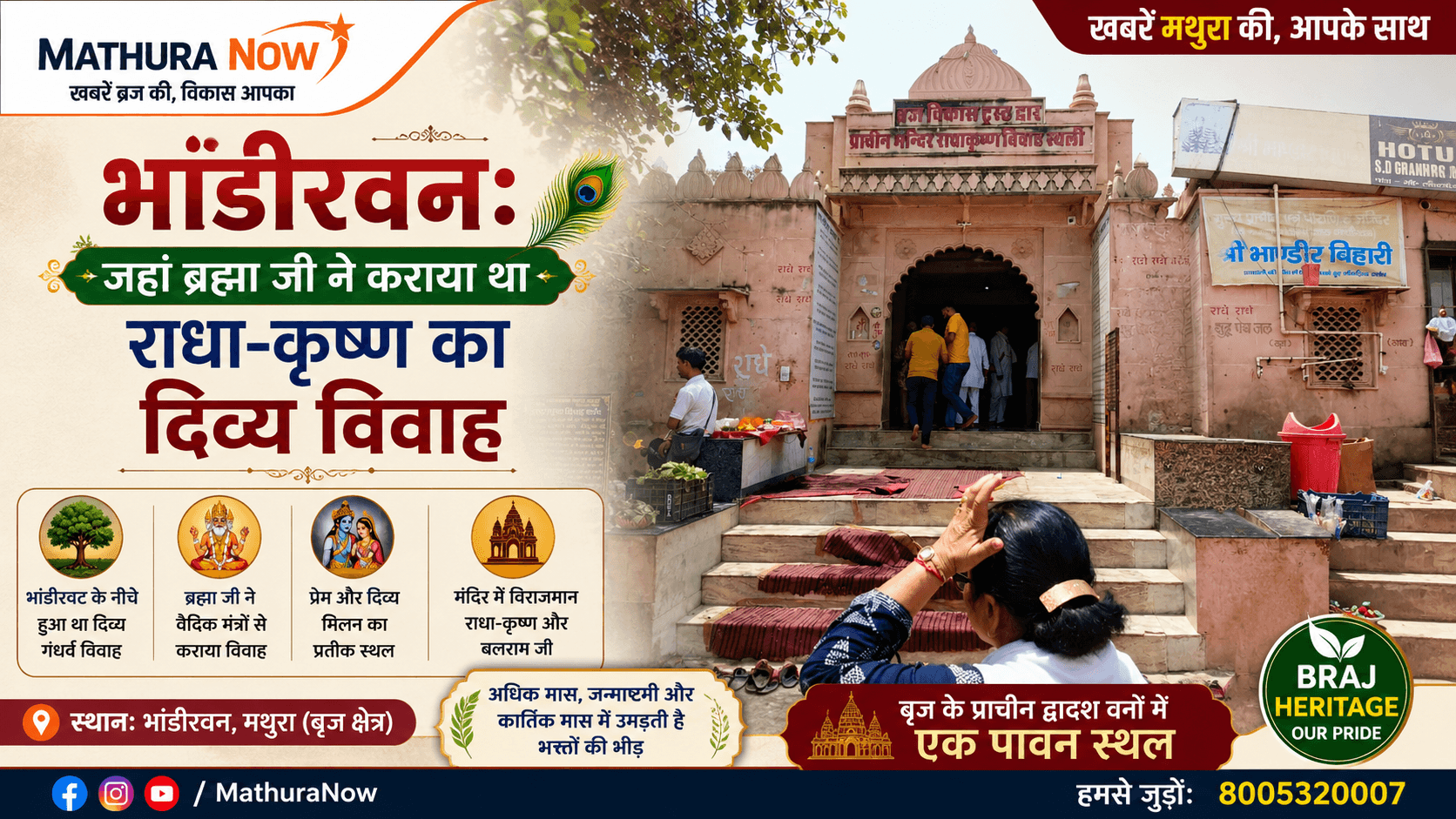
Bhandirvan: The Sacred Forest Where Brahma Performed Radha-Krishna’s Divine Marriage
Mathura: Nestled within the sacred Braj region of Mathura district, Bhandirvan is regarded as one of the holiest sites associated with the childhood and youthful pastimes of Lord Krishna. Revered as one of the ancient Dwadash Vans (Twelve Sacred Forests of Braj), Bhandirvan occupies a unique place in Vaishnava tradition due to its association with the divine marriage of Radha and Krishna.
According to religious traditions and Braj folklore, it was here beneath the legendary Bhandir Vat, a massive banyan tree, that Lord Brahma himself solemnized the celestial wedding of Shri Radha and Shri Krishna. This sacred event transformed Bhandirvan into a symbol of eternal divine love and spiritual union.
The Origin of the Name Bhandirvan
The forest derives its name from the ancient banyan tree known as Bhandir Vat. Devotees believe that this sacred tree witnessed one of the most mystical episodes in Braj’s spiritual history. Even today, pilgrims visit the site to pay homage to the memory of the divine wedding believed to have taken place beneath its shade.
The Mystical Wedding of Radha and Krishna
Ancient devotional literature and Braj traditions narrate a remarkable episode associated with Bhandirvan.
One day, Nanda Baba entered the forest carrying infant Krishna while tending cows. Suddenly, by Krishna’s divine will, dark storm clouds gathered across the sky. Powerful winds began to blow, lightning flashed repeatedly, and dense darkness covered the entire forest.
Seeing the terrifying atmosphere, Nanda Baba became anxious and worried. At that very moment, an extraordinary radiance brighter than millions of suns illuminated the forest.
From this divine effulgence appeared Shri Radha Rani, the daughter of King Vrishabhanu. Recognizing her transcendental nature, Nanda Baba respectfully placed child Krishna in her lap.
According to tradition, the moment Radha held Krishna, a miraculous transformation occurred. The infant Krishna instantly manifested His enchanting adolescent form, adorned with yellow garments and the brilliant Kaustubha jewel.
The ordinary forest then transformed into a celestial realm. Magnificent palaces, jewel-studded pillars, golden courtyards, and a divine wedding pavilion appeared throughout the area.
Brahma Conducts the Divine Wedding
To witness this cosmic event, Lord Brahma, the creator of the universe, personally appeared in Bhandirvan.
Following Vedic traditions, Brahma established a sacred fire altar and began the marriage ceremony. Radha and Krishna exchanged flower garlands and sat upon a divine throne.
As Vedic mantras echoed throughout the heavens, the divine couple circumambulated the sacred fire. Tradition further narrates that Lord Krishna Himself filled Radha’s hair parting with vermilion, completing the sacred marriage ritual.
At that moment, celestial beings showered flowers from the sky. Gandharvas, Kinnaras, and other heavenly beings sang auspicious hymns celebrating the divine union.
The Conclusion of the Divine Pastime
After the marriage ceremony concluded, the celestial pavilion disappeared. Krishna once again assumed His infant form, and the extraordinary vision came to an end.
However, the memory of this sacred event continues to live on through the revered Bhandirvan Vivah Mandir, where devotees can still witness representations of the divine marriage pastime.
Bhandirvan Temple and Its Significance Today
The temple at Bhandirvan houses beautiful deities of Radha-Krishna and Balram Ji. Pilgrims visiting Braj often include this sacred site in their spiritual journey.
The location attracts large numbers of devotees during:
- Adhik Maas
- Janmashtami
- Kartik Month
- Braj Chaurasi Kos Yatra
For many devotees, Bhandirvan represents not merely a historical or religious site, but a living symbol of eternal devotion, divine love, and the inseparable relationship between Radha and Krishna.
Historical References and Restoration
Bhandirvan finds mention in the writings and traditions associated with great saints including Chaitanya Mahaprabhu and Vallabhacharya.
Historical records and local traditions suggest that the temple suffered damage during the invasion of Ahmad Shah Abdali in 1757. Later, around 1800 CE, a merchant named Seth Kudheram undertook restoration efforts and helped revive the temple’s grandeur.
MathuraNow View
In an era when spiritual tourism is rapidly growing across India, Bhandirvan offers visitors more than a temple visit. It provides a glimpse into one of Braj’s most cherished devotional traditions—a sacred narrative where divine love transcends earthly boundaries.
Whether viewed through the lens of faith, culture, heritage, or history, Bhandirvan remains one of Braj’s most spiritually significant destinations, preserving a timeless story that continues to inspire devotees from around the world.
Frequently Asked Questions (FAQ)
Where is Bhandirvan located?
Bhandirvan is located in the Braj region of Mathura district, Uttar Pradesh, and is one of the twelve sacred forests of Braj.
Why is Bhandirvan famous?
Bhandirvan is believed to be the place where Lord Brahma performed the divine marriage of Radha and Krishna beneath the sacred Bhandir Vat tree.
What is Bhandir Vat?
Bhandir Vat is the sacred banyan tree associated with the divine wedding tradition of Radha and Krishna.
Which deities are worshipped at Bhandirvan Temple?
The temple houses deities of Radha-Krishna and Balram Ji.
When is the best time to visit Bhandirvan?
Adhik Maas, Kartik Month, Janmashtami, and Braj pilgrimage seasons are considered especially auspicious times to visit.