

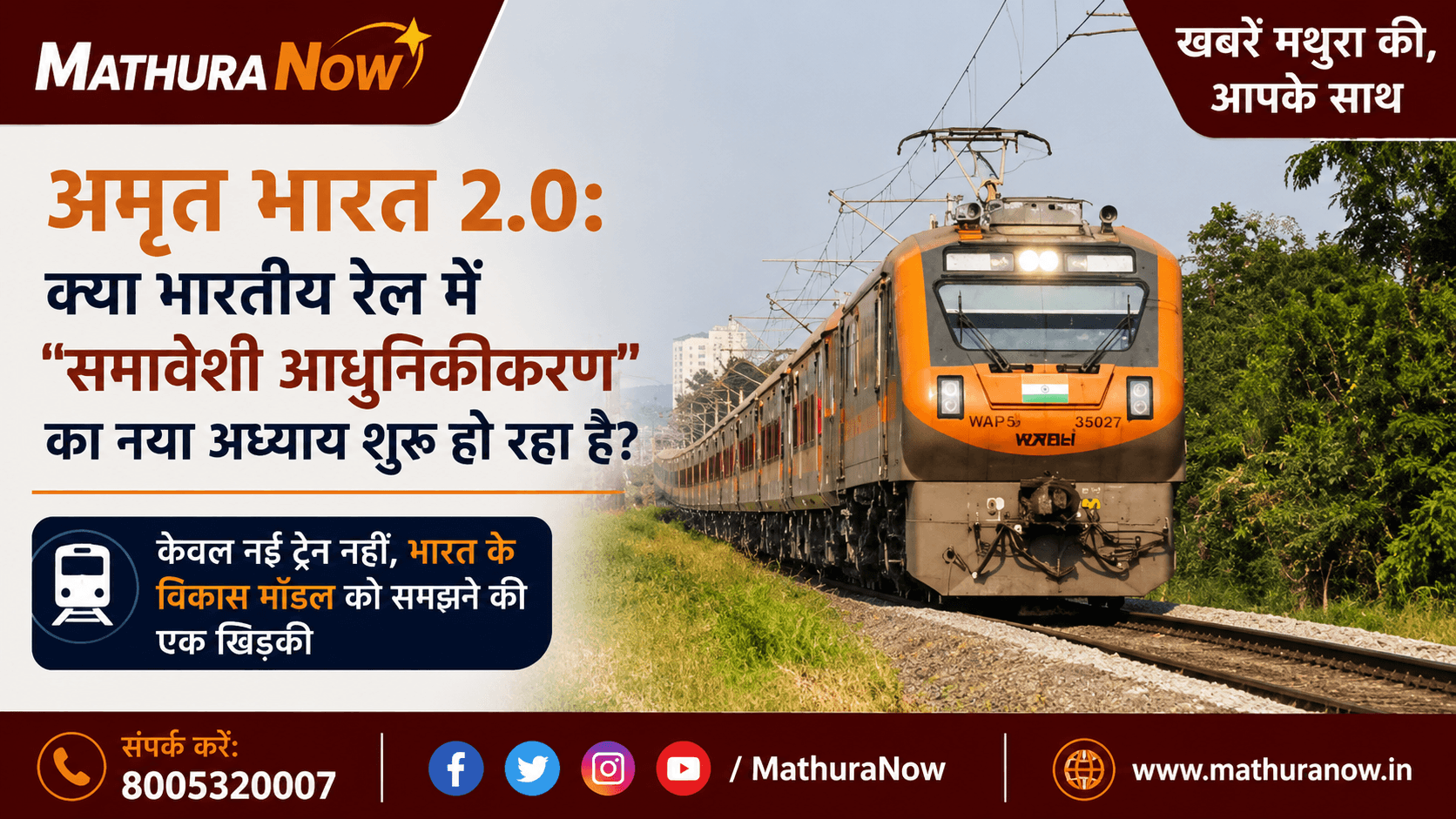
Mathura/ New Delhi: When discussions about Indian Railways take place, they are often limited to train numbers, speed, fares, punctuality, or passenger facilities. However, viewing Indian Railways merely as a transportation network understates its true significance. Railways are not only responsible for moving people across the country but also serve as one of the strongest pillars supporting India’s economy, social integration, regional development, and national unity.
Against this backdrop, Railway Minister Ashwini Vaishnaw’s announcement of Amrit Bharat 2.0 deserves deeper examination. At first glance, it may appear to be another railway modernisation initiative. A closer analysis, however, suggests that it represents an important shift in India’s infrastructure and development philosophy.
According to Railway Ministry announcements, Amrit Bharat 2.0 is designed to provide improved travel experiences for lower-income and lower-middle-income passengers through a combination of enhanced safety, better comfort, and modern technology. Indian Railways has indicated that multiple passenger-centric upgrades are planned, with dozens of new Amrit Bharat trains expected to be introduced in the coming years.
From Colonial Infrastructure to a Development Engine
The history of Indian Railways is not merely the history of transportation. Introduced in 1853 under British rule, the railway network was initially built to serve colonial economic interests. After Independence, the same network gradually transformed into a powerful instrument of nation-building.
From supporting the Green Revolution to facilitating industrialisation, urbanisation, and the creation of a unified national market, railways have played a critical role in India’s development journey.
Yet despite rapid economic growth over the past three decades, a significant gap remained between passenger expectations and the quality of services available to ordinary travellers.
This raises an important question: Should modern railway facilities remain confined to premium travellers, or should ordinary passengers also benefit from technological and comfort upgrades?
Amrit Bharat 2.0 appears to be an attempt to answer that question.
The Third Phase of Railway Modernisation
The evolution of Indian Railways can broadly be understood through three major phases.
- Phase One: Expansion of the railway network.
- Phase Two: Electrification, safety improvements, and capacity enhancement.
- Phase Three: Passenger experience and technology-driven transformation.
While Vande Bharat trains established a new benchmark for premium rail travel, their benefits have primarily reached middle- and higher-income passengers. Amrit Bharat 2.0 seeks to bridge this gap by extending modern facilities to a much larger segment of society.
The First Big Idea: Democratisation of Railway Modernisation
Traditionally, modernisation is often associated with expensive infrastructure and premium services. Amrit Bharat 2.0 presents a different philosophy.
Its underlying message is that modern amenities should not be treated as a privilege reserved for a select group. Better lighting, improved seating ergonomics, enhanced safety systems, upgraded toilets, and passenger-friendly design should be available to ordinary citizens as well.
If successfully implemented, Amrit Bharat 2.0 could become a practical example of what development economists describe as “Inclusive Modernisation.”
Global Perspective: What Other Countries Teach Us
The success of railway systems in countries such as Japan, France, and China is not based solely on speed. Their strength lies in creating multiple service layers that cater to different income groups.
High-speed trains serve premium passengers, while affordable and comfortable services remain available for ordinary citizens.
India’s railway policy increasingly appears to be moving toward a similar framework built around three principles:
- Accessibility
- Affordability
- Quality
This aligns closely with modern development theories that emphasise broad-based access to public infrastructure.
Economic Impact Beyond Transportation
Railway investment is often viewed as expenditure. In reality, it is a productive investment that generates long-term economic returns.
Potential benefits associated with initiatives such as Amrit Bharat 2.0 include:
- Improved long-distance travel experience.
- Greater mobility for workers and migrants.
- Better connectivity between regional markets.
- Growth in tourism activity.
- Increased manufacturing and employment opportunities.
- Expansion of railway supply chains.
When workers travel more safely and comfortably, their productivity can improve. This aspect is often overlooked in public discussions.
The Second Big Idea: Transport as Human Capital Investment
Human capital is generally associated with education and healthcare. Yet transportation also plays an important role in shaping economic productivity.
Students, workers, traders, and professionals all depend on reliable mobility. Better transportation reduces physical stress, saves time, and expands economic opportunities.
Viewed from this perspective, Amrit Bharat 2.0 is not merely a railway project—it is also an investment in India’s human capital.
Policy Significance and Adaptive Governance
Another notable aspect of Amrit Bharat 2.0 is its apparent reliance on feedback-driven policy evolution.
Railway officials have indicated that lessons learned from earlier railway modernisation programmes, including Amrit Bharat 1.0 and other contemporary train projects, have contributed to the design of the new version.
This reflects the public policy principle known as Adaptive Governance—the ability to improve policies based on real-world experience and operational feedback.
For students of governance, public administration, and public policy, this provides an interesting case study in institutional learning.
Opportunities Ahead
If successfully implemented, Amrit Bharat 2.0 could generate several long-term benefits:
- Improved travel quality for ordinary passengers.
- Reduced regional disparities.
- Greater public confidence in Indian Railways.
- Growth in domestic tourism.
- Wider adoption of modern railway technologies.
- Strengthening of citizen-centric public services.
Challenges That Cannot Be Ignored
Like any major public infrastructure programme, Amrit Bharat 2.0 also faces challenges.
- Maintenance and upkeep of upgraded coaches.
- Managing passenger overcrowding.
- Ensuring long-term operational quality.
- Encouraging responsible public usage.
India has often demonstrated excellence in infrastructure creation, but long-term maintenance remains an area requiring continued attention.
The Third Big Idea: Modern Railways Need Modern Civic Culture
Infrastructure alone cannot guarantee success. International experience shows that high-quality public services depend equally on citizen participation and responsible behaviour.
The future of Indian Railways will be shaped not only by engineering excellence but also by public ownership of shared infrastructure.
What Could the Next Decade Look Like?
If current trends continue, Indian Railways may evolve around four key pillars:
- High-speed premium services such as Vande Bharat.
- Inclusive modern services such as Amrit Bharat.
- Redeveloped stations and multimodal transport hubs.
- Digital, green, and technology-enabled railway systems.
Viewed together, Amrit Bharat trains and the Amrit Bharat Station Scheme suggest a broader attempt to transform the entire passenger experience rather than simply adding new trains.
Conclusion
Amrit Bharat 2.0 should not be viewed merely as another train project. It represents a broader vision that seeks to combine modernisation, affordability, and inclusiveness within India’s public infrastructure framework.
Its ultimate success will not be measured by the number of trains introduced, but by whether ordinary passengers experience safer, more comfortable, and more dignified journeys.
If that objective is achieved, Amrit Bharat 2.0 may be remembered not only as a railway initiative but also as a significant milestone in India’s journey toward inclusive infrastructure development.
Author: Pradeep Delpuriya “Manu”
Manu Drishti | Beyond Headlines, Into the Depth of Society