

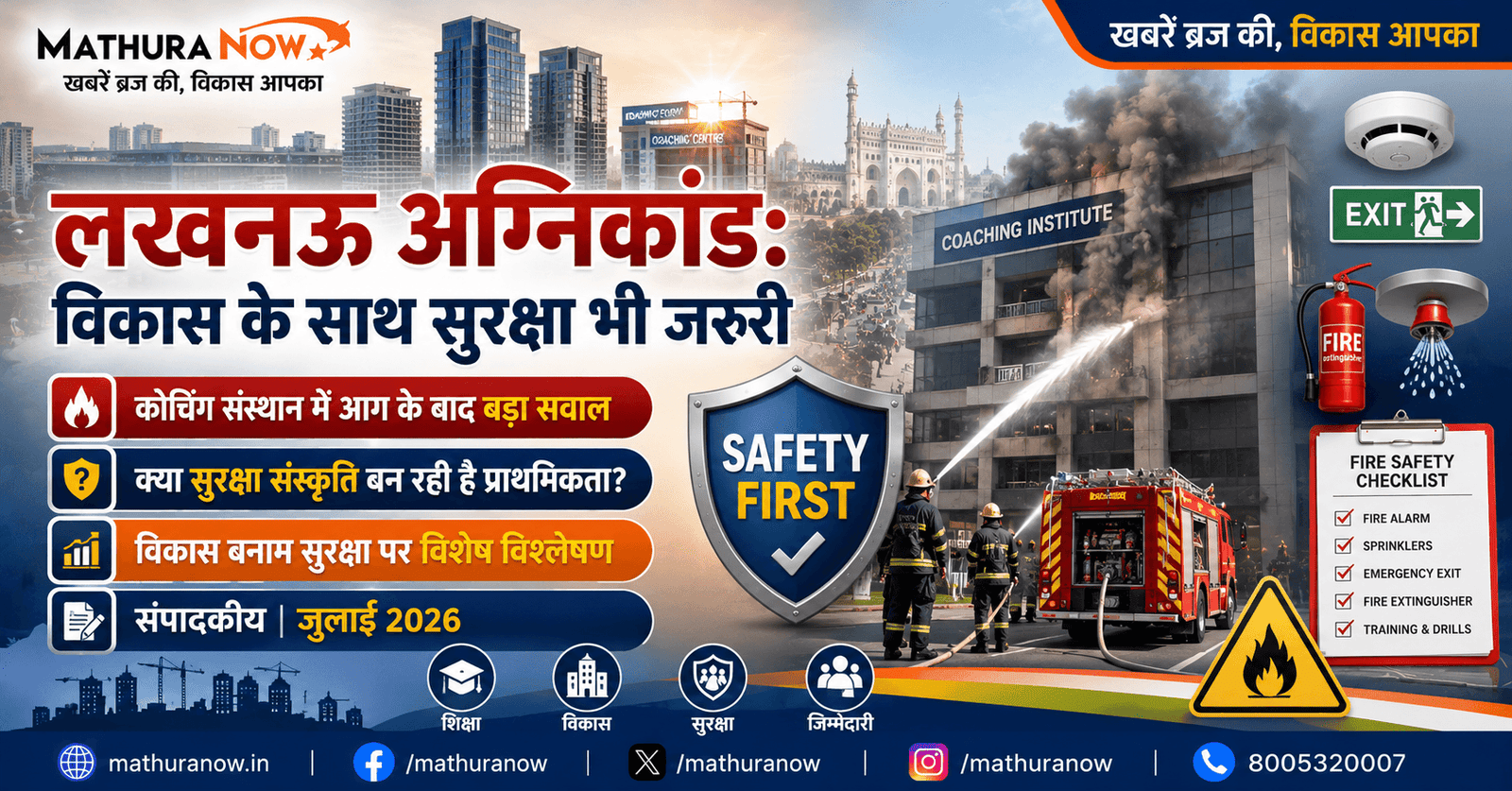
Lucknow Fire Raises Questions Over India’s Safety Culture
Mathura/Lucknow, June 2026: A society’s progress cannot be measured solely by highways, skyscrapers, modern hospitals or expanding educational institutions. The true measure of development lies in how effectively it protects the lives, dignity and safety of its citizens.
The recent fire incident at a coaching institute in Lucknow has once again brought India face-to-face with an uncomfortable but essential question: Are we expanding infrastructure faster than we are building a culture of safety?
This editorial does not seek to assign responsibility for any specific incident. Instead, it examines the broader issue of safety preparedness that affects educational institutions, hospitals, commercial buildings and other public spaces across the country.
Development Without Safety Is Incomplete
India has witnessed rapid urbanisation over the past two decades. Cities have expanded, educational hubs have emerged and commercial activity has accelerated.
However, physical growth must be matched by equally strong investment in safety systems. Fire prevention, emergency evacuation planning, structural compliance and disaster preparedness should be treated as essential components of development—not optional additions.
The Missing Safety Culture
In many developed nations, safety is embedded into planning from the design stage itself. Fire exits, emergency lighting, evacuation drills, accessible staircases and routine inspections form part of everyday institutional management.
In India, however, safety often becomes a subject of attention only after an accident occurs.
Common shortcomings observed across many public and commercial buildings include:
- Delayed or irregular fire safety audits.
- Blocked or inadequate emergency exits.
- Poor maintenance of firefighting equipment.
- Limited emergency response training for staff.
- Overcrowding beyond the designed capacity of buildings.
Any one of these factors can significantly increase risk during an emergency.
The Expanding Coaching Economy
Cities such as Lucknow, Prayagraj, Kota, Delhi, Patna, Kanpur and Varanasi have become major educational destinations, attracting lakhs of students every year.
This growth has created valuable educational opportunities, but it has also introduced new infrastructure challenges.
Several institutions operate from buildings that were not originally designed for educational use. In some cases, parking space, evacuation routes and emergency access may be limited, while student occupancy can exceed the building’s intended capacity.
As educational infrastructure expands, safety planning must evolve alongside it.
Hospitals Require Even Higher Standards
Following the incident, the Uttar Pradesh Government directed safety reviews of hospitals and other public institutions.
Hospitals require particularly stringent safety standards because many patients cannot evacuate independently.
Critical care units, oxygen-supported patients, operation theatres and life-support systems make emergency response significantly more complex than in ordinary commercial buildings.
For this reason, healthcare facilities require continuous monitoring, periodic fire audits and regular emergency preparedness exercises.
Beyond Immediate Administrative Action
Post-incident inspections are important, but sustainable improvement depends upon long-term institutional reforms.
Meaningful progress requires:
- Mandatory periodic fire safety audits.
- Digital monitoring of safety compliance.
- Strict enforcement against repeated violations.
- Independent technical inspections.
- Regular emergency evacuation drills.
- Greater public awareness regarding building safety.
Citizens Also Have a Role
Safety cannot become a priority only for governments and institutions.
Before choosing a school, coaching institute or hospital, citizens often ask about academic results, faculty reputation or medical expertise.
Equally important questions deserve attention:
- Has the building undergone a recent fire safety audit?
- How many emergency exits are available?
- Are evacuation drills conducted regularly?
- Is firefighting equipment functional?
When public awareness increases, institutional accountability naturally becomes stronger.
Redefining Development
Uttar Pradesh is witnessing rapid progress through expressways, airports, industrial corridors and digital infrastructure.
The next stage of development should place equal emphasis on safe infrastructure.
A truly developed state is not defined only by modern buildings.
It is defined by buildings that are safe, institutions that are accountable, regulations that are enforced and citizens who can confidently use public spaces without unnecessary risk.
A Moment for Reflection
Every major accident leaves behind lessons that can strengthen future policy.
If incidents like the one in Lucknow lead to stronger safety standards, improved compliance mechanisms and greater public awareness, they can become turning points in preventing future tragedies.
Development and safety are not competing priorities—they are complementary responsibilities.
Only when safety becomes an integral part of planning, governance and public behaviour can sustainable development truly be achieved.
“The progress of a nation should not be measured by the height of its buildings, but by how safely its people live within them.”
Frequently Asked Questions
Is this article reporting findings from an official investigation?
No. This is an editorial analysis discussing broader public safety and infrastructure issues. It does not assign responsibility for any specific incident.
Why is safety culture important?
A strong safety culture helps reduce risks through better planning, regular inspections, emergency preparedness and public awareness.
Why are coaching institutes and hospitals highlighted?
These institutions often accommodate large numbers of people, making robust safety planning and emergency preparedness particularly important.
What is the main message of this editorial?
Sustainable development requires safety to become a core part of infrastructure planning, governance and public responsibility.