

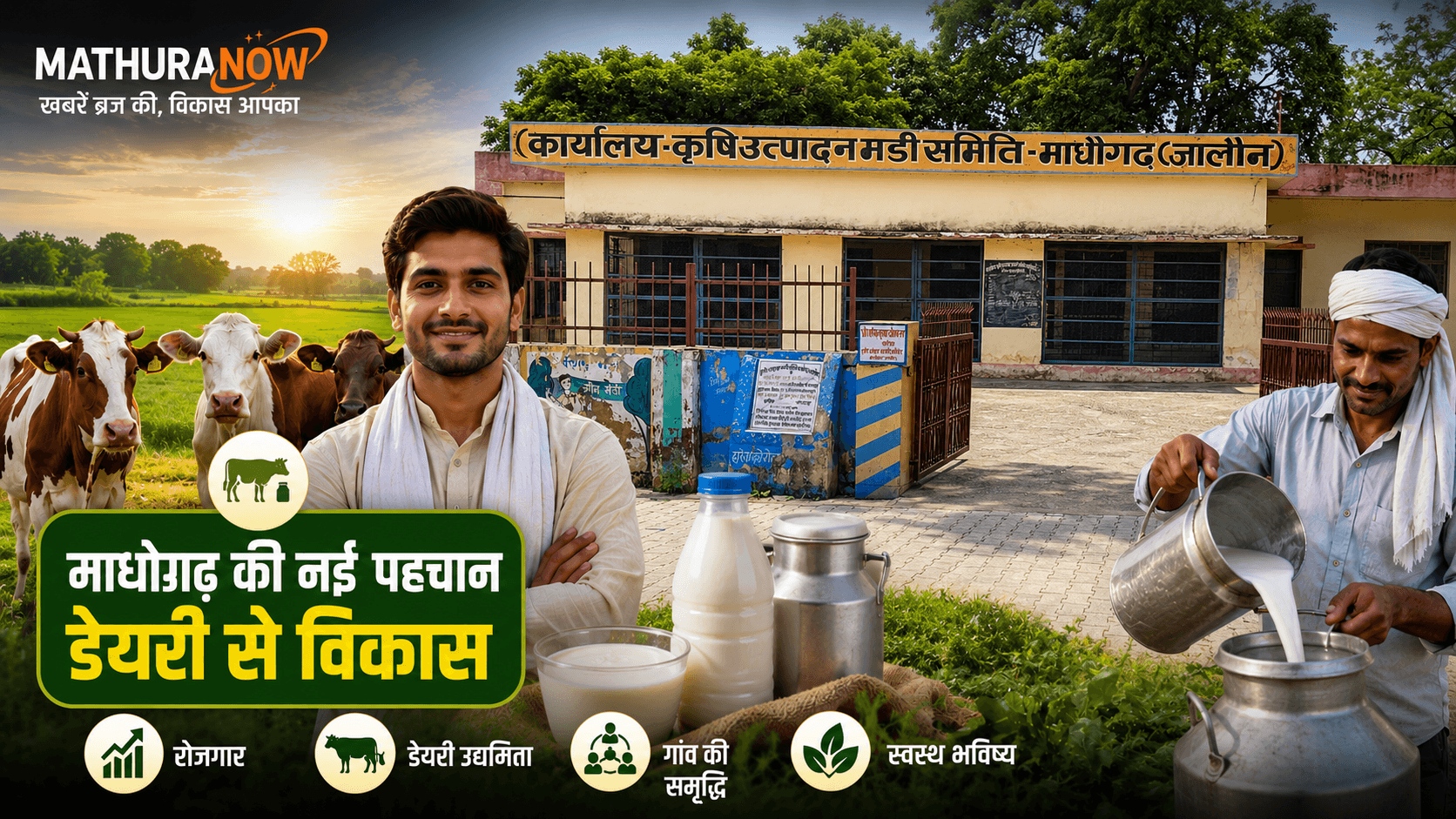
From Migration and Unemployment to Rural Prosperity: A Ground-Level Blueprint for Delpura and Madhogarh
Introduction: The Question Facing Bundelkhand
Across Bundelkhand, a silent transformation has been taking place for decades.
Every year, thousands of young people leave their villages not because they want to, but because they feel they have no alternative.
Madhogarh tehsil in Jalaun district reflects this reality.
The region possesses fertile agricultural land, a long tradition of livestock rearing, hardworking families, and deep cultural roots. Yet employment opportunities remain limited. As a result, migration toward cities such as Kanpur, Delhi, Noida, Ahmedabad, Surat, and Mumbai has become a normal part of life.
Many villages today present a familiar picture:
- Elderly people remain in the village.
- Children grow up with one or both parents working elsewhere.
- Agricultural income struggles to keep pace with rising costs.
- Local economic activity remains weak.
The question is no longer whether migration exists.
The real question is:
Can Madhogarh create an economic model strong enough to make young people stay—or even return?
The Larger Vision: Beyond Tourism
Recently, Madhogarh has started being discussed as a potential rural tourism and cultural destination because of its emotional, ecological, and heritage value.
However, tourism alone cannot become the backbone of a local economy.
Tourism creates seasonal income.
Villages need year-round income.
That is where dairy entrepreneurship enters the discussion.
If tourism can bring visitors, dairy can create stable livelihoods.
Together, they can become complementary pillars of development.
What Brazil Teaches the World
Brazil today ranks among the world’s largest dairy-producing nations.
What makes Brazil’s story important is that many successful dairy regions there were not originally wealthy.
Several areas faced challenges similar to those found in parts of rural India:
- Distance from major cities
- Agricultural dependency
- Limited industrialization
- Rural migration
Brazil’s transformation was not built solely through giant dairy corporations.
Instead, it focused on empowering small farmers through:
- Improved cattle breeds
- Affordable credit
- Veterinary support
- Training programs
- Market connectivity
The philosophy was simple:
Rural families should become dairy entrepreneurs rather than merely livestock owners.
That shift changed entire local economies.
Why Dairy Is Naturally Suited to Madhogarh
Unlike heavy industry, dairy entrepreneurship does not require massive infrastructure.
Madhogarh already possesses many of the ingredients needed for a dairy ecosystem:
| Resource | Availability |
|---|---|
| Agricultural land | Strong |
| Crop residue for fodder | Available |
| Livestock tradition | Strong |
| Family-based labor | Available |
| Rural market demand | Growing |
| Nearby urban markets | Accessible |
The challenge is not resources.
The challenge is organization.
The Five-Cow Entrepreneurship Model
Large dairy farms often appear attractive on paper.
But for villages like Delpura, a family-managed model may be more practical.
Proposed Startup Model
- 5 dairy cows
- Family-run operation
- Gradual expansion
- Local fodder integration
- Direct milk marketing
This structure remains manageable while generating commercial-scale income.
Choosing the Right Breed: The Most Critical Decision
Many dairy businesses fail because of poor breed selection.
Success in Bundelkhand depends on selecting animals that can handle:
- Extreme summer temperatures
- Water limitations
- Local fodder conditions
- Rural management systems
Option 1: Red Sindhi
Advantages:
- Heat resistant up to extreme temperatures
- Strong disease resistance
- Lower maintenance
- Suitable for village conditions
Average Milk Production:
8–12 litres/day
Option 2: Gir
Advantages:
- Premium A2 milk demand
- Higher milk output
- Strong market value
Average Milk Production:
10–18 litres/day
Option 3: Tharparkar
Advantages:
- Adapted to dry climates
- Performs well in water-scarce conditions
- Suitable for Bundelkhand ecology
Recommended Combination for Delpura
Pure Gir-based models may increase risk because of higher maintenance requirements.
A more balanced approach would be:
3 Red Sindhi + 2 Gir
Benefits:
- Climate resilience
- Better risk management
- Strong milk production
- Access to premium A2 milk markets
Startup Investment Analysis
Estimated Capital Requirement
| Component | Approx Cost |
|---|---|
| 3 Red Sindhi Cows | ₹2.40 lakh |
| 2 Gir Cows | ₹2.00 lakh |
| Shed Construction | ₹1.50 lakh |
| Fodder Storage | ₹50,000 |
| Equipment & Water Setup | ₹50,000 |
| Working Capital | ₹1 lakh |
| Total | ₹8 lakh |
Financing Options Available
Many rural youth assume dairy entrepreneurship requires impossible amounts of capital.
In reality, multiple funding channels already exist.
Government Schemes
- Mukhyamantri Yuva Udyami Yojana
- Animal Husbandry Department Support
- Dairy Development Programs
Banking Institutions
- SBI
- Punjab National Bank
- Bank of Baroda
- Aryavart Bank
Institutional Support
- NABARD-backed livestock financing
- Dairy entrepreneurship support programs
Income Reality: The Economics of a Five-Cow Dairy
Assumption:
- 50 litres milk/day
- Average selling price: ₹60/litre
Revenue Table
| Category | Amount |
|---|---|
| Daily Revenue | ₹3,000 |
| Monthly Revenue | ₹90,000 |
Monthly Operating Costs
| Expense | Estimate |
|---|---|
| Fodder | ₹15,000 |
| Feed & Supplements | ₹10,000 |
| Medicines & Veterinary Care | ₹5,000 |
| Maintenance | ₹5,000 |
| Total | ₹35,000–40,000 |
Potential Monthly Net Income
₹45,000–55,000
For many young people, this exceeds income earned through low-paying urban private jobs.
The Real Opportunity Is Value Addition
Most villages focus only on milk.
That is where earnings remain limited.
The real transformation begins when dairy becomes a complete rural enterprise.
Additional Revenue Streams
- Ghee production
- A2 milk branding
- Organic manure
- Vermicompost
- Panchgavya products
- Cow-based organic inputs
One cow can support multiple income channels.
What Happens If 20 Families Participate?
Village-Level Projection
| Metric | Estimate |
|---|---|
| Families | 20 |
| Dairy Cows | 100 |
| Daily Milk Production | 1,000 Litres |
| Monthly Milk Revenue | ₹18 lakh |
| Annual Revenue Potential | ₹2+ Crore |
At this scale, Delpura begins operating not as a village economy but as a rural enterprise cluster.
Could Dairy Support Rural Tourism Too?
Interestingly, yes.
Modern urban families increasingly seek authentic rural experiences.
Globally, farm tourism and agri-tourism are growing sectors.
A future Madhogarh tourism model could include:
- Dairy farm visits
- Organic farming experiences
- Traditional village food
- Cow-based rural tourism
- Agricultural learning programs
This aligns with the broader vision already discussed regarding Madhogarh’s potential as a rural heritage and emotional tourism destination.
Social Impact Beyond Income
The biggest benefits may not be financial.
Potential Social Outcomes
- Reduced migration
- Stronger family structures
- Increased village participation
- Better organic farming adoption
- Reduced idle youth unemployment
- Stronger local identity
Economic stability often creates social stability.
Challenges That Must Be Addressed
No development model is perfect.
Several risks require planning:
| Challenge | Solution |
|---|---|
| High fodder costs | Community fodder banks |
| Veterinary shortages | Mobile animal health units |
| Milk marketing issues | Village dairy cooperatives |
| Loan repayment pressure | Phased expansion |
| Breed management | Training centers |
Ignoring these challenges could weaken the model.
Addressing them could make it sustainable.
Why Delpura Could Become a Demonstration Village
Delpura possesses a unique advantage.
Many families maintain emotional and financial ties to the village even while living in cities.
If such families invest in:
- Dairy entrepreneurship
- Training programs
- Youth mentoring
- Cooperative structures
the village could emerge as a regional model.
FAQ
Can dairy entrepreneurship really reduce migration?
Yes. Stable local income reduces the need for long-term migration and allows families to remain together.
Which breed is safest for Bundelkhand conditions?
Red Sindhi and Tharparkar are generally considered highly adaptable to hot and dry climates.
Is ₹8 lakh investment mandatory?
No. Smaller models with fewer animals can also be started and expanded gradually.
Can A2 milk create additional income?
Yes. Premium A2 milk often receives higher market prices in urban markets.
Is government support available?
Various dairy, livestock, entrepreneurship, and rural development schemes already exist through banks and government departments.
The MathuraNow View
For decades, rural development discussions have revolved around attracting factories, industries, and external investment. But some regions may already possess the resources needed for transformation. Madhogarh has land. It has livestock traditions. It has youth. It has social capital. The challenge is connecting these resources into a working economic system.
Brazil’s dairy success demonstrates that rural prosperity does not always begin with mega projects. Sometimes it begins with a few cows, a family enterprise, and a community willing to believe that development can emerge from its own soil. And perhaps that is the most important lesson for Madhogarh. The future may not lie in leaving the village. It may lie in rebuilding it.