

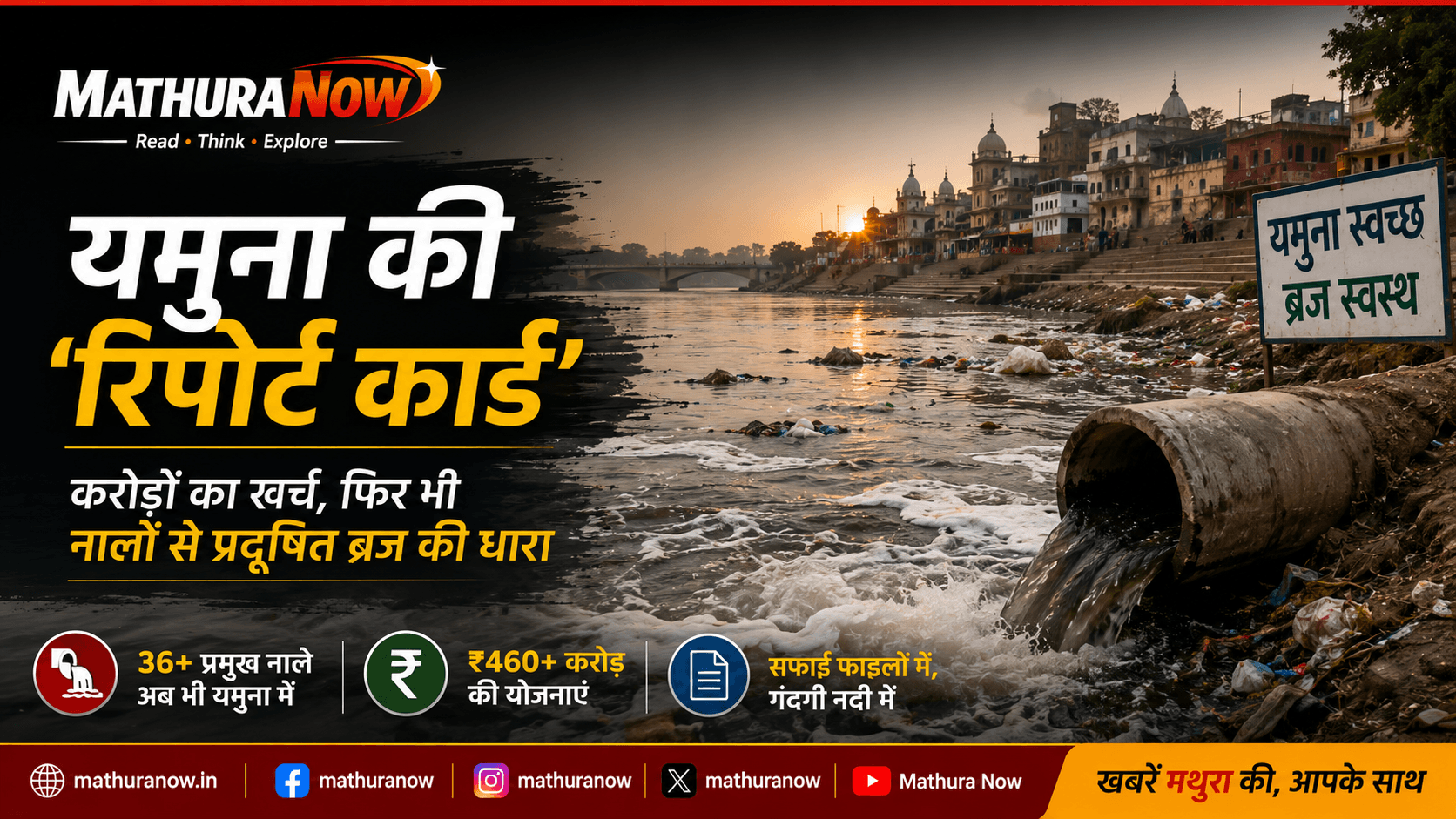
Yamuna Pollution: Key Facts
- Region: Mathura-Vrindavan
- Core Issue: Sewage and Drain Pollution
- Impact: Environment, Tourism and Public Health
- Key Infrastructure: STPs, Interceptor Drains and Treatment Projects
- Stakeholders: Government Agencies, Local Bodies and Citizens
Yamuna’s Report Card: Crores Spent, Yet Cleanliness Still Flows Mostly Through Files
Mathura (MathuraNow Editorial): Standing at Vishram Ghat in Mathura or Keshi Ghat in Vrindavan remains a deeply spiritual experience for millions of devotees. Yet beneath the devotional atmosphere lies a question that continues to surface every summer: if hundreds of crores have been invested in Yamuna rejuvenation, why does the river still struggle with visible pollution?
As water levels recede during the peak summer months, the condition of several stretches of the river becomes increasingly apparent. The contrast between ambitious project announcements and on-ground realities continues to fuel public debate across the Braj region.
For a city that draws pilgrims and visitors from across India and abroad, the condition of the Yamuna is more than an environmental concern—it is directly linked to the image, economy, and future growth of Mathura.
Major Investments, Persistent Challenges
Over the years, substantial investments have been directed toward improving sewage treatment and wastewater management in Mathura-Vrindavan. Infrastructure such as Sewage Treatment Plants (STPs), interceptor systems, and advanced treatment facilities have been introduced with the objective of reducing pollution entering the Yamuna.
These initiatives represent significant public expenditure and institutional effort. However, the broader challenge lies not merely in constructing infrastructure but ensuring its consistent operation, maintenance, monitoring, and integration with the entire drainage network.
Many residents continue to raise concerns regarding drains that ultimately find their way into the river, especially during periods when river flow is low and pollutants become more visible.
The Drainage Question
One of the recurring public concerns revolves around the numerous drains carrying untreated or partially treated wastewater into the Yamuna.
A common explanation often highlights upstream pollution originating from other states and urban centers. While interstate pollution is undeniably a major factor affecting the Yamuna basin, environmental experts frequently note that local pollution sources also require sustained attention.
In simpler terms, pollution arriving from elsewhere cannot become an excuse to overlook local responsibilities.
For river restoration to succeed, every contributing source—whether upstream or local—must be addressed simultaneously.
The discussion is no longer about identifying the problem; it is about accelerating measurable solutions and ensuring that investments translate into visible environmental improvements.
Beyond Faith: An Economic Opportunity
The Yamuna is not only a sacred river but also a critical economic asset for Mathura and Vrindavan.
- Enhanced religious tourism.
- Longer visitor stay durations.
- Improved attractiveness of heritage ghats.
- Growth in hospitality and local businesses.
- Better opportunities for handicrafts and cultural tourism.
- A stronger global image for Braj’s spiritual destinations.
Cities across India have demonstrated how riverfront improvement projects can transform tourism ecosystems and generate long-term economic benefits.
For Mathura, a healthy Yamuna should be viewed not merely as an environmental objective but as a strategic development priority.
A Constructive Suggestion
Public investment is already being made. The next stage may require stronger emphasis on transparency, performance monitoring, and measurable outcomes.
Citizens often wish to know:
- How many drains have been fully intercepted?
- How many treatment facilities are functioning at their designed capacity?
- What are the latest water quality indicators?
- What measurable improvements have been achieved compared to previous years?
Regular public disclosure of such metrics could help strengthen both public confidence and accountability.
When progress is measurable, trust grows stronger. When outcomes remain unclear, public skepticism naturally increases.
Public Responsibility Matters Too
Government agencies alone cannot restore the Yamuna.
Plastic waste, non-biodegradable offerings, and indiscriminate dumping continue to add pressure on the river ecosystem. Community participation remains essential for any long-term solution.
Environmental stewardship and spiritual devotion must go hand in hand.
Every citizen who avoids littering, supports cleanliness initiatives, and encourages responsible practices contributes to the long-term revival of the river.
The MathuraNow View
MathuraNow acknowledges the efforts made through infrastructure investments and ongoing river-cleaning initiatives. At the same time, meaningful progress must ultimately be measured by the condition of the river itself rather than the size of project budgets.
The Yamuna is central to Braj’s identity, economy, heritage, and faith. Its revival deserves sustained commitment from governments, institutions, communities, and citizens alike.
As Mathura continues to grow as a global spiritual destination, the future of the Yamuna may well determine the future image of Braj itself.
The goal is simple: a Yamuna that carries life, faith, and prosperity—not pollution.
Frequently Asked Questions (FAQ)
Why is the Yamuna River polluted in Mathura?
Environmental experts attribute Yamuna pollution in Mathura to multiple factors, including untreated or partially treated sewage, drain discharge, reduced river flow during summer months, solid waste disposal, and pollution entering from upstream regions.
How many drains are believed to impact the Yamuna in Mathura-Vrindavan?
Various government and environmental reports have identified multiple major and minor drains that ultimately contribute wastewater to the Yamuna basin in the Mathura-Vrindavan region. Their interception and treatment remain key components of river-cleaning efforts.
What is the role of STPs in Yamuna cleaning?
Sewage Treatment Plants (STPs) are designed to treat wastewater before it enters natural water bodies. Their effectiveness depends on proper capacity utilization, maintenance, power availability, and continuous monitoring.
Why is Yamuna cleaning important for Mathura’s economy?
A cleaner Yamuna can strengthen religious tourism, improve the visitor experience, boost local businesses, enhance heritage conservation, and support long-term economic development across the Braj region.
Can citizens contribute to Yamuna conservation?
Yes. Citizens can help by avoiding plastic disposal, using designated waste collection facilities, supporting cleanliness initiatives, and promoting environmentally responsible religious practices.
What challenges do authorities face in restoring the Yamuna?
River restoration requires coordination among multiple agencies, sustained funding, effective wastewater treatment, drain management, public participation, and cooperation between upstream and downstream regions.
How does low river flow affect Yamuna water quality?
During periods of low flow, pollutants become more concentrated, reducing the river’s natural ability to dilute contaminants. This often makes pollution more visible during the summer season.
What are the long-term benefits of a cleaner Yamuna?
A healthier Yamuna can improve environmental sustainability, strengthen public health outcomes, increase tourism potential, preserve Braj’s cultural heritage, and enhance the quality of life for local residents.
Further Reading
- National Mission for Clean Ganga (NMCG)
- Central Pollution Control Board (CPCB)
- National Green Tribunal (NGT)
- Ministry of Jal Shakti
Editorial Note: This article represents a public-interest analysis of environmental and civic issues affecting the Yamuna River in Mathura-Vrindavan. It focuses on policy, infrastructure, environmental challenges, and citizen participation rather than any individual official or institution.