

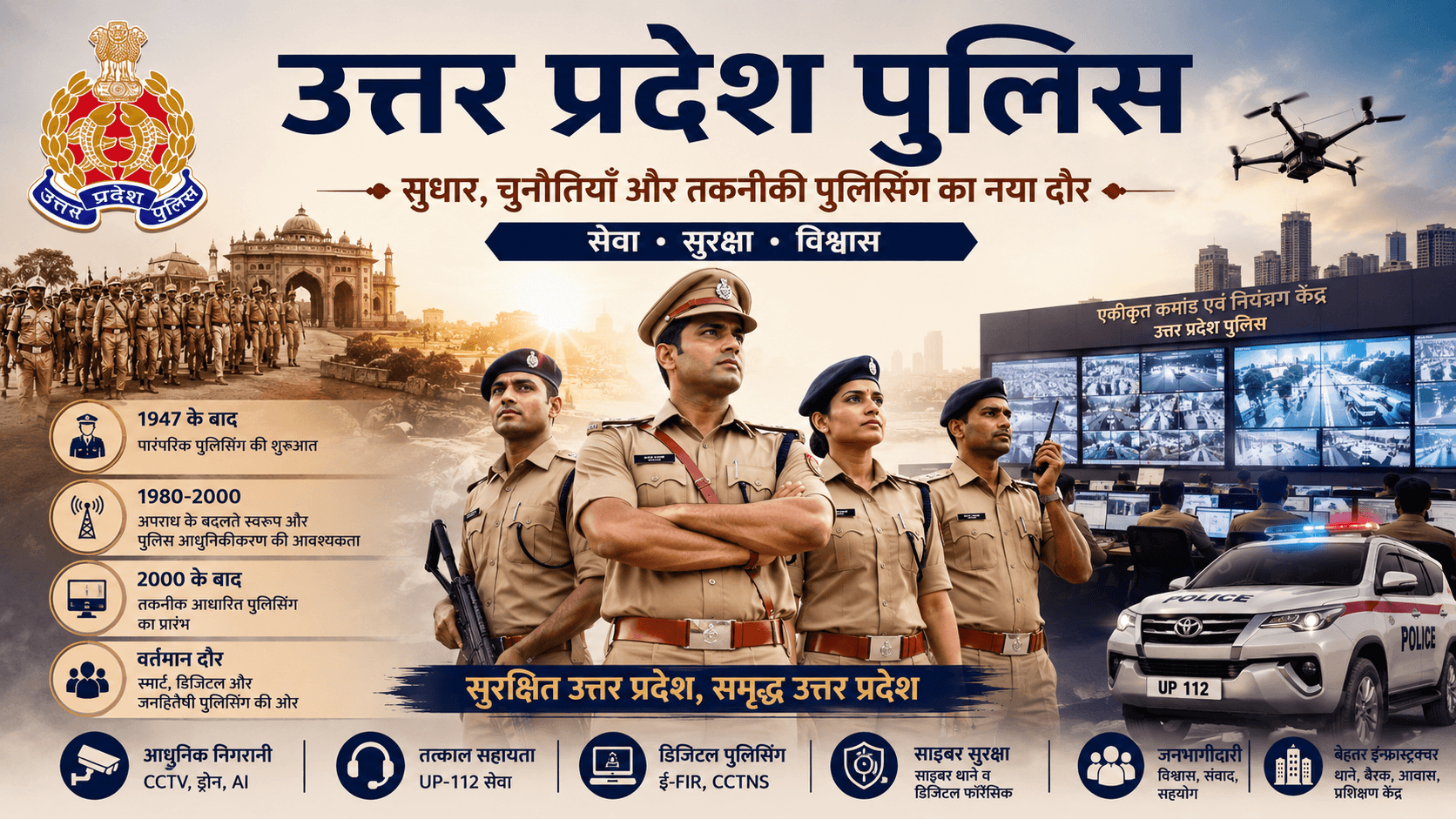
Mathura / Lucknow 29 May 2026: Since India’s Independence in 1947, the policing (UP Police) system of Uttar Pradesh has continuously evolved through reforms, modernization, administrative restructuring, and technological transformation. As India’s most populous state, Uttar Pradesh has always faced unique law-and-order challenges because of its massive population, social diversity, geographical complexity, and rapidly changing crime patterns.
Over the decades, the role of police in Uttar Pradesh has expanded far beyond traditional crime control. Today, the force operates through integrated emergency systems, cyber crime units, digital surveillance networks, AI-supported monitoring, forensic technologies, and data-driven policing models.
The recent review meeting of the Uttar Pradesh Police Housing Corporation chaired by Chief Minister Yogi Adityanath once again highlighted the government’s emphasis on police infrastructure modernization, better residential facilities for police personnel, modern barracks, and improved workplace environments. These developments indicate a broader administrative shift toward technologically capable and professionally efficient policing.
Policing Structure After Independence
After Independence, the policing structure of Uttar Pradesh largely continued under the framework inherited from British colonial administration. During that period, the primary objective of policing focused on maintaining public order and ensuring administrative control.
Rural policing faced serious challenges due to limited communication systems, shortage of trained personnel, weak transportation networks, and lack of modern equipment. Most police stations depended on handwritten registers, manual documentation, and delayed communication channels.
Between the 1950s and 1980s, police functioning remained heavily manpower-oriented. Investigations were comparatively slow, technological support was minimal, and increasing population pressure made policing increasingly difficult.
The Changing Nature of Crime
From the 1980s onward, Uttar Pradesh witnessed major changes in the nature of crime. Organized criminal gangs, dacoity, communal violence, political crime, and interstate criminal networks emerged as serious concerns for law enforcement agencies.
Several regions of the state struggled with dacoit activity and organized crime syndicates. During this period, policymakers and administrators began recognizing the urgent need for police modernization.
The expansion of wireless communication systems, strengthening of police training institutions, and formation of specialized units such as the Special Task Force (STF) marked the beginning of a new era in policing reforms.
Technology and the Rise of Smart Policing
The rise of the internet and mobile communication after the year 2000 fundamentally transformed criminal activity across India. Cyber fraud, online banking scams, digital blackmail, social media crimes, identity theft, and interstate cyber operations emerged as new security threats.
As a result, Uttar Pradesh Police gradually adopted technology-driven policing systems to improve operational efficiency and response mechanisms.
Modern policing is no longer limited to physical patrolling and traditional investigation methods. Artificial intelligence, CCTV surveillance networks, facial recognition systems, drone monitoring, digital tracking tools, and data analytics now play an increasingly important role in crime prevention and investigation.
The introduction of integrated emergency response services such as UP-112 significantly improved police response time and citizen accessibility. Digital record management systems and crime mapping technologies also strengthened operational transparency and crime analysis capabilities.
Major Challenges Before Uttar Pradesh Police
1. Population Pressure
With a population larger than many countries, maintaining law and order across Uttar Pradesh remains an enormous administrative challenge.
2. Heavy Workload on Police Personnel
Long working hours, limited leave, mental stress, and continuous field deployment often affect the efficiency and well-being of police personnel. Read our previous article “Vrindavan Police”
3. Increasing Complexity of Cyber Crime
As technology evolves rapidly, cyber criminals continue developing more sophisticated methods of digital fraud and online crime, creating continuous pressure on law enforcement agencies.
4. Urban-Rural Infrastructure Gap
While major cities are increasingly equipped with digital policing systems, many rural areas still face shortages of advanced technology, trained cyber personnel, and modern surveillance infrastructure.
5. Public Trust and Police Image
Experts believe that strengthening trust between citizens and police remains one of the most important aspects of police reform. Modern policing requires both administrative authority and public confidence.
Major Changes Under the Yogi Government
Since 2017, Uttar Pradesh has witnessed visible structural and technological changes in its policing system. The state government has consistently emphasized stronger law enforcement, organized crime control, infrastructure development, and digital modernization.
Crackdown on Organized Crime
Large-scale campaigns were launched against organized criminal networks and mafia operations. Action against illegal properties linked to criminals introduced a more aggressive crime-control strategy.
Expansion of Police Infrastructure
New police stations, police lines, training centers, barracks, and administrative buildings have been constructed across different regions of the state. Infrastructure modernization has become a major focus area.
Focus on Women’s Safety
Initiatives such as Anti-Romeo Squads, Mission Shakti, and women help desks were introduced to strengthen women’s safety and public security mechanisms.
Digital Transformation of Policing
E-FIR systems, CCTNS networks, command and control centers, digital databases, and surveillance integration have improved transparency, response speed, and operational coordination.
Police Welfare and Administrative Efficiency
The Yogi government has also emphasized improving the morale and working conditions of police personnel. In recent review meetings, Chief Minister Yogi Adityanath stressed the importance of quality residential facilities, modern barracks, training infrastructure, and better workplace environments for police employees.
Administrative experts believe that effective policing is not possible without mentally secure, professionally trained, and technologically equipped personnel. This reflects a broader shift toward human-resource-centered policing reforms.
The Future of Smart Policing in Uttar Pradesh
Uttar Pradesh Police is now gradually moving toward a technology-driven policing model where artificial intelligence, predictive analysis, integrated surveillance systems, and digital intelligence will play increasingly larger roles.
Experts suggest that future reforms should focus on cyber specialization, mental health support for police personnel, advanced technical training, and stronger citizen-police communication mechanisms.
If these reforms continue with consistency and institutional support, Uttar Pradesh Police could emerge as one of India’s most technologically advanced and operationally effective policing systems in the coming years.
Conclusion
The journey of Uttar Pradesh Police from post-Independence traditional policing to AI-assisted smart policing reflects not only technological transformation but also a major shift in administrative thinking.
Today’s policing demands more than force and enforcement. It requires technological capability, rapid response systems, cyber expertise, public trust, infrastructure modernization, and human-centered administration.
The current reforms related to police infrastructure, digital policing, and personnel welfare indicate that Uttar Pradesh is attempting to build a more modern, efficient, and responsive policing system for the future.