
UP Government’s Farmer Chaupal Model Aims to Transform Indian Agriculture
An in-depth analysis of the Uttar Pradesh government’s new Farmer Chaupal and Kisan Mela initiative, exploring how technology, research, transparency and rural connectivity could reshape Indian agriculture and strengthen farmers’ incomes.
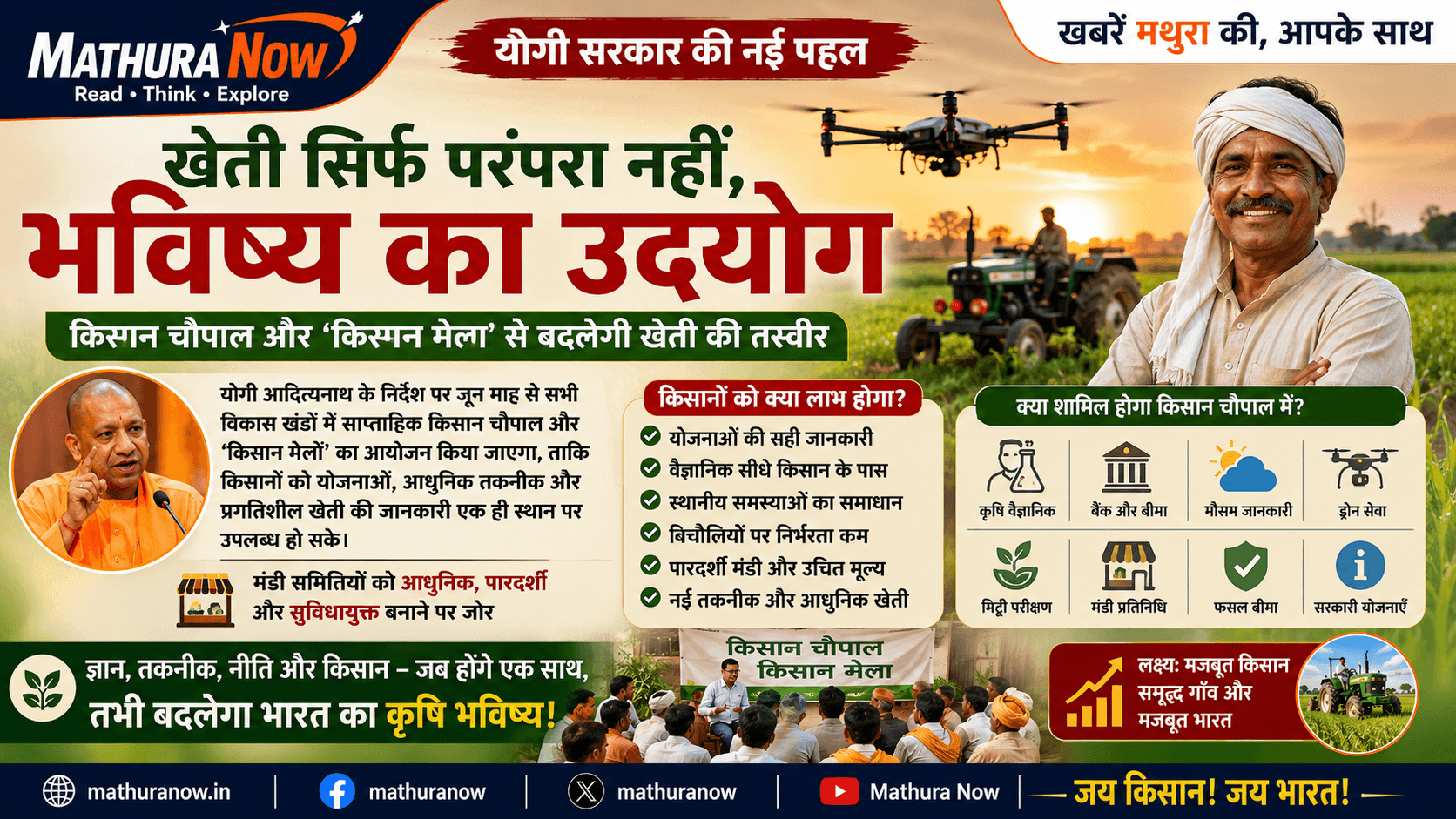
Recently, during a review meeting of the Agriculture Department, Uttar Pradesh Chief Minister Yogi Adityanath directed officials to organize weekly Farmer Chaupals and “Kisan Melas” in all development blocks starting from June. The objective is to provide farmers with information about government schemes, modern agricultural technologies and progressive farming practices at one centralized location.
The government also emphasized the modernization of mandi committees to make them more transparent, efficient and farmer-friendly.
Also Read: Braj Raj Utsav 2026: 11-Day Cultural Fair Set for Mathura and Vrindavan
At first glance, this may appear to be an ordinary administrative announcement. However, on deeper analysis, it reflects an attempt to address one of the oldest and most critical weaknesses of Indian agriculture:
“The gap between knowledge, technology, policy and the farmer.”
The Biggest Contradiction of Indian Agriculture
India is among the world’s largest agricultural nations.
The country has:
- Vast agricultural land,
- Agricultural universities,
- Research institutions like ICAR,
- Thousands of agricultural scientists,
- Numerous government schemes,
- And millions of hardworking farmers.
Yet, farmer incomes remain limited, agriculture continues to be risky, and rural migration is steadily increasing.
Why does this contradiction exist?
Because the four major pillars of India’s agricultural system:
- Government
- Bureaucracy
- Agricultural universities and research institutions
- Farmers
often appear disconnected from each other.
Knowledge remains trapped inside laboratories, policies stay confined to files, and farmers continue depending on unpredictable weather and unstable markets.
Farmer Chaupal and Kisan Mela: More Than Just Events
If implemented effectively, this initiative could become much more than an information-sharing exercise. It has the potential to create a complete rural agricultural ecosystem.
How Farmers May Benefit
1. Better Access to Government Information
Even today, a large number of farmers remain unaware about available subsidies, crop insurance benefits, drone technology, natural farming and precision agriculture methods.
Farmer Chaupals can significantly reduce this information gap.
2. Scientists Reaching Farmers Directly
India conducts extensive agricultural research, but much of it never reaches actual farms.
Examples include:
- New seed varieties,
- Water conservation techniques,
- Disease control systems,
- Low-cost farming models,
- AI-based agriculture,
- Soil testing technologies,
- Drone spraying,
- Sensor-based irrigation systems.
If scientists directly interact with farmers during Chaupals, the “Lab-to-Land” model could become significantly stronger.
3. Local Problems Need Local Solutions
Different regions of Uttar Pradesh face different agricultural challenges.
- Bundelkhand: Water scarcity
- Purvanchal: Flooding
- Western UP: Sugarcane payment delays
- Terai Region: Waterlogging
- Small Farmers: Market accessibility issues
Weekly Chaupals can help administrators and experts understand local realities through direct interaction.
4. Reduced Dependence on Middlemen
If mandis become transparent and digitally integrated, farmers may gain fair pricing, faster payments, online bidding systems and storage facilities.
This can strengthen the bargaining power of farmers.
Who is Responsible for Agricultural Challenges?
1. Previous Governments
Many governments focused mainly on short-term relief such as loan waivers, free electricity and MSP support, but long-term agricultural reforms progressed slowly.
2. Bureaucratic Structure
Policies are often created at the top while ground realities remain ignored. Field visits are limited and much data remains restricted to paperwork.
3. Agricultural Universities and Research Institutions
Much agricultural research remains disconnected from farmers’ real needs.
If farmers cannot understand how universities are improving their lives, then the knowledge system remains incomplete.
4. Structural Problems in Agriculture
- Small landholdings
- Water scarcity
- Market instability
- Lack of storage infrastructure
- Climate change
- Rising farming costs
The Possible Solution: “Farm-to-Future” Model
1. Block-Level Agricultural Knowledge Centers
Farmers should receive access to scientists, banks, insurance companies, mandi representatives, drone services, soil testing facilities and weather data at one place.
2. Universities Should Adopt Villages
Agricultural universities should create model villages, conduct field visits and work directly with farmers through participatory farming research.
3. Data-Driven Farming
The future of farming will increasingly depend on:
- Soil Health Cards
- Weather forecasting
- AI-based disease detection
- Drone mapping
- Water usage analytics
4. Farmer Producer Organizations (FPOs)
FPO models can help small farmers through collective purchasing, selling, processing and branding.
Successful Global Models
Israel Model
Israel achieved agricultural success through drip irrigation, scientific farming and farmer-scientist collaboration.
Netherlands Model
The Netherlands became a major agricultural exporter through research-based high-tech farming.
Japan’s Cooperative Model
Japan strengthened small farmers through cooperative processing, marketing and machine-sharing systems.
India’s Amul Model
Amul demonstrated how farmers can become economically self-reliant through organization, technology and market connectivity.
Can This Reduce Rural Migration?
If agriculture becomes connected with technology, processing industries, agri-startups and digital markets, villages can gradually transform into employment hubs.
Can Farmers’ Income Truly Double?
Yes — but not merely through higher production.
Also Read: Shiv-Parvati Vivah Enacted at Shri Krishna Janmabhoomi – Mathura Ram Leela Mahotsav 2026
Farmer income can improve through:
- Lower farming costs,
- Value addition,
- Direct market access,
- Processing infrastructure,
- Crop diversification,
- Affordable technology adoption.
Conclusion
The Uttar Pradesh government’s initiative should not remain limited to Farmer Chaupals alone.
If connected with scientific research, administrative accountability, digital technology, transparent mandis and local participation, it could become the foundation for rebuilding India’s rural economy.
India’s agricultural challenge is not merely about production—it is fundamentally a challenge of management, coordination and connectivity.
The day farmers, scientists, universities, governments and markets stand together on one shared platform, agriculture may transform from a survival activity into a respected and profitable enterprise.
And perhaps then, the forced migration from villages to cities may gradually begin to slow down.

Pradeep Delpuriya "Manu"
Bureau Chief
Pradeep Delpuriya "Manu" is a distinguished educator and media professional based in Kanpur Nagar, Uttar Pradesh. Alongside his active role in journalism as a field reporter and…
Get Mathura's latest news on WhatsApp
Breaking news and important local updates, straight to your phone
Join channel