Smart Phones: A Modern Convenience or a Growing Social and Mental Concern?
An analytical article discussing how smart phones have transformed modern life while also creating concerns related to addiction, mental health, family communication and digital imbalance in society.
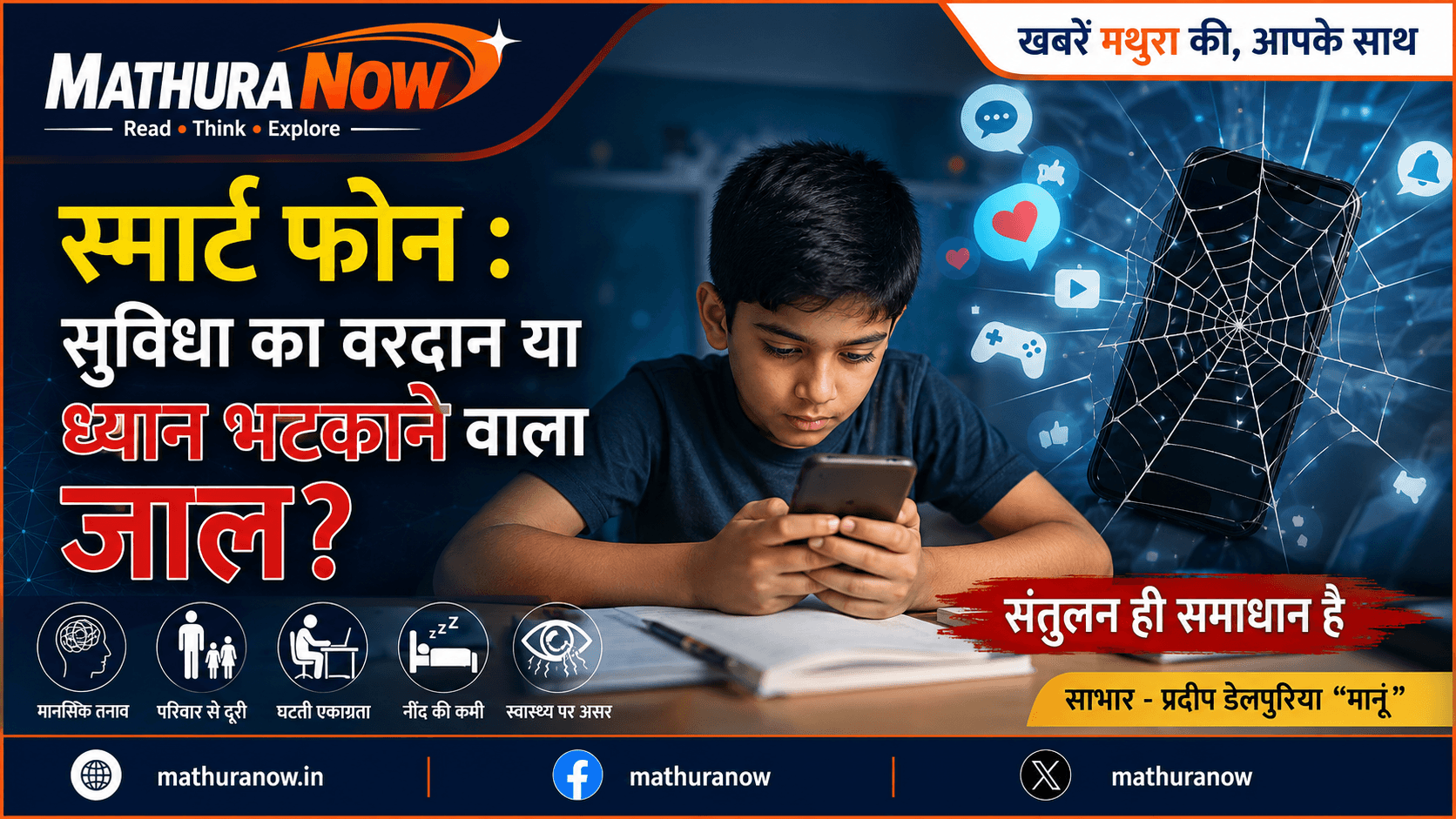
Smart Phone: A Boon of Convenience or a Trap of Distraction?
There was a time when mobile phones were merely a medium of communication. Their use was limited and they were utilized only when necessary. However, technological advancement transformed the ordinary mobile phone into a “smart phone,” and gradually it became one of the most influential tools in our lives.
Today, banking, online payments, electricity bill deposits, gas cylinder bookings, education, job applications, business, entertainment, news and social media—almost every activity has become dependent on smart phones.
Also Read: Braj Raj Utsav 2026: 11-Day Cultural Fair Set for Mathura and Vrindavan
If observed carefully, smart phones have undoubtedly made life extremely convenient. The world has come into our palms. However, every convenience also brings certain challenges. The same smart phone that was once merely a “necessity” is now becoming a “habit” and slowly turning into an “addiction” for many people. This situation has emerged as a serious concern for society.
Where Did the Problem Begin?
The real negative impact of smart phones began increasing rapidly when social media, short videos, reels, online games and continuous notifications became an inseparable part of them.
Today, the situation is such that:
- Children repeatedly check mobile phones during studies.
- Youths spend hours watching reels and videos.
- Families living under the same roof communicate less with each other.
People have started living more in the “virtual world” than in real life.
Several studies are indicating that excessive screen time may increase mental and social problems in the future.
Major Negative Effects of Smart Phones
1. Lack of Focus and Concentration in Children
Constantly changing videos and fast-paced entertainment are making children’s brains habitual to instant gratification.
As a result:
- Reduced concentration in studies,
- Lack of patience,
- Getting bored quickly,
- Weakening memory power
are becoming increasingly common problems. Children are becoming more accustomed to short and rapid content rather than lengthy reading or deep thinking.
2. Waste of Time and Energy Among Youth
Youth is the time to learn, build careers and develop skills. However, many young people today spend several hours daily scrolling social media.
Gradually, this habit leads to:
- Distraction from goals,
- Laziness,
- A mindset of comparison,
- Lack of self-confidence,
- Depression-like problems.
By constantly watching the “edited and glamorous lives” of others, people begin feeling dissatisfied with their own real lives.
3. Decline in Family Communication
Earlier, families used to sit together and talk. Now, scenes like these are common:
- Children busy on mobile phones,
- Parents occupied on social media,
- Elderly people sitting alone.
Physical presence remains in the house, but emotional connection is gradually weakening.
4. Loneliness and Depression Among Elderly People
The elderly are becoming one of the most affected sections of society.
Many elderly individuals either cannot use smart phones efficiently or prefer staying away from them. When family members remain constantly engaged with mobile phones, elderly people begin feeling neglected.
This situation may increase:
- Loneliness,
- Mental stress,
- Depression.
5. Impact on Physical Health
Excessive mobile phone usage is causing:
- Eye-related problems,
- Neck and spinal pain,
- Lack of sleep,
- Obesity,
- Physical inactivity.
Watching screens late at night does not allow the brain to receive adequate rest.
Is Technology Wrong?
No.
Technology itself is not the problem. The issue lies in its unbalanced and uncontrolled usage.
The same smart phone through which:
- Education can be obtained,
- Online business can be conducted,
- New skills can be learned,
- The world can be connected,
can also destroy both time and mental peace if used improperly.
Technology is a powerful tool. It depends upon us whether we become its master or its slave.
What Can Be the Solutions?
1. Set Time Limits for Mobile Usage
Limit daily screen time.
Also Read: Shiv-Parvati Vivah Enacted at Shri Krishna Janmabhoomi – Mathura Ram Leela Mahotsav 2026
Define “No Mobile Time,” such as:
- During meals,
- While sitting with family,
- One hour before sleeping.
2. Digital Discipline for Children is Essential
Parents should:
- Avoid giving personal mobile phones to children at an early age,
- Maintain balance between studies and entertainment,
- Encourage outdoor games, books and creative activities.
Children learn what they observe at home. Therefore, parents themselves must also practice balanced usage.
3. Purposeful Use of Social Media
Before opening a mobile application, ask yourself: “Why am I opening this?”
If there is no clear purpose, then it may merely be a habit or waste of time.
4. Spend Real Time with Family
Sit together daily without mobile phones.
- Talk to elderly family members,
- Play with children,
- Make family meals “mobile-free.”
Emotional connection is more important than any digital connection.
5. Adopt Digital Detox
Spending a day or a few hours every week away from:
- Social media,
- Excessive screen exposure,
- Digital distractions
and instead engaging in:
- Nature,
- Reading books,
- Meditation and yoga,
- Meeting real friends
can increase mental peace.
6. Make Mobile Phones a Tool, Not Life Itself
Smart phones are meant to make life easier, not to become the center of life itself.
If balance is not maintained in time, future generations may become technologically over-connected but emotionally extremely isolated.
Conclusion
Smart phones are one of the greatest inventions of the modern age. They have played a significant role in connecting the world and simplifying life. However, when any convenience starts controlling our independent thinking, time, relationships and mental peace, it becomes necessary to remain cautious.
Today, the need is not to abandon technology, but to learn living a balanced life alongside it.
If society, families, schools and individuals collectively adopt digital discipline, smart phones will continue to remain a blessing; otherwise, the same convenience may become a cause of social and mental crisis in the future.
Courtesy:
Pradeep Delpuriya “Manu”

Pradeep Delpuriya "Manu"
Bureau Chief
Pradeep Delpuriya "Manu" is a distinguished educator and media professional based in Kanpur Nagar, Uttar Pradesh. Alongside his active role in journalism as a field reporter and…
Get Mathura's latest news on WhatsApp
Breaking news and important local updates, straight to your phone
Join channel