84 Lakh Yonis: Why Human Birth Is Considered Rare in Hindu Philosophy
Hindu philosophy describes life as a cycle of birth, death and rebirth. The traditional idea of 84 lakh yonis explains the diversity of life while placing special spiritual importance on human birth, karma and the possibility of moksha.
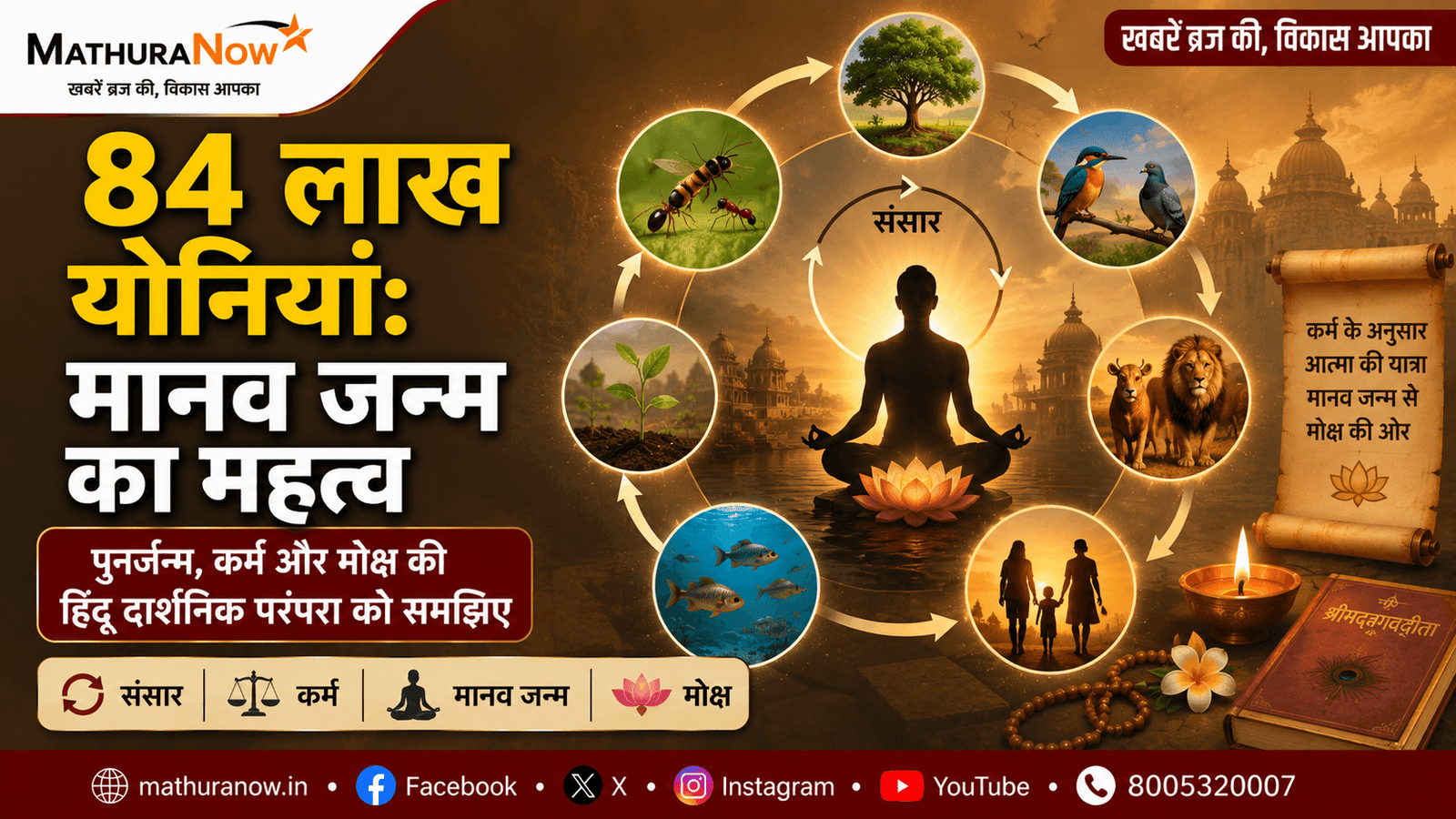
However, the concept should be understood as a religious and philosophical framework, not as a modern biological classification. Ancient Hindu texts use categories such as aquatic life, immobile life, insects, birds, animals and human beings in a very different conceptual framework from modern taxonomy.
What Does the Word ‘Yoni’ Mean?
The Sanskrit word yoni has several meanings, including womb, source, origin and form of birth. In discussions of rebirth, it can refer to a particular form or condition of embodied existence.
Therefore, the expression 84 lakh yonis should not automatically be interpreted as a modern scientific list of 8.4 million biological species.
Within Hindu philosophical thought, different forms of life represent different conditions of embodied existence. The larger idea is connected with karma, rebirth and the continuing journey of the individual soul through samsara.
How Are the 84 Lakh Yonis Traditionally Classified?
A traditional Sanskrit verse commonly associated with the Padma Purana gives a total of 8.4 million life forms through six broad categories. The verse is widely cited in Hindu literature and commentarial traditions.
The traditional classification is generally presented as follows:
- Jalaja — 9 lakh: Life forms associated with water.
- Sthavara — 20 lakh: Immobile forms of life, traditionally associated with trees and plants.
- Krimayo — 11 lakh: Insects and other small or creeping forms of life in traditional classification.
- Pakshinam — 10 lakh: Birds and flying forms of life.
- Pashavah — 30 lakh: Animals and other terrestrial forms.
- Manavah — 4 lakh: Human and human-associated forms in the traditional count.
Together, these numbers total 84 lakh. The categories should not be equated directly with modern biological species, families or taxonomic groups.
Does Hindu Philosophy Say That Every Soul Must Pass Through All 84 Lakh Forms?
This is one of the most important points to understand.
The popular expression that a soul must literally take birth in each of the 84 lakh forms before receiving a human birth is widespread in religious discourse. However, Hindu traditions contain different explanations of karma, rebirth and the movement of the soul. It is therefore more accurate to describe the 84 lakh concept as a traditional framework for understanding the vast range of embodied existence rather than presenting one literal sequence as universally accepted Hindu doctrine.
The central philosophical idea is that karma influences future existence and that the cycle of samsara continues until liberation is attained.
Why Is Human Birth Considered So Important?
Human birth occupies a special position in many Hindu philosophical traditions because human beings are considered capable of self-reflection, ethical choice and spiritual practice.
A human being can ask questions such as: Who am I? What is the purpose of life? What is right action? What is the nature of the self?
This capacity for discrimination, known in Sanskrit as viveka, is central to several Indian philosophical traditions.
Human Birth and Karma
Hindu thought does not generally describe karma simply as a system of reward and punishment. Karma is connected with action, intention and the consequences of action.
The Bhagavad Gita places great emphasis on action and responsibility. Human life therefore becomes important because a person can make conscious choices, cultivate knowledge, practise discipline and pursue a spiritual path.
This is also why the idea of a rare human birth is often used as a reminder: human life should not be treated merely as an opportunity for material enjoyment, but also as an opportunity for dharma, self-knowledge and spiritual growth.
Is Moksha Possible Only Through Human Life?
In many Hindu traditions, human existence is regarded as especially suitable for spiritual practice and the pursuit of moksha, or liberation from samsara.
Different schools explain the path to liberation in different ways. These may include jnana or knowledge, bhakti or devotion, karma yoga or disciplined action, and dhyana or meditation.
The broader message is that human life provides an unusual opportunity for conscious spiritual effort.
What Does the 84 Lakh Idea Mean in the Modern World?
The traditional number of 84 lakh should not be presented as a scientific estimate of Earth’s biodiversity.
Modern biology uses a completely different system for defining and counting species. A widely cited 2011 study published in PLOS Biology estimated approximately 8.7 million eukaryotic species on Earth, with an uncertainty of about 1.3 million. The researchers also noted that a large proportion of Earth’s species had yet to be formally described.
The numerical similarity between 8.4 million in the traditional Hindu classification and the scientific estimate of about 8.7 million eukaryotic species is interesting, but it does not establish that the two figures were derived using the same method or that the ancient classification anticipated modern biological taxonomy.
For this reason, the comparison should be treated as an interesting cultural observation rather than scientific proof.
84 Lakh Yonis and the Idea of Interconnected Life
The philosophical value of the concept becomes particularly relevant when viewed through the relationship between humans and other forms of life.
If existence is understood as a vast network of living forms, then human beings are not completely separate from the natural world. Hindu traditions have developed several ideas around ahimsa, compassion and respect for living beings.
This perspective can also encourage a modern conversation about biodiversity, animal welfare and environmental responsibility. However, these contemporary interpretations should be clearly distinguished from what a particular ancient text explicitly states.
Why Human Birth Is Called ‘Durlabha’
The expression durlabha manushya janma — the rarity or preciousness of human birth — appears frequently in Indian spiritual literature and teaching traditions.
The underlying message is not simply that humans are biologically superior. Rather, human life is considered valuable because it provides the ability to reflect on existence, distinguish between right and wrong, pursue knowledge and consciously work towards liberation.
In this view, the value of human birth lies not only in living longer or achieving material success, but in understanding the purpose of life.
What Is the Spiritual Message of 84 Lakh Yonis?
The deeper message of the 84 lakh yonis tradition is about responsibility and opportunity.
Human life is temporary. Wealth, status, physical strength and social position change over time. Hindu spiritual traditions therefore encourage a person to use human life for meaningful action, knowledge, compassion, devotion and self-realisation.
The concept also places karma at the centre of personal responsibility. A person’s actions matter because they shape the continuing journey through samsara.
84 Lakh Yonis: Five Things to Understand
- It is a traditional Hindu concept: The 84 lakh figure belongs to religious and philosophical traditions surrounding life, rebirth and karma.
- It is not modern biological taxonomy: Ancient categories such as jalaja, sthavara and pashavah cannot be directly mapped onto today’s scientific classification of species.
- Human birth is given special spiritual importance: Human beings are considered capable of conscious ethical and spiritual choices.
- Karma is central to the philosophy of rebirth: Actions and their consequences are linked to the continuing cycle of samsara.
- The 8.4 million figure should not be presented as scientific proof: Its similarity to some modern estimates of global biodiversity is numerically interesting, but the two systems are fundamentally different.
Frequently Asked Questions
What are the 84 lakh yonis?
In Hindu religious tradition, 84 lakh yonis refer to a traditional count of different forms or categories of embodied life. A commonly cited classification includes aquatic life, immobile life, insects, birds, animals and human-associated forms.
Does Hinduism say that every soul must take birth in all 84 lakh yonis?
The idea is widely expressed in popular religious teaching, but Hindu traditions contain different explanations of rebirth and karma. It is more accurate to describe 84 lakh yonis as a traditional framework for understanding the diversity of embodied existence rather than claim that every Hindu school teaches one identical literal sequence.
Why is human birth considered important?
Human life is considered especially valuable because human beings are capable of self-reflection, ethical choice, spiritual practice and the pursuit of moksha.
Is 84 lakh the same as the number of species on Earth?
No. The traditional 84 lakh figure and modern scientific estimates of biodiversity come from different systems of classification. A 2011 scientific study estimated about 8.7 million eukaryotic species, but that estimate cannot be used to prove the religious classification.
Does the 84 lakh concept have a scientific basis?
It should primarily be understood as a religious and philosophical concept. The traditional categories do not correspond directly to modern biological taxonomy, so the concept should not be presented as a scientifically established count of species.
Conclusion: Human Life as an Opportunity
The traditional idea of 84 lakh yonis is ultimately less about counting life forms and more about understanding the value of human existence within the Hindu philosophy of samsara.
It reminds the individual that life is temporary, actions have consequences and human existence provides an opportunity for conscious spiritual effort.
The number 84 lakh may be read within its traditional religious context, while modern biodiversity estimates should be understood through the methods of contemporary science. Keeping these two frameworks distinct allows the subject to be explored without either dismissing the religious tradition or presenting it as scientific fact.
The central spiritual message remains simple: human birth is considered precious, and the opportunity it provides should be used with awareness, compassion, knowledge and purposeful action.

Shri Shri Amit Agarwal
Astrologer
Shri Shri Amit Agarwal - Astrologer is associated with MathuraNow and contributes coverage related to spirituality, Braj culture, temple affairs, religious events, public-interest…
Get Mathura's latest news on WhatsApp
Breaking news and important local updates, straight to your phone
Join channel