Meta AI Console: Could Website Owners Get a New Gateway?
Meta has not officially announced a product called “Meta AI Console” as of August 20, 2026. But its expansion of Meta AI, real-time news partnerships, business-data personalization and new AI models raises an important question: could publishers eventually get a dedicated way to make their content more discoverable inside Meta’s AI ecosystem?
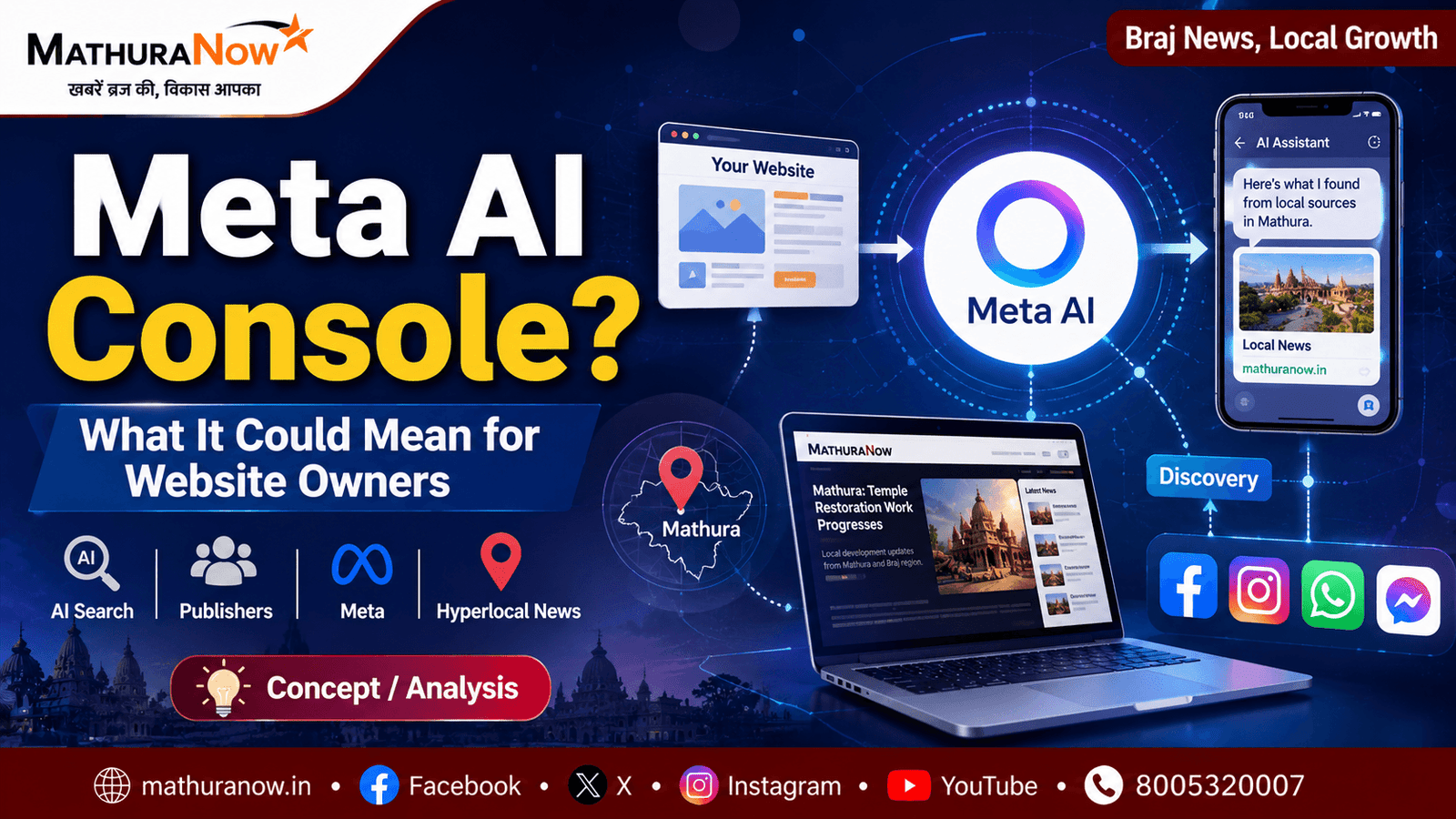
There is already a name circulating for that possibility: “Meta AI Console.”
But there is an important fact-check before anyone treats that name as a product announcement.
Fact Check: As of August 20, 2026, Meta has not publicly announced an official product called “Meta AI Console.” The name should therefore be treated as an industry hypothesis or possible future concept, not as an existing Meta product.
This article is an analysis of Meta’s publicly announced AI direction and what that direction could mean for website owners, publishers and hyperlocal news platforms such as MathuraNow.
Why the Meta AI Console Question Matters
The web is moving from a search-first environment towards an answer-first environment.
For years, a website owner primarily wanted to be discovered through search engines. The basic equation was simple: publish a page, get it indexed, rank for relevant queries and receive traffic.
AI assistants are changing that behaviour.
Users can increasingly ask an AI system a question and receive a direct answer, a recommendation, a summary or a selection of links without starting with a traditional search page.
That makes one question increasingly important for publishers:
How does an AI system discover and trust the information published by a website?
Meta is particularly interesting because its AI is being integrated into an ecosystem that includes WhatsApp, Instagram, Facebook, Messenger, Threads and AI-powered devices.
Meta Has Already Taken Several Steps in This Direction
Meta’s April 2026 announcement of Muse Spark was an important development. Meta said the model powers Meta AI and was being expanded across its major consumer platforms. The company also described plans for richer answers that could incorporate recommendations and content from its ecosystem.
In July, Meta introduced Muse Image, expanding the company’s AI capabilities further into image creation and creative tools. Together, these developments show that Meta is not treating AI as a single chatbot product. It is building AI into a wider network of services.
For publishers, that distinction matters.
If AI becomes part of the places where people already spend time, content discovery could increasingly happen inside those platforms rather than through a traditional browser search.
Meta AI Is Already Moving Towards Real-Time Content
One of the strongest signals comes from Meta’s March 2026 announcement about bringing more international news and content to Meta AI.
Meta said its AI would provide broader access to real-time content across areas including news, entertainment and lifestyle. The company also announced partnerships with publications including News Corp, Le Figaro, Prisa and Süddeutsche Zeitung.
Importantly for publishers, Meta said these integrations could provide links back to partner websites, creating a path from an AI answer to the original publisher.
This is not a “Meta AI Console.” But it demonstrates that publisher content is already becoming part of Meta’s AI strategy.
Could Meta Eventually Build a Publisher Dashboard?
This is where analysis begins rather than confirmed news.
If Meta continues expanding AI-powered discovery, a publisher-facing dashboard would be a logical possibility. Such a system could potentially allow websites to identify themselves, provide technical information, submit feeds, manage content preferences or understand how their material is being surfaced.
However, there is currently no public evidence that Meta has announced such a system or confirmed a product named Meta AI Console.
Possible future names could be completely different. Meta AI for Publishers, Meta AI Publisher Tools, AI Content Hub or another name could theoretically serve a similar purpose.
For now, these are scenarios, not announcements.
What About Meta Pixel and Website Data?
Another part of the discussion concerns the enormous amount of activity that businesses already share with Meta.
In June 2026, Meta announced changes to how it uses information that businesses already share with the company. Meta said this information could be used to personalize content in users’ feeds and, going forward, AI responses, in addition to advertising.
Meta also said it was not collecting new data as part of that particular update. :contentReference[oaicite:6]{index=6}
This is significant, but it should not be overstated.
It does not prove that Meta Pixel is being turned into an AI indexing system for websites. It does show, however, that Meta is connecting information from businesses with increasingly personalized AI experiences.
The Walled-Garden Question
There is another strategic possibility that publishers cannot ignore.
Meta controls several of the world’s largest consumer platforms. If users can ask questions, discover products, find news and receive recommendations without leaving WhatsApp, Instagram or Facebook, the importance of external websites could change.
At the same time, Meta has an obvious reason to keep sending users to useful external sources: high-quality information can make an AI answer more useful, while links can give publishers additional audiences.
That is already visible in Meta’s approach to news partnerships, where the company says users can receive information and links that lead them to publisher websites.
The future therefore may not be about websites disappearing. It may be about how AI systems decide which websites deserve to be recommended.
What Could This Mean for Hyperlocal News?
This is where the opportunity becomes particularly interesting for MathuraNow and other hyperlocal publishers.
A national publisher can cover Parliament, national politics, major technology launches and international events. But a hyperlocal newsroom can publish information that is much harder to obtain at scale.
Examples include local civic developments, Mathura and Vrindavan temple updates, Braj festivals, neighbourhood issues, administrative decisions, local events and other information that matters to people in a specific geographic area.
If AI platforms increasingly try to answer questions based on location and context, this type of original local reporting could become valuable.
But there is an important distinction:
Being hyperlocal does not guarantee priority in any future Meta system.
The advantage comes from producing information that is original, timely, clearly attributed and genuinely useful to people in the area being covered.
What Should Website Owners Do Before Any Meta Console Appears?
Waiting for a future dashboard would be the wrong strategy.
Website owners should prepare for AI discovery now.
- Publish original reporting: Do not simply rewrite another publisher’s article.
- Strengthen entity signals: Clearly identify people, places, organisations, events and businesses mentioned in stories.
- Use clean article structure: Strong headlines, short paragraphs, descriptive subheadings and clear factual statements make content easier to understand.
- Maintain accurate publication dates: Google recommends clear article dates and appropriate structured data for news content.
- Use NewsArticle structured data where appropriate: Google says Article structured data can help it understand titles, images, dates and authors.
- Keep important pages crawlable: AI search features still depend heavily on normal search crawling and indexing.
- Build topical authority: A publisher consistently covering one geographic or subject area can develop a stronger information footprint than a site publishing unrelated content.
Google AI Search Gives Website Owners an Important Clue
There is a useful lesson from Google’s current AI Search guidance.
Google says there are no additional technical requirements specifically for appearing in AI Overviews or AI Mode. A page must be indexed and eligible to appear in normal Google Search, while publishers should continue following fundamental SEO and quality practices.
Google’s newer guidance also stresses unique, valuable and people-first content rather than content created primarily to manipulate rankings.
That principle is likely to remain important even if other AI platforms develop their own publisher tools.
Could Meta AI Console Arrive in 2026 or 2027?
There is currently no reliable public basis for assigning a launch date to a product called Meta AI Console.
A more responsible way to look at the future is through scenarios.
Scenario one: Meta expands its existing publisher partnerships and builds more direct content integrations without creating a public console.
Scenario two: Meta eventually introduces tools that allow a wider group of publishers, businesses and creators to manage how their public information interacts with Meta AI.
Scenario three: Meta develops separate systems for news, commerce, creators and business information rather than one universal dashboard.
All three are plausible. None should currently be described as an announced Meta roadmap.
Why MathuraNow Should Pay Attention
For a hyperlocal publication, the biggest opportunity is not simply being first to register with a hypothetical future platform.
The real opportunity is becoming a reliable source of information about a place.
If someone asks an AI system about a Mathura civic issue, a Vrindavan development, a Braj festival, a local temple event or a district-level announcement, the value of a publisher depends on whether its reporting is original, current, geographically relevant and trustworthy.
That is a much stronger long-term strategy than chasing an unconfirmed product name.
The Bottom Line
“Meta AI Console” does not currently exist as an officially announced Meta product.
But the idea behind the discussion is worth watching.
Meta is expanding AI across its major platforms. Muse Spark is powering a broader Meta AI experience, Meta has begun bringing more real-time news and content into Meta AI, and the company has said information already shared by businesses can contribute to personalization of AI responses.
These developments do not prove that a publisher console is coming. They do suggest that AI-driven content discovery is becoming an important part of the digital publishing ecosystem.
For website owners, the safest strategy is therefore simple: do not wait for a hypothetical dashboard. Build the kind of website an AI system would have a reason to trust.
For hyperlocal publishers, that means original reporting, strong local expertise, accurate facts, identifiable sources, clear entities and consistent coverage of the communities they serve.
The next generation of traffic may not begin with “Where do I rank?” It may begin with “Which source does the AI trust enough to recommend?”
Editorial Note: This article is an analysis based on publicly available information and Meta’s announced product direction as of August 20, 2026. “Meta AI Console” is used as a hypothetical term for a possible future publisher-facing system. It is not being presented as an existing Meta product or an official Meta announcement.

News Desk
Editor
MathuraNow News Desk is the official editorial team of MathuraNow, covering hyperlocal news, Braj culture, temple affairs, civic developments, spirituality, festivals, public…
Get Mathura's latest news on WhatsApp
Breaking news and important local updates, straight to your phone
Join channel