


India Expands Nuclear Energy Capacity and Applications Under New Strategic Framework
India aims to reach 100 gigawatts of nuclear capacity by 2047 through the SHANTI Act, 2025, prioritizing sustainability, safety, and innovation.
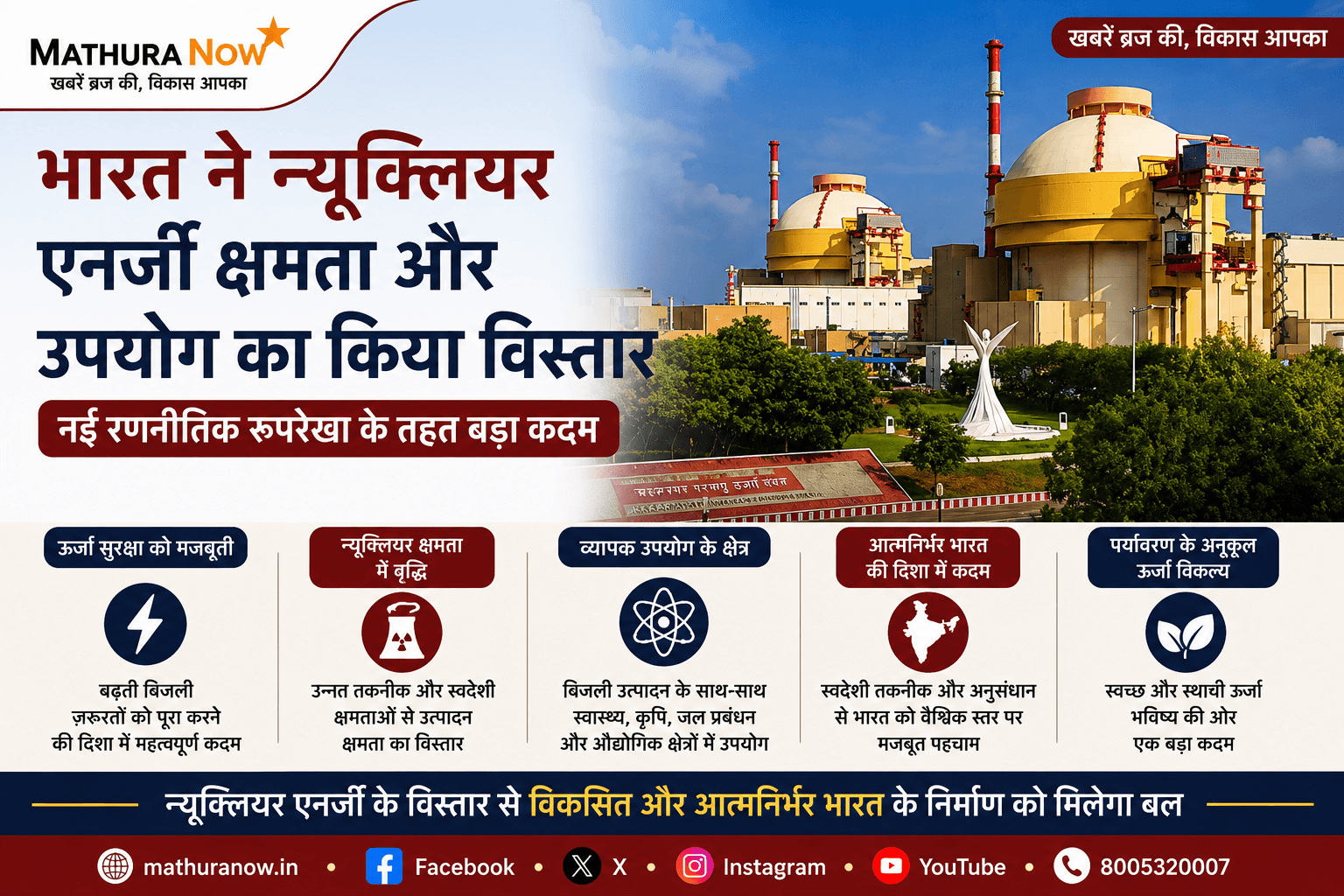
Mathura, August 28, 2026: India is scaling up its nuclear energy sector as a core component of its national development, focusing on long-term sustainability, safety, and technological innovation. Since the launch of the Tarapur Atomic Power Station in 1969, the nation has utilized atomic power to supply low-carbon electricity to homes and industries. Current efforts are guided by the Nuclear Energy Mission for Viksit Bharat, which sets a goal of reaching 100 gigawatts of nuclear capacity by 2047.
To facilitate this growth, the SHANTI Act, 2025, has been introduced to establish a modernized framework for the sector. Financial support for this expansion is also being prioritized, with the Union Budget 2025–26 earmarking ₹20,000 crore for the development of indigenous Small Modular Reactors.
Also Read: DELHI INFERNO: Digital Condolences vs. Ground Reality
At present, India operates 24 nuclear power reactors across seven sites, maintaining a total installed capacity of 8.78 GW. Future expansion is already underway, with nine reactors currently under construction and preparations finalized for 10 additional units.
Safety remains a fundamental priority for the country’s nuclear programme. Facilities are managed through a robust regulatory framework that employs multiple safety barriers, constant monitoring, and strict security protocols. India maintains coordination with the International Atomic Energy Agency to ensure adherence to safety, security, and safeguard standards.
Beyond its role in power generation, nuclear energy is recognized as a highly efficient, low-carbon source of energy. Data for the 2025–26 fiscal year indicates that one gigawatt of nuclear capacity prevented approximately 5.4 million tonnes of CO₂ equivalent emissions. In comparison, hydropower, wind, and solar energy avoided 2.7 million tonnes, 1.6 million tonnes, and 0.9 million tonnes of CO₂ respectively. Over its history, the national programme has cumulatively avoided 851 million tonnes of CO₂ equivalent emissions, a total impact described as equivalent to the sequestration provided by more than 38 billion mature trees.
Also Read: Unity, Not Disputes, Is the Need of the Hour: Satish Agrawal
The utility of nuclear technology in India extends into diverse sectors, including healthcare, scientific research, industry, water desalination, and food preservation. In the medical field, institutions such as the Bhabha Atomic Research Centre, the Tata Memorial Centre, and others are conducting research into radiopharmaceuticals, advanced imaging, and cancer therapy. Efforts to improve public healthcare access include the 2025 inauguration of the 150-bed Homi Bhabha Cancer Hospital and Research Centre in Muzaffarpur. During the 2024–25 fiscal year, the Tata Memorial Centre provided services to 1.3 lakh patients and conducted screenings for approximately five lakh women for breast, oral, and cervical cancers. Furthermore, radiation technologies have been employed to sterilize 1.53 crore medical devices to assist in the reduction of healthcare-associated infections.
In the agricultural sector, nuclear research supports the development of new crop varieties using cross-breeding and radiation-induced mutagenesis. These indigenous technological advancements, coupled with the new legislative and budgetary measures, form the basis of India’s strategy to utilize nuclear energy as a pillar for future-ready national progress.
Source: PIB — Press Releases RSS





Your first comment on any article never needs an account. If an author replies and you want to keep the conversation going, a free account keeps things trustworthy. Log in or sign up.