UPI Transaction Fee 0.4% MDR on Merchant Payments Over ₹2,000 Started from Oct 15
From October 15, 2026, the NPCI has implemented a Merchant Discount Rate (MDR) of 0.4% on UPI transactions exceeding ₹2,000. Find out how this will impact merchants and customers.
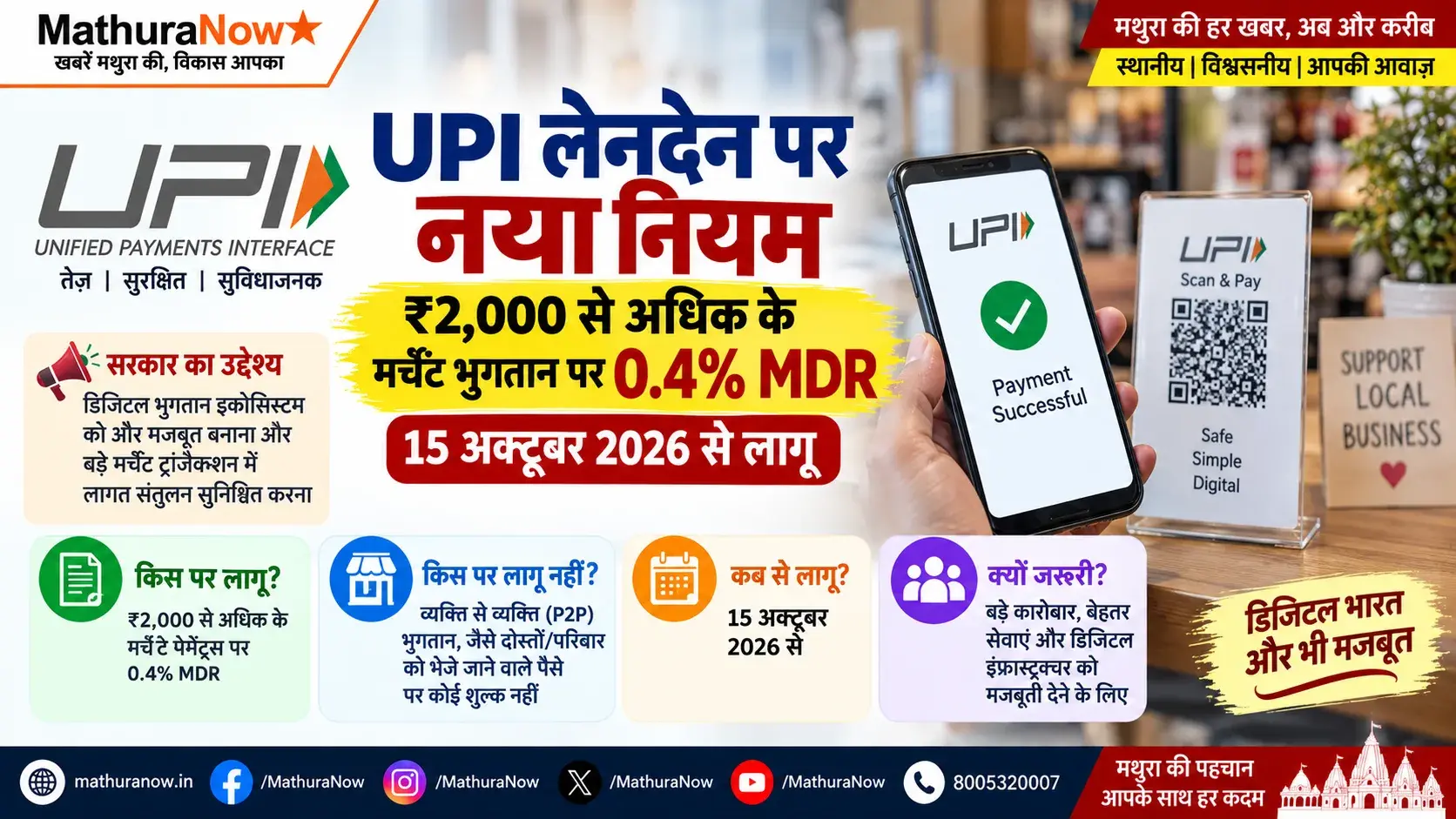
Mathura, September 17, 2026: A significant change has taken place in India’s digital payment system effective October 15, 2026. The National Payments Corporation of India (NPCI) has implemented a new fee structure for certain merchant transactions. According to an official directive, a Merchant Discount Rate (MDR) of 0.4% has come into effect for all Unified Payments Interface (UPI) merchant transactions (P2M) exceeding ₹2,000 in value.
Impact on Consumers and Peer-to-Peer Transfers
It is important to emphasize that for the average consumer, UPI usage remains entirely free of charge. The new regulatory framework introduced by the NPCI does not impose any financial burden on the end-user. Whether a customer is making a payment below the ₹2,000 threshold or a high-value purchase exceeding it, there will be no additional fees levied on the consumer’s transaction. Furthermore, personal transfers between individuals, such as payments made to friends, family members, or relatives—categorized as Person-to-Person (P2P) transfers—remain completely free. The digital infrastructure continues to prioritize the convenience of personal financial exchanges without any deductions for the sender or receiver.
Also Read: Mathura Traders Strengthen Local Units With Sethwara Business Committee Formation
The National Payments Corporation of India (NPCI) has issued a directive regarding the implementation of the Merchant Discount Rate (MDR) for specific UPI transactions. Please consult this fee structure reference to understand the applicable costs for merchant transactions based on your total transaction value.
| Transaction Value | % Applicable MDR | MDR Paid by Merchant |
|---|---|---|
| Up to ₹2,000 | 0% | ₹0 |
| ₹3,000 | 0.40% | ₹12 |
| ₹10,000 | 0.40% | ₹40 |
| ₹20,000 | 0.40% | ₹80 |
| ₹30,000 | 0.40% | ₹120 |
| ₹40,000 | 0.40% | ₹160 |
| ₹50,000 | 0.40% | ₹200 |
| ₹60,000 | 0.40% | ₹240 |
| ₹70,000 | 0.40% | ₹280 |
| ₹75,000 and above | Fixed cap | ₹300 |
| ₹1,00,000 | Fixed cap | ₹300 |
| ₹5,00,000 | Fixed cap | ₹300 |
The Merchant Fee Structure and Relief Measures
While the regulation introduces a cost for businesses, it includes significant relief for smaller merchants. Payments up to ₹2,000 will continue to attract a 0% MDR, ensuring that the vast majority of daily retail transactions in small shops remain unaffected. According to administrative data, more than 95% of small-scale daily transactions fall within this exempt bracket, protecting the viability of micro-businesses across Mathura and the rest of the country. For transactions exceeding the ₹2,000 limit, merchants will incur a charge of 0.40%. To ensure this does not disproportionately impact large-value trade, a fixed cap of ₹300 has been established. This means that even if a transaction is valued at ₹75,000, ₹1,00,000, or ₹5,00,000, the maximum fee deducted from the merchant’s account will not exceed ₹300 per transaction.
Regulatory Enforcement and Specialized Services
The Ministry of Finance and the NPCI have provided strict clarification regarding the collection of these fees. Merchants and UPI applications are prohibited from passing this 0.4% charge onto the customer. Any attempt to levy this as a surcharge at the point of sale is against the established guidelines. Instead, the deduction will be managed automatically by banks and payment service providers directly from the merchant’s settlement account. This mechanism is intended to support the ongoing maintenance, expansion, and security enhancements of the UPI digital ecosystem.
Also Read: Mathura Sweet Sellers Association Holds District-Level Meet on FSSAI Compliance
Special provisions have also been made for essential services. For high-value payments—specifically those over ₹2,000—related to railway ticketing, fuel purchases at petrol pumps, and the payment of utility bills like electricity and water, the system will apply a flat fee of ₹5 rather than the 0.4% percentage-based rate. This ensures that the cost structure for critical public services remains predictable and minimized for service providers. Traders and business owners in the Mathura region are advised to familiarize themselves with these automated deductions to manage their accounting and digital cash flow effectively as the October deadline approaches. The move aims to balance the sustainability of digital payment infrastructure with the affordability needs of the nation’s retail economy.
Get Mathura's latest news on WhatsApp
Breaking news and important local updates, straight to your phone
Join channel