
Is Astrology Really a Science? A Balanced View of Shastra and Science
Is astrology a science, a traditional knowledge system, or something else? This analysis by astrologer Deepti Mishra examines Jyotisha through Indian scriptures, astronomy, scientific testing and the limits of modern evidence.
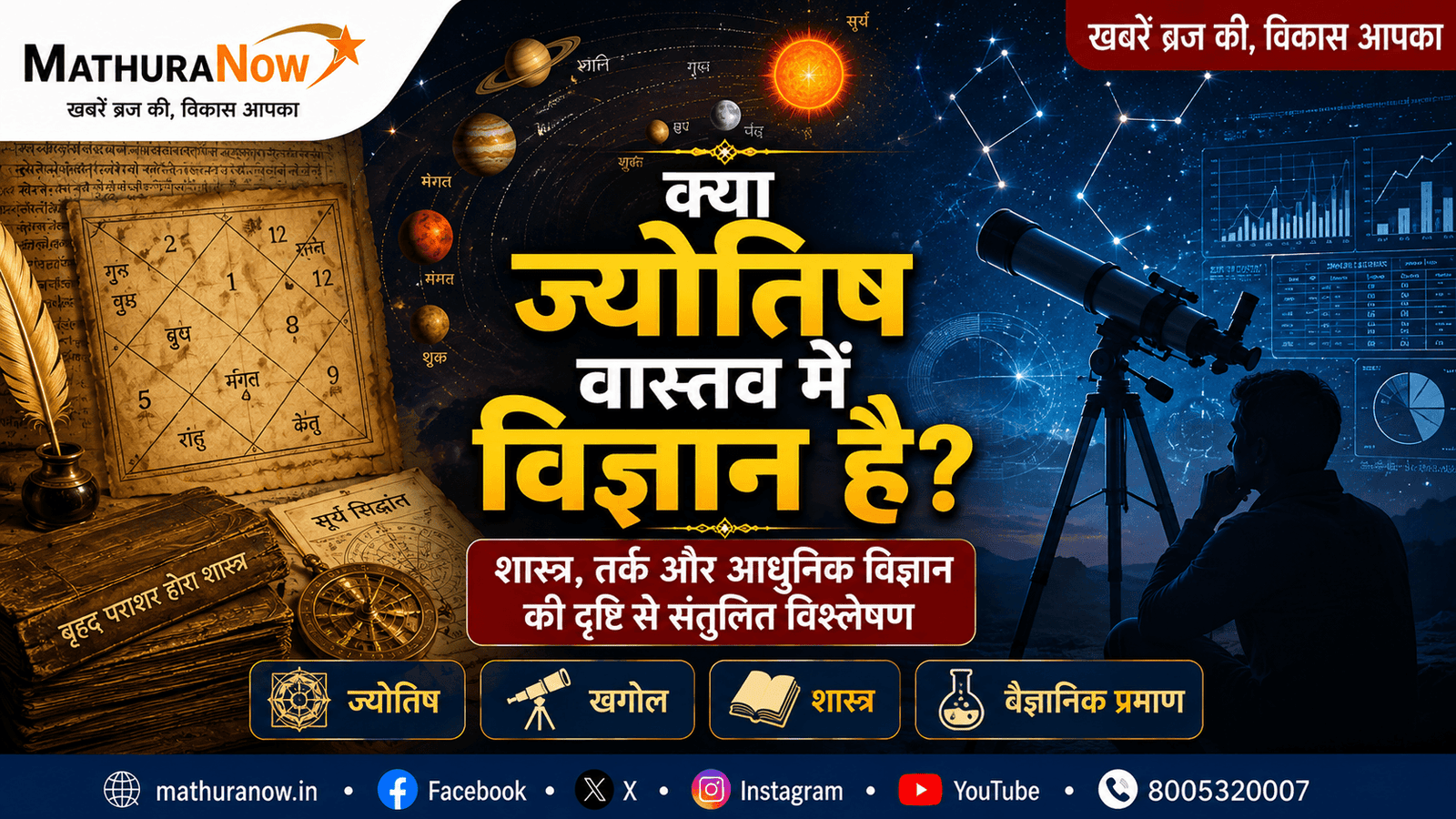
MATHURA: Is astrology really a science? The question has remained relevant for generations, and the answer depends on what exactly we mean by the word “astrology.” In the Indian tradition, Jyotisha includes the study of time, calendars, celestial movements and, in its later branches, the interpretation of planetary positions in human life.
Supporters of astrology often describe it as an ancient science. Critics argue that predictive astrology does not meet the testing standards of modern science. A balanced examination requires us to separate these different claims instead of treating the entire tradition as one subject.
Also Read: Mathura Ramlila Festival to Begin with Grand Ganesh Shobhayatra on Oct 3
This analysis by Pandit Deepti Mishra, astrologer and spiritual researcher, looks at Jyotisha through the perspectives of Indian tradition, astronomy, scientific reasoning and available research.
What Does Science Mean?
Modern science is based on systematic observation, testing and the ability to check whether a result can be reproduced. A scientific claim must be open to measurement and independent verification.
This distinction matters when astrology is discussed. Some parts of the broader Jyotisha tradition involve astronomical observation and mathematical calculation. Predictive astrology, however, makes additional claims about personality, events and human life. Those claims require a different kind of evidence.
Scientific testing has not established that the positions of planets at the time of birth can reliably determine a person’s personality or future events. A well-known double-blind study published in Nature in 1985 tested whether natal charts could accurately describe personality traits. The study remains an important reference in discussions about the empirical testing of astrology. :contentReference[oaicite:0]{index=0}
What Does the Indian Tradition Mean by Jyotisha?
In the Indian knowledge tradition, Jyotisha was not originally limited to the modern idea of horoscope prediction. Vedanga Jyotisha was closely connected with the calculation and fixing of time for Vedic rituals.
The Government of India’s Vedic Heritage Portal describes Vedanga Jyotisha as a system concerned with the celestial knowledge needed to determine appropriate days and times for Vedic sacrifices. It also records the development of later Indian works dealing with astronomy and mathematical calculations. :contentReference[oaicite:1]{index=1}
This historical distinction is important. The astronomical and calendrical aspects of Jyotisha belong to the history of Indian astronomy and timekeeping. They should not automatically be treated as evidence that every form of modern horoscope prediction has been scientifically established.
The Three Broad Branches of Jyotisha
Indian astrological literature is commonly discussed through three broad areas: Siddhanta, Samhita and Phalita.
- Siddhanta Jyotisha: Deals primarily with astronomical calculations, planetary positions and mathematical methods.
- Samhita Jyotisha: Traditionally deals with broader subjects such as natural events, weather, agriculture and matters affecting society.
- Phalita Jyotisha: Interprets birth charts, planetary periods, transits and other astrological factors in relation to individual life.
The first category has a direct connection with mathematical astronomy. The third is more interpretive and is the area in which questions about scientific evidence become particularly important.
Did Ancient Indian Jyotisha Contain Astronomy?
Yes. Ancient Indian scholars developed sophisticated traditions of astronomical observation and calculation. Historical accounts of Indian astronomy include the work of scholars such as Aryabhata, Varahamihira and Bhaskaracharya.
The International Astronomical Union has documented the importance of the Vedanga Jyotisha in the history of Indian calendrical astronomy. It describes a luni-solar calendar based on observations and calculations involving the Sun and Moon. :contentReference[oaicite:2]{index=2}
Modern academic work also continues to study the mathematical methods contained in early Indian astronomical texts. A 2026 study of Vedanga Jyotisha, for example, examined its calculations concerning the duration of daylight and their mathematical and geographical implications. :contentReference[oaicite:3]{index=3}
This history is significant, but astronomy and astrology should not be treated as identical disciplines. Astronomy studies physical celestial objects and their measurable behaviour. Astrology makes additional interpretive claims about their relationship with human life.
Do Planets Control Human Life?
Traditional Indian astrology does not necessarily describe planets as creators of human destiny. A common philosophical interpretation is that planets indicate the results or timing associated with karma rather than independently creating those results.
A simple traditional analogy is that a clock shows time but does not create time. In the same way, planets may be understood by astrologers as indicators of a larger cosmic order.
This is a philosophical and religious interpretation, however, rather than a conclusion established by modern experimental science. Keeping that distinction clear allows the discussion to remain respectful without presenting a belief as a laboratory-tested fact.
What Does Modern Science Say?
Modern science clearly establishes that celestial bodies can have physical effects on Earth. The Sun is the primary energy source for Earth’s climate system and life. The Moon’s gravitational influence produces ocean tides. Solar activity can also affect Earth’s near-space environment and technological systems.
But these established physical effects are different from the claim that a person’s birth-time planetary configuration determines their personality or future.
There is currently no accepted scientific mechanism or body of reproducible evidence showing that planetary positions at birth reliably determine individual life outcomes. NASA’s educational discussion of astrology notes that empirical scientific investigation has not supported the accuracy of astrological predictions and that astrology is generally regarded as a pseudoscience today. :contentReference[oaicite:4]{index=4}
Has Astrology Been Scientifically Tested?
Yes. Astrology has been subjected to scientific and statistical testing.
One of the best-known examples is Shawn Carlson’s double-blind study, published in Nature in 1985. It tested whether natal charts could accurately describe personality characteristics. The study used controlled testing rather than relying only on personal experience or anecdotal success. :contentReference[oaicite:5]{index=5}
The existence of such research does not mean that every astrological tradition has been tested in every possible form. It does mean that specific claims made by astrology can be tested scientifically, and that the evidence available so far has not established predictive astrology as a generally accepted science.
Why Does Astrology Remain Relevant?
Astrology remains culturally important for several reasons.
- It is connected to a long Indian tradition of observing celestial cycles and calculating time.
- Panchang, calendars and traditional muhurta calculations continue to have practical religious importance.
- Astrology has accumulated centuries of textual traditions and interpretive practices.
- Many people use astrology for reflection, cultural practice and personal decision-making.
- It remains deeply connected with festivals, rituals and family traditions across India.
These cultural and personal reasons are different from scientific proof. A tradition can have historical and social value even when a particular claim within that tradition has not been scientifically demonstrated.
Are Astrology and Science Opposed to Each Other?
Not necessarily. The relationship becomes clearer when their different methods are recognised.
Also Read: When exactly did Pitru Paksha begin? “From roots to the future — from grandfather to grandson” | Part 2/9
Science asks whether a claim can be measured, tested and independently reproduced. Jyotisha, particularly in its traditional form, also contains philosophical, cultural and interpretive dimensions.
Where Jyotisha deals with calendars, celestial observation and mathematical astronomy, it overlaps with the history of astronomy. Where it makes predictions about individual personality or future events, it enters a different area that requires empirical evidence.
Therefore, describing all Jyotisha as “science” is too broad. Describing the entire tradition as “mere superstition” is also an incomplete description of its historical development.
Where Should the Line Be Drawn?
The most useful approach is to separate tradition, astronomy, philosophy and empirical evidence.
A Panchang calculation can be checked against astronomical observations. A historical astronomical model can be studied through mathematics and historical records. A philosophical belief about karma belongs to a different category. A claim that a birth chart can predict a specific future event can be tested statistically.
Each claim should therefore be judged according to the type of evidence it requires.
The Balanced View
Jyotisha is an important part of India’s intellectual and cultural history. Its early calendrical and astronomical traditions demonstrate systematic observation of celestial cycles and the development of mathematical methods for timekeeping. :contentReference[oaicite:6]{index=6}
At the same time, modern science has not established that predictive astrology can reliably determine a person’s personality, behaviour or future from planetary positions at birth. Scientific tests have produced results that do not support treating such claims as established science. :contentReference[oaicite:7]{index=7}
That distinction does not require disrespect toward faith or tradition. It simply means that cultural importance and scientific validation are two different questions.
Conclusion: What Is the Most Reasonable Answer?
So, is astrology really a science?
The most balanced answer is that Jyotisha is a broad traditional knowledge system with important historical connections to astronomy, mathematics and calendar-making, while predictive astrology has not been established as a modern empirical science.
Its astronomical and calendrical history deserves serious study. Its philosophical ideas deserve to be understood in their cultural context. Its predictive claims can be examined through scientific methods without either automatically accepting or dismissing them.
For believers, astrology may remain a language for understanding time, karma and personal reflection. For scientists, its empirical claims must meet the same standards of evidence applied to other claims about the natural world.
The traditional philosophical message can therefore be understood in a simple way: the planets may be interpreted as indicators of time, but human effort remains central to how life is lived.
Author:
Pandit Deepti Mishra
Astrologer and Spiritual Researcher
Editorial note: This article presents the author’s perspective alongside historical and scientific context. Statements about astrology’s cultural or philosophical meaning should not be treated as scientific proof. Readers should distinguish traditional belief, astronomical calculation and experimentally verified scientific claims.
Pandit Deepti Mishra
Astrologer and Spiritual Researcher
Get Mathura's latest news on WhatsApp
Breaking news and important local updates, straight to your phone
Join channel