Nag Panchami and Sustainability: Why Gen Z Should Revisit an Ancient Tradition
Nag Panchami is more than a ritual. Its cultural symbolism offers a useful modern conversation about wildlife, coexistence and ecological responsibility. But tradition and science must be understood separately.
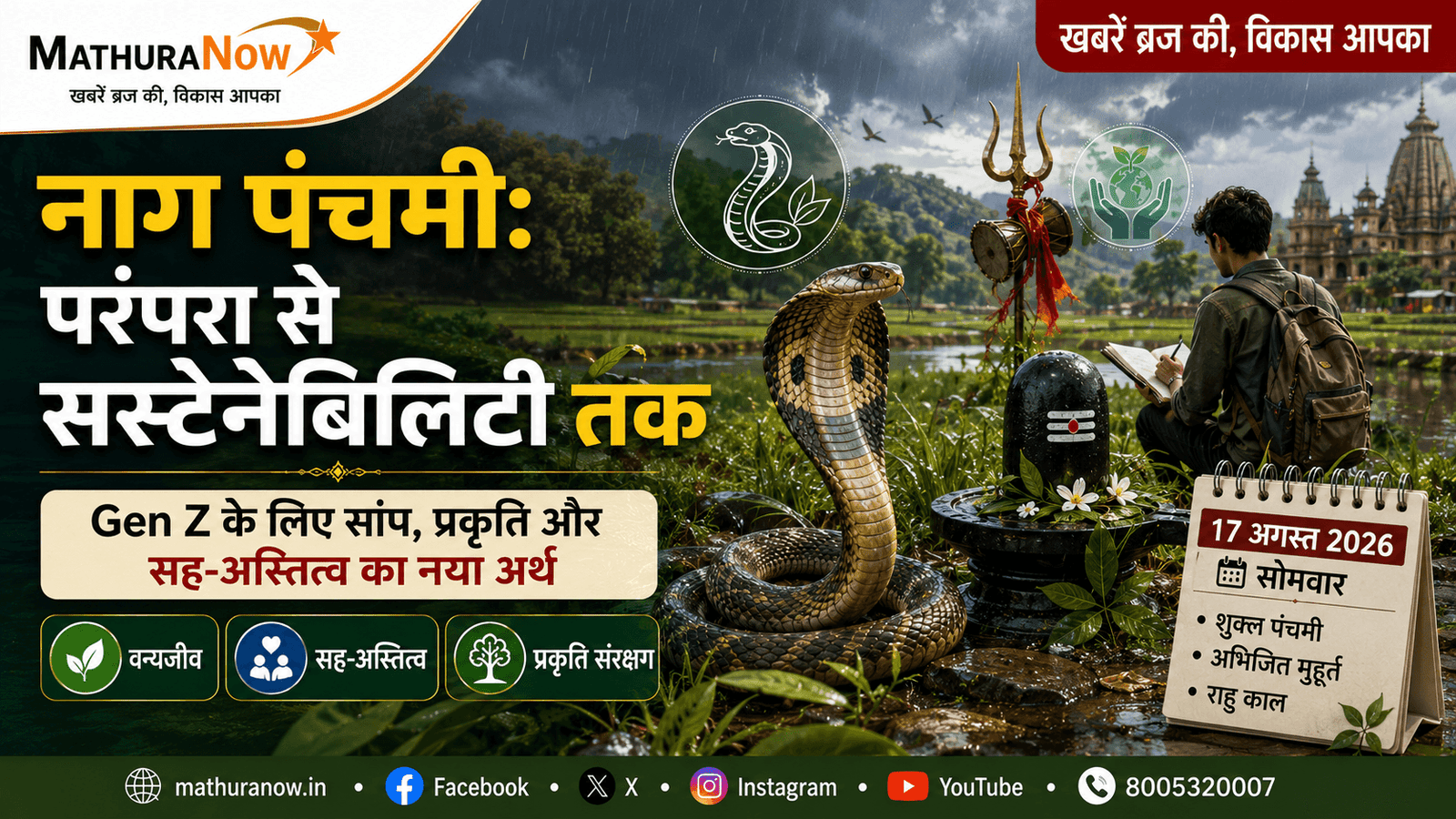
MATHURA: Every year, Nag Panchami brings snakes into the centre of India’s cultural and religious conversation. For many families, the festival is part of the traditional observance of Shravana. For a younger generation, however, it also raises a different question: can an ancient tradition be understood through the modern language of ecology, wildlife conservation and coexistence?
The answer is yes, but only if tradition and science are kept in their proper context.
Also Read: Emotional Enactment of Narad Moh and Ravana’s Birth Held in Mathura Ram Leela Mahotsav
Nag Panchami is traditionally observed on the fifth day of the bright half of the Hindu month of Shravana and is associated with the worship of serpents. The festival carries different stories and practices across India, but respect for the naga has remained an important part of its cultural identity.
From Fear and Revenge to Compassion
One of the popular folk stories associated with Nag Panchami tells of a farmer whose plough accidentally killed young snakes while he was working in his field. The mother snake, driven by anger, is said to have attacked the farmer’s family. The farmer’s daughter, however, worshipped the snakes and sought forgiveness. The story ends with the family’s restoration.
The story should be read as folklore rather than as a historical account. Its deeper message is about compassion, restraint and the consequences of harming another living being.
For a modern reader, that message remains relevant. A snake does not attack because it wants revenge. Wildlife education organisations have repeatedly highlighted that snakes generally respond to threats and are often misunderstood because of long-standing myths.
Why Snakes Matter in the Ecosystem
The ecological argument for respecting snakes is stronger than many popular myths surrounding them.
Several snake species feed on rodents and other small animals. This places them within the natural food chain and can make them useful in agricultural landscapes where rodents can damage crops and stored grain.
Indian agricultural research has documented the scale of rodent-related crop damage and has promoted integrated and environmentally responsible approaches to pest management. Snakes are only one part of a much larger ecosystem, but their role as predators illustrates why biodiversity matters.
That does not mean every snake is automatically beneficial to every farm or household. It means that removing wildlife from an ecosystem without understanding its role can have wider consequences.
Why Is Nag Panchami Celebrated in Shravana?
Nag Panchami falls during Shravana, the monsoon season in much of India. This timing has encouraged many modern interpretations linking the festival with increased human-snake encounters during the rainy season.
However, one should be careful about presenting a specific environmental explanation as the original reason for fixing the festival in Shravana. The historical and religious development of Nag Panchami is much more complex than a single ecological theory.
What can be said with confidence is that monsoon conditions can bring humans and wildlife into closer contact. Snakes may be encountered around fields, drains, buildings and other places where people live or work. That makes awareness and safe coexistence particularly important during the rainy season.
The Milk Question: Tradition and Science Are Different
This is where the modern conversation around Nag Panchami needs a clear fact check.
Snakes are reptiles, not mammals, and milk is not a natural part of their diet. Wildlife organisations and snake-rescue groups have repeatedly warned that snakes cannot properly digest milk. A snake may sometimes consume liquid when severely dehydrated, but that does not mean milk is suitable food for it.
There is also a documented concern about the treatment of live snakes brought into public religious gatherings. Wildlife rescue organisations have reported cases involving dehydration, captivity and other harmful practices associated with snake handling.
For devotees, there is a safer distinction to make: religious offerings can be made to a representation or deity rather than forcing food or milk on a live wild animal.
What the Festival Can Teach Gen Z
Gen Z often approaches traditions with a simple question: what does this practice mean today?
Nag Panchami offers an opportunity to discuss that question without dismissing either faith or science.
The snake has occupied an important place in Indian religious symbolism for centuries. Lord Shiva is traditionally depicted with a serpent around his neck, while naga traditions appear in several strands of Indian mythology and religious culture. These stories have helped place the snake within a framework of reverence rather than treating it simply as an animal to be feared.
The modern interpretation can go one step further: respect for wildlife should mean allowing wild animals to remain wild.
From Worship to Wildlife Awareness
The strongest sustainability message of Nag Panchami does not require changing the festival itself. It requires changing the way people interact with wildlife.
- Do not catch or handle wild snakes for religious display.
- Do not force milk or other food into a snake’s mouth.
- Do not encourage people to touch, carry or pose with venomous snakes.
- If a snake enters a home, keep a safe distance and contact trained wildlife rescuers or the appropriate local authorities.
- Teach children to identify snakes as wildlife rather than as objects of entertainment.
- Protect natural habitats instead of removing every snake encountered near human settlements.
Wildlife Institute of India material also reflects the broader principle that people responsible for animals have a duty to prevent unnecessary pain and suffering.
Is Nag Panchami an Ancient Environmental “Peace Treaty”?
It is tempting to describe Nag Panchami as an ancient ecological treaty between humans and snakes. That makes for a powerful headline, but it would be historically too strong without specific evidence.
Also Read: Agroha Dham to Host 43rd Annual Grand Fair on October 25
Similarly, claims that ancient “Nag clans” were uniformly nature protectors should not be presented as established historical fact without reliable evidence.
What can be established is that snakes and naga traditions have deep roots in Indian religious and cultural history, and that the festival continues to express ideas of reverence, protection and coexistence.
The Braj Perspective
For Braj, where religious traditions remain closely connected with everyday life, festivals such as Nag Panchami are not simply dates on a calendar. They are part of a wider cultural landscape in which nature, animals, temples, stories and community practices often overlap.
That makes the festival an opportunity for a modern public conversation as well. Faith can continue to be respected while wildlife can be protected through responsible behaviour.
The idea is simple: devotion does not require harming the object of devotion.
The Takeaway for a New Generation
Nag Panchami should not be reduced either to superstition or to a modern environmental slogan. It is a living cultural tradition with religious, mythological and regional dimensions.
But its message can still be interpreted for the present.
For Gen Z, perhaps the most meaningful way to revisit Nag Panchami is to replace fear with knowledge and unnecessary handling with coexistence. Respecting a snake does not mean touching it, feeding it or bringing it into a crowded celebration. It can simply mean allowing the animal to live safely in its natural environment.
That is where an old cultural tradition and a modern sustainability principle can meet: human beings do not own the ecosystem. They are part of it.
— Analysis by Pradeep Delpuria “Maanu”
Editorial note: This article distinguishes between traditional beliefs, folklore and scientifically supported wildlife information. Claims that present a particular ecological explanation as the historical origin of Nag Panchami have been avoided where reliable evidence is insufficient.
In this story

Pradeep Delpuriya "Maanu"
Bureau Chief
Pradeep Delpuriya "Maanu" is a distinguished educator and media professional based in Kanpur Nagar, Uttar Pradesh. Alongside his active role in journalism as a field reporter and…
Get Mathura's latest news on WhatsApp
Breaking news and important local updates, straight to your phone
Join channel