Why Are Agarwals Traditionally Linked to Nagas, Nag Panchami Special
The traditional relationship between the Agarwal community and Nagas is linked to the story of Maharaja Agrasen and Princess Madhavi. Learn why Nagas are traditionally regarded as “mama” in some Agarwal traditions.
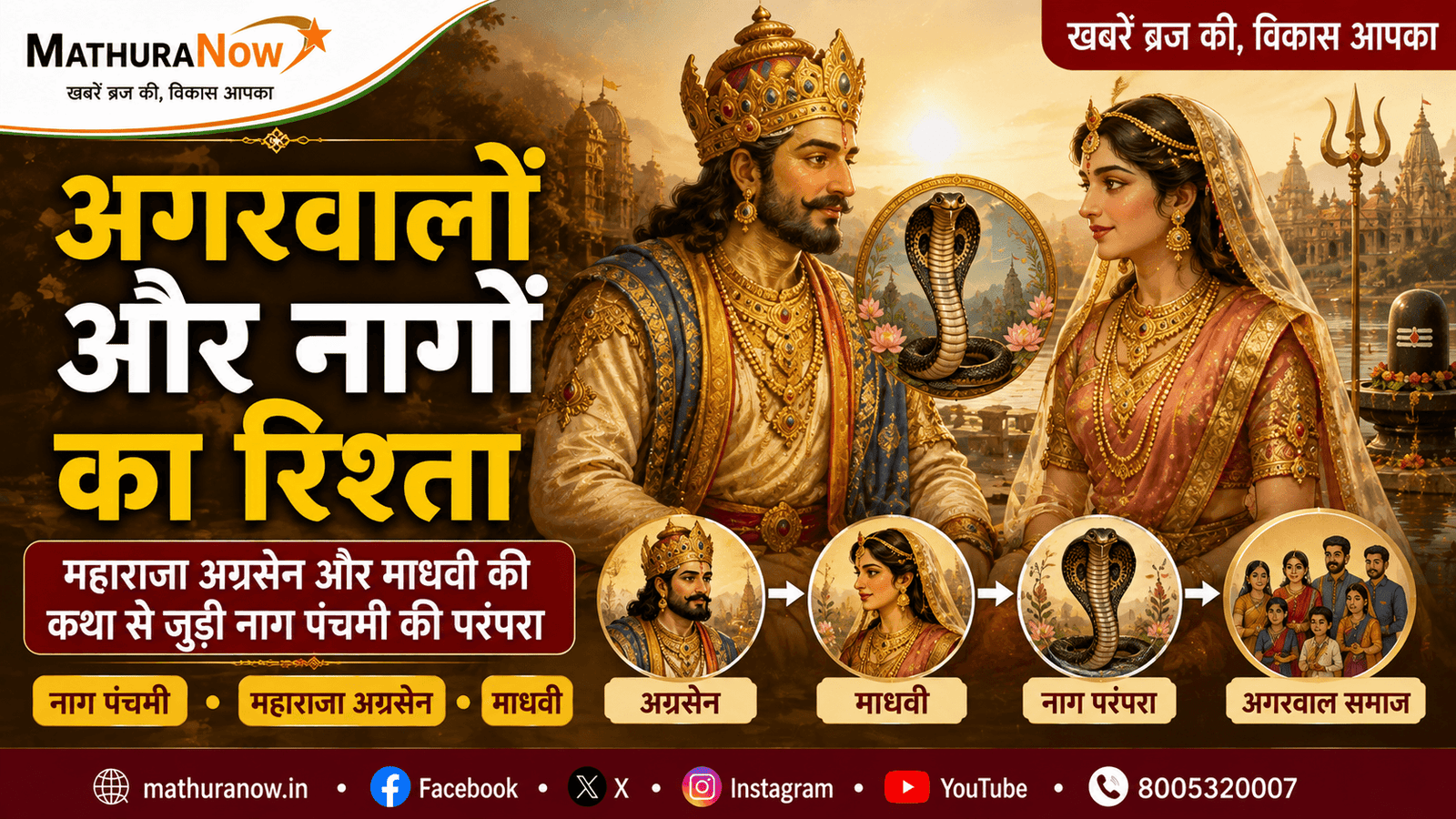
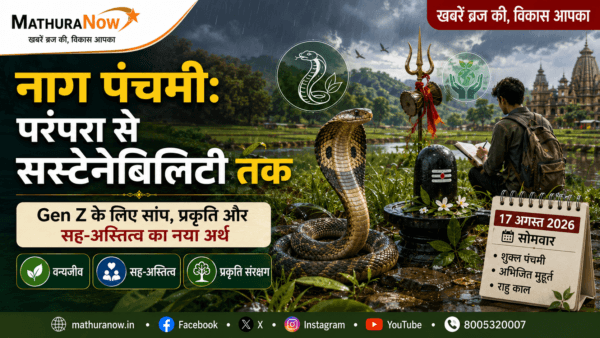
MATHURA: As Nag Panchami is observed across India, an unusual cultural tradition associated with the Agarwal community also comes into focus: why are snakes traditionally regarded as “maternal uncles” or “mamas” in some Agarwal traditions?
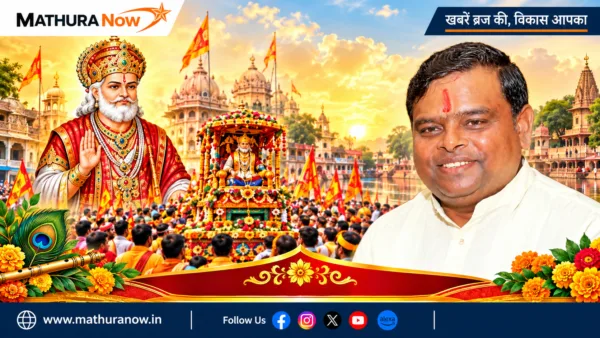
The answer lies in a widely circulated community legend about Maharaja Agrasen and Princess Madhavi, who is described in the tradition as the daughter of Nagaraja Kumud. The story connects the Agarwal community with the Naga tradition through marriage and the maternal side of the family.
Also Read: Emotional Enactment of Narad Moh and Ravana’s Birth Held in Mathura Ram Leela Mahotsav
It is important to make one distinction at the beginning. This is a religious and community tradition, not a scientifically established genealogy. Different accounts of Maharaja Agrasen and the origin traditions of the Agarwal community exist, and the story of Agrasen and Madhavi belongs to that wider traditional narrative.
The Story of Maharaja Agrasen and Madhavi
According to a well-known Agarwal tradition, Maharaja Agrasen attended the svayamvara of Princess Madhavi, the daughter of Nagaraja Kumud. A svayamvara was a traditional ceremony in which a princess chose her husband from among the eligible suitors.
The story says that several powerful figures, including Indra, were interested in Madhavi. She ultimately chose Agrasen as her husband. Their marriage is therefore remembered in the tradition as a union between Agrasen’s lineage and the Naga lineage.
Several Agarwal community organisations continue to describe Madhavi as a Naga princess and regard her as an important figure in the community’s traditional history.
So, Why Are Nagas Called “Mama”?
This is the central point of the tradition.
If Madhavi was the daughter of Nagaraja Kumud, then the Naga side becomes the maternal side in the traditional family narrative. In Indian kinship terminology, the mother’s brother is called mama.
That is why some Agarwal traditions describe the Nagas as the community’s “mama”. A community history published by Aggarwal Samaj Tri Nagar explicitly connects the marriage of Agrasen and Madhavi with the tradition of considering snakes as maternal uncles. It also records Nag Panchami worship and a snake-shaped marriage symbol as associated customs in some families.
Nag Panchami Gives the Tradition a Special Meaning
The connection becomes particularly visible during Nag Panchami, when snakes and naga traditions receive special religious attention.
Some Agarwal family traditions include worship associated with snakes or snake holes on Nag Panchami. A scholarly study of contemporary Hindu practice also records the connection between the Agrasen-Madhavi legend and the worship of snake holes during Nag Panchami.
However, these customs are not necessarily identical across every Agarwal family. Religious practices can differ by region, family tradition and local community.
Is Maharaja Agrasen’s Marriage to Madhavi Historical?
This is where the story needs careful treatment.
Maharaja Agrasen is regarded by the Agarwal community as its traditional forefather, but accounts of his life contain different versions. The Government of India’s National Mission on Monuments and Antiquities, for example, refers to Agarwalon ki Utpatti, written by Bharatendu Harishchandra in 1871, as one important source for a traditional account of Agrasen’s origin.
Research on the Agarwal community also describes the Agrasen-Madhavi story as a legend recorded in the nineteenth century. One academic study notes that Bharatendu Harishchandra’s 1871 account was based on tradition and an account associated with the Mahalakshmi Vrat Katha.
For this reason, the marriage of Agrasen and Madhavi should be described as a traditional or mytho-historical account, rather than as a historically proven marriage supported by contemporary records.
The Naga Connection Is a Cultural Relationship
The word “Naga” itself has appeared in several religious, cultural and historical contexts in the Indian subcontinent. In the Agarwal tradition discussed here, however, the Naga connection is specifically presented through Madhavi’s family.
That distinction matters. Saying that Agarwals have a traditional relationship with the Nagas is different from claiming that a biological or genetic relationship has been historically established.
The available community accounts support the existence of the cultural tradition. They do not establish a modern scientific blood relationship between the Agarwal community and snakes or historical Naga groups.
What the Agrasen Tradition Represents
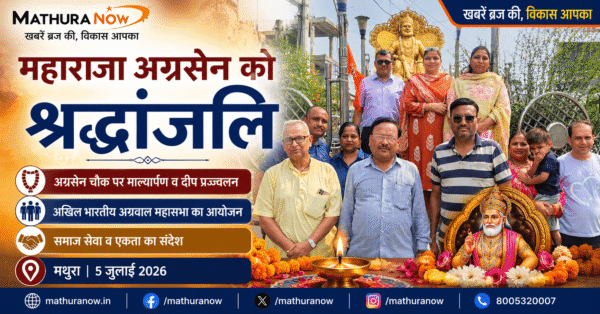
The story of Maharaja Agrasen extends beyond his marriage to Madhavi. Agarwal traditions remember him as a ruler associated with principles such as compassion, non-violence, social cooperation and prosperity.
Also Read: Braj Raj Utsav 2026: 11-Day Cultural Fair Set for Mathura and Vrindavan
Community accounts also connect Agrasen with Agroha and with the later identity of the Agarwal community. The Government of India’s cultural documentation similarly identifies Agrasen as the traditional progenitor associated with the Agarwal community and Agroha.
The Agrasen-Madhavi story therefore forms one part of a much larger community tradition involving lineage, migration, social organisation and religious identity.
Why This Story Matters on Nag Panchami
For an Agarwal family following this tradition, Nag Panchami can carry a meaning beyond the general worship of Nag Devta.
The Naga is remembered as part of the community’s traditional maternal lineage through Madhavi. The idea of calling Nagas “mama” therefore transforms what could otherwise be a distant religious symbol into a family relationship within the traditional narrative.
The cultural message is one of respect rather than fear. At the same time, modern readers should distinguish religious symbolism from the treatment of live wildlife. Respect for snakes should never require catching, handling or harming wild animals.
Agarwal-Naga Relationship: 5 Things to Know
- Maharaja Agrasen is traditionally regarded by Agarwals as their community forefather.
- Princess Madhavi is described in the popular tradition as the daughter of Nagaraja Kumud.
- The marriage of Agrasen and Madhavi creates the traditional maternal connection with the Naga side.
- Because of this maternal relationship, some Agarwal traditions refer to Nagas as “mama”.
- The relationship is a religious and cultural tradition, not a scientifically established biological genealogy.
Frequently Asked Questions
Why do Agarwals traditionally call Nagas “mama”?
According to the community tradition, Maharaja Agrasen married Madhavi, who was the daughter of Nagaraja Kumud. The Naga side therefore represents the maternal side of the family in the traditional narrative, leading to the use of “mama”.
Was Madhavi really a Naga princess?
She is described as the daughter of Nagaraja Kumud in the traditional Agarwal account. This should be understood as part of the community’s religious and mytho-historical tradition rather than as a modern historical record.
Do all Agarwal families worship snakes on Nag Panchami?
Not necessarily. Religious customs can differ between families and regions. Sources documenting Agarwal traditions record Nag Panchami worship in some family practices, but this should not be presented as a uniform practice followed by every Agarwal family.
Is there historical proof of a blood relationship between Agarwals and Nagas?
No such modern biological relationship has been established by the tradition itself. The connection is a cultural and religious relationship based on the story of Agrasen and Madhavi.
Why is the story especially relevant during Nag Panchami?
Nag Panchami is traditionally associated with the worship and reverence of Nag Devta. In Agarwal tradition, the additional connection with Madhavi gives the festival a distinctive family and community meaning.
The Takeaway
The traditional relationship between Agarwals and Nagas begins, in the community’s popular narrative, with the marriage of Maharaja Agrasen and Princess Madhavi, the daughter of Nagaraja Kumud.
From that story comes the idea of the Naga as a maternal relative, or “mama”, in some Agarwal traditions. The custom is particularly relevant during Nag Panchami, when serpent traditions receive special religious attention.
For readers today, the most accurate way to understand the story is to respect its cultural importance while keeping a clear line between tradition, mythology and documented history.
Nag Panchami Special | MathuraNow Culture & Heritage Desk
In this story

Vinod Garg
Bureau Chief
Vinod Garg is a seasoned journalist currently serving as the Bureau Chief for Firozabad at the regional news network, MathuraNow. With an extensive background in hyper-local and…
Get Mathura's latest news on WhatsApp
Breaking news and important local updates, straight to your phone
Join channel