Meta Taught Reels, Google Built Utility: Who Wins the AI Race?
From Mathura's hyperlocal news to India's small businesses, the next AI race may not be about who creates the most content, but who connects people with reliable information, real-time business data and useful tools.
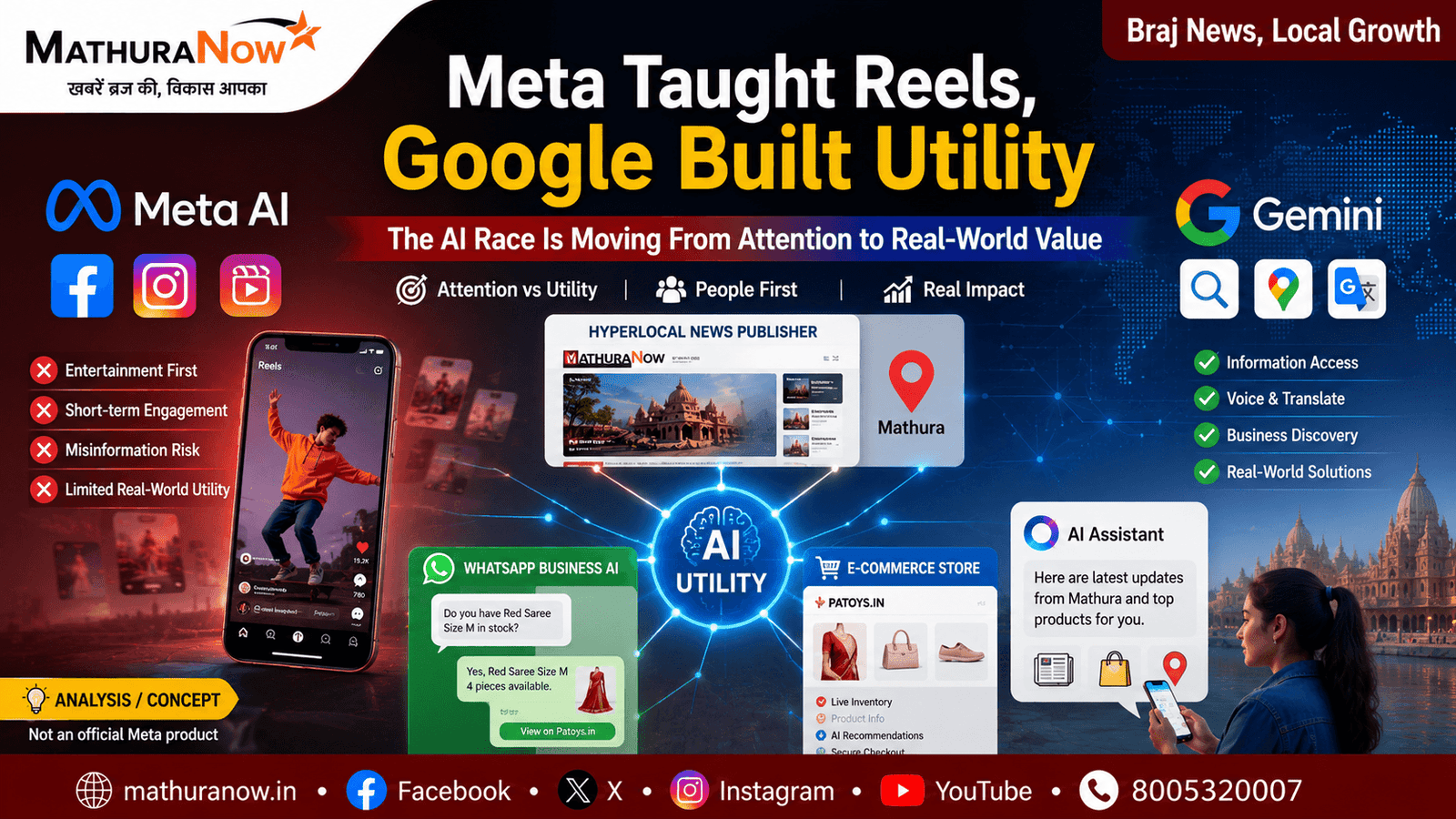
This is where the contrast between Meta and Google becomes interesting. Meta has built an enormous social and messaging ecosystem around Facebook, Instagram, WhatsApp and Threads. Google built its global position around Search, Maps, Translate, voice interaction and increasingly Gemini-powered services.
Meta Built Attention. Google Built Utility.
Meta’s strongest consumer products have historically been designed around social interaction, visual content and engagement. Reels, Stories and image-based creation are powerful examples of that strategy.
But engagement and utility are not the same thing.
A person spending 30 minutes watching short videos may generate valuable engagement for a platform. A shopkeeper using voice search to find a supplier, translating a message for a customer or discovering a product may create a direct economic outcome.
This difference could become increasingly important as AI becomes part of everyday life.
Google’s Advantage Is the Information Layer
Google’s advantage is not simply Gemini. It is the enormous information and services ecosystem surrounding Search, Maps, YouTube, Translate, advertising and other products.
Google is also moving AI directly into commercial discovery. In 2026, Google announced new Gemini-powered advertising experiences in India, including Business Agent for Leads, which can use information from an advertiser’s website to answer questions and interact with potential customers inside an ad experience.
That model points towards a future in which a website is not merely a destination. Its structured information can become part of an AI-driven conversation.
Meta Is Not Standing Still
It would be unfair to describe Meta as an entertainment-only company that has ignored business AI.
Meta has already moved significantly in the opposite direction. Its 2026 Business AI products allow eligible businesses in India to answer customer questions, recommend products, capture leads and support sales through WhatsApp. Meta has also introduced a Business Agent platform for businesses that want to build and deploy AI agents at scale.
Meta has also said it is exploring ways for Business AI to make personalised product recommendations and facilitate sales using information from a business website.
So the real question is no longer whether Meta understands the value of business data. It clearly does.
The bigger question is whether Meta can build enough trust, structured information and publisher connectivity to make its AI genuinely useful for the open web.
Where Could a “Meta AI Console” Fit?
As of August 21, 2026, there is no official Meta product announcement for a product called “Meta AI Console”. Therefore, the name should be treated as a concept rather than an existing Meta service.
But the underlying idea is not difficult to imagine.
Imagine a future publisher or business dashboard where a website owner can verify a domain, connect structured data, submit product or news feeds, specify update frequency and control which information an AI system can use.
For a hyperlocal publisher such as MathuraNow, that could eventually mean making fresh information about Mathura and Braj easier for an AI assistant to discover and understand.
For an e-commerce business such as Patoys.in, the equivalent could be much more commercial: product information, inventory, prices, availability and customer-service data could potentially become usable inside conversational commerce.
That is an important distinction. The opportunity is not simply “getting indexed by Meta”. It is creating a reliable machine-readable bridge between a business or publisher and an AI assistant.
WhatsApp Could Be Meta’s Biggest Advantage
Meta already has something many AI companies would struggle to build from scratch: a huge messaging ecosystem.
In India, Meta has been expanding WhatsApp as a business platform. Its Business AI can already answer customer questions, recommend products and support sales, while Meta has also been developing payment and commerce capabilities around WhatsApp.
That creates a powerful possibility: search, recommendation, conversation and transaction could happen inside one environment.
But that system will only be as useful as the information behind it.
The Real Problem: Trust and Data Quality
This is where the criticism of Meta’s information ecosystem deserves serious discussion.
Social platforms contain valuable first-hand information, but they can also contain rumours, copied material, clickbait and misinformation. An AI assistant that relies heavily on low-quality information can produce low-quality answers.
The principle is simple: better AI answers require better sources.
That is why verified publishers, official organisations, local businesses and structured first-party data could become increasingly important in AI search.
For a local news organisation, this creates a major opportunity. A well-maintained website with clear dates, locations, authorship, structured news data and original reporting can provide something that a random social-media post cannot: traceable information with editorial accountability.
Muse Spark and Muse Image Show Meta’s Direction
Meta is also clearly investing in more capable AI. In April 2026, Meta introduced Muse Spark as a model designed to power Meta AI across its products, including WhatsApp, Instagram, Facebook and Messenger. Meta later introduced Muse Spark 1.1 with capabilities that allow Meta AI to work with connected applications and perform tasks on a user’s behalf.
Meta also launched Muse Image in July 2026. However, an important correction is necessary: Meta did not withdraw Muse Image itself. Meta withdrew one feature that allowed users to reference public Instagram accounts through an @-mention after receiving feedback that the feature had missed its intended mark.
That distinction matters because technology analysis loses credibility when criticism is built on an inaccurate claim.
Shopify Shows What Business AI Can Look Like
The competitive pressure is also coming from platforms outside the traditional AI race.
Shopify’s Sidekick is built directly into the commerce platform and can work with store data, generate content, analyse performance, build automations and perform operational tasks. Shopify also says its systems are moving towards AI-driven commerce in which product information, inventory and pricing can be made available to AI agents.
This is an important lesson for Meta: businesses do not simply want an AI that creates attractive images. They want an AI that understands their business and helps them operate it.
Could Meta Face a “Yahoo Moment”?
Comparisons with Yahoo should be treated as an opinion, not a prediction.
Meta is far larger and more deeply integrated into everyday communication than Yahoo was in its later years. It also has significant AI investment, a massive user base and one of the world’s largest messaging platforms.
But the underlying warning is valid: market leadership can weaken when a company mistakes user attention for long-term user value.
If AI becomes the primary interface for information, commerce and work, Meta cannot depend only on keeping people inside entertainment feeds. It needs to become useful when a person has a real problem to solve.
What This Means for MathuraNow and Local Websites
For MathuraNow, the lesson is straightforward. The future of AI visibility should not depend on waiting for a hypothetical “Meta AI Console”. The foundation must already be in place.
- Publish original local reporting.
- Maintain accurate dates, locations and entity names.
- Use structured NewsArticle data correctly.
- Build strong author and publisher identity.
- Keep important information available on the website rather than only on social media.
- Make news and business information easy for machines to understand.
- Build first-party authority around Mathura and the wider Braj region.
If Meta eventually creates a formal publisher or website-data programme, sites that already maintain clean, trustworthy and structured information will be in a much stronger position than sites that depend entirely on social posts.
Final Analysis: Meta Needs to Move From Attention to Value
The AI race is changing the definition of a successful technology company.
Meta has users, messaging, commerce, advertising and an increasingly capable AI system. Google has Search, information infrastructure, commercial intent and Gemini. Shopify has commerce data and an AI assistant embedded directly into the merchant workflow.
The winner may not be the company with the most impressive demo.
It may be the company that can answer one simple question better than everyone else:
“I have a real problem. Can your AI help me solve it?”
For Meta, the opportunity is enormous. But the next phase cannot be only about more Reels, more images or more engagement. It has to be about trusted information, useful business tools, reliable data and measurable outcomes.
For publishers like MathuraNow and businesses like Patoys.in, that shift could create a completely new distribution channel—if Meta eventually opens its AI ecosystem to reliable first-party website data.
That is the real opportunity behind the idea of a “Meta AI Console”. The console does not exist today. But the problem it would solve is very real.

News Desk
Editor
MathuraNow News Desk is the official editorial team of MathuraNow, covering hyperlocal news, Braj culture, temple affairs, civic developments, spirituality, festivals, public…
Get Mathura's latest news on WhatsApp
Breaking news and important local updates, straight to your phone
Join channel