Historic Cultural Revival in Lahore Sparks New Debate on India-Pakistan Tourism and Economic Cooperation
A growing cultural movement in Pakistan’s Punjab province has triggered fresh discussions across South Asia about whether India and Pakistan could benefit more from tourism, heritage restoration, and people-to-people connections instead of prolonged political tensions and military hostility.
A growing cultural movement in Pakistan’s Punjab province has triggered fresh discussions across South Asia about whether India and Pakistan could benefit more from tourism, heritage restoration, and people-to-people connections instead of prolonged political tensions and military hostility.
While diplomatic relations between India and Pakistan frequently remain under strain, public sentiment on both sides of the border often reflects a far more emotional and culturally connected reality. Millions of families still share ancestral roots, memories, relatives, traditions, and historical identities linked to regions now separated by the India-Pakistan border.
Also Read: Lakshmi Narayan Chaudhary Criticizes Political Opponents in Chhata
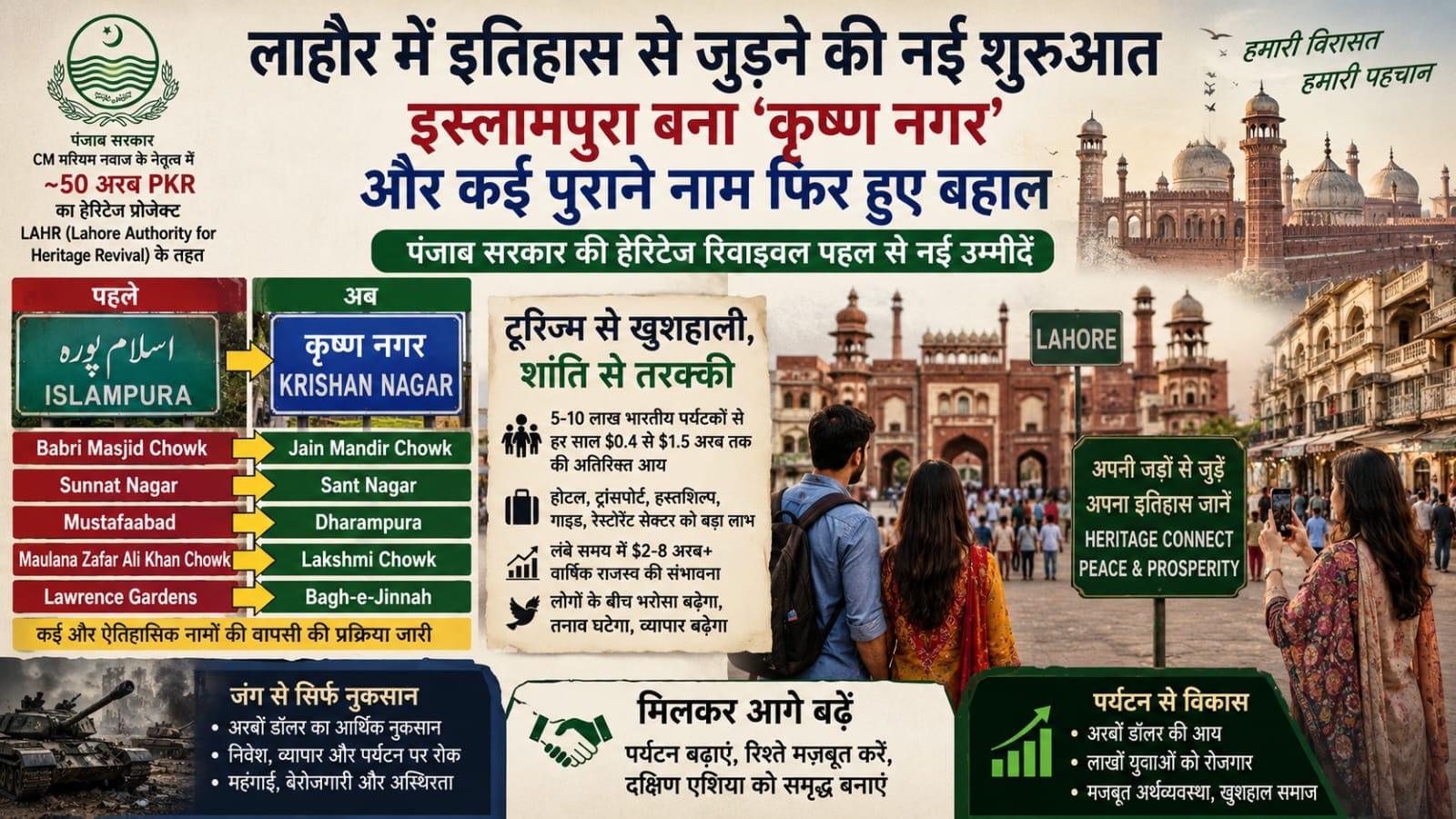
Recently, a major heritage restoration initiative in Lahore has intensified international attention on this topic. The Punjab Government in Pakistan, reportedly backed by Chief Minister Maryam Nawaz and former Prime Minister Nawaz Sharif, is working toward reviving several historical pre-partition names across Lahore under the Lahore Authority for Heritage Revival (LAHR).
The heritage initiative is reportedly linked to a large-scale cultural restoration project worth nearly 50 billion Pakistani rupees. Under this campaign, many historical locations and neighborhoods are being reconnected with their original identities from the pre-1947 era.
One of the most discussed developments is the restoration of the historical identity of “Krishan Nagar,” which had officially been renamed “Islampura” in 1992 following communal and political tensions. Historical records suggest the locality was originally developed during British India in the 1930s alongside nearby areas such as Sant Nagar.
Several other locations in Lahore are also being associated once again with older historical names, including Babri Masjid Chowk being referred to as Jain Mandir Chowk, Sunnat Nagar reconnecting with Sant Nagar, Mustafaabad linked with Dharampura, and Lakshmi Chowk regaining broader cultural visibility.
Experts believe these developments represent more than symbolic renaming. Many analysts describe the initiative as an attempt to acknowledge Lahore’s multicultural, multi-religious, and shared civilizational history that existed before partition.
The conversation has now expanded beyond cultural identity into economic and tourism possibilities between India and Pakistan. International tourism experts believe that if both countries gradually ease restrictions for religious tourism, heritage travel, and family visits, the economic impact could be substantial.
Pakistan’s economy continues to face multiple financial challenges according to various international reports and economic agencies. Analysts estimate Pakistan’s GDP during 2025-26 to be between 410 and 450 billion US dollars, while the tourism sector still remains significantly underdeveloped compared to its regional potential.
Travel industry observers believe India could become one of the largest tourism sources for Pakistan if structured and secure tourism corridors are introduced. India already represents one of the fastest-growing outbound travel markets globally, with millions of Indians traveling internationally every year.
Historical cities such as Lahore, Karachi, Peshawar, Sikh pilgrimage sites, ancient Hindu temples, Buddhist heritage locations, and pre-partition family neighborhoods could attract significant Indian tourism interest if easier visa systems and travel arrangements are implemented.
Social and economic observer Himanshu Agrawal believes emotional connections between ordinary citizens of both countries still remain strong despite decades of political conflict. According to him, many families continue searching for ancestral homes, old neighborhoods, lost family connections, and shared cultural roots across the border.
Also Read: Supporter Begins Prostrate Journey from Budaun to Vrindavan for Akhilesh Yadav
He suggests that carefully regulated “Heritage Tourism” and “Family Connect Tourism” models could generate employment, improve business activity, and gradually rebuild trust between communities on both sides.
Economic analysts estimate that even if 500,000 to 1 million Indian tourists visit Pakistan annually and spend an average of 800 to 1500 US dollars per trip, Pakistan’s tourism economy could potentially generate hundreds of millions to over one billion dollars in additional yearly revenue.
Hotels, restaurants, transportation services, local markets, artisans, tour guides, handicraft businesses, and small traders would likely receive direct economic benefits from increased tourism activity.
In contrast, experts repeatedly warn that military conflict and border tensions negatively impact stock markets, foreign investment, tourism, trade, infrastructure growth, and overall regional economic stability. The financial effects of geopolitical conflict often continue for years beyond the actual period of confrontation.
Policy experts have also proposed the idea of a future “Heritage & Family Connect Corridor” inspired partly by the Kartarpur Corridor model. Such frameworks could potentially allow easier religious pilgrimages, controlled family reunions, and cultural tourism routes connecting cities like Delhi, Amritsar, and Lahore.
Supporters of cultural diplomacy believe that if Pakistan continues preserving and promoting its pre-partition heritage, it could eventually contribute toward a broader South Asian model of “Peace Tourism” and historical reconciliation.
For readers interested in international affairs, culture, tourism, and South Asian developments, more regional stories and analysis can also be explored at MathuraNow.
Disclaimer: Economic and tourism estimates mentioned in this article are based on publicly available international reports, IMF estimates, World Bank references, WTTC tourism analysis, media reports, and independent assessments. Actual outcomes may vary depending on future political, economic, and diplomatic developments.

News Desk
Editor
MathuraNow News Desk is the official editorial team of MathuraNow, covering hyperlocal news, Braj culture, temple affairs, civic developments, spirituality, festivals, public…
Get Mathura's latest news on WhatsApp
Breaking news and important local updates, straight to your phone
Join channel