

Whenever we type a quick message on our smartphones or work on our laptops, a curious question often pops up: Why aren’t the keys arranged in simple alphabetical order like A-B-C-D? Instead, we rely on the cluttered layout starting with Q-W-E-R-T-Y (QWERTY).
The layout isn’t a modern scientific design, but rather a brilliant solution to a mechanical crisis that occurred over 150 years ago. Here is the fascinating history, the logic behind the layout, and why the digital age refuses to change it.
The Birth of QWERTY: When and Who Invented It?
The story goes back to the late 19th century when writing by hand was proving too slow for rapidly growing businesses. The typewriter was built to solve this problem.
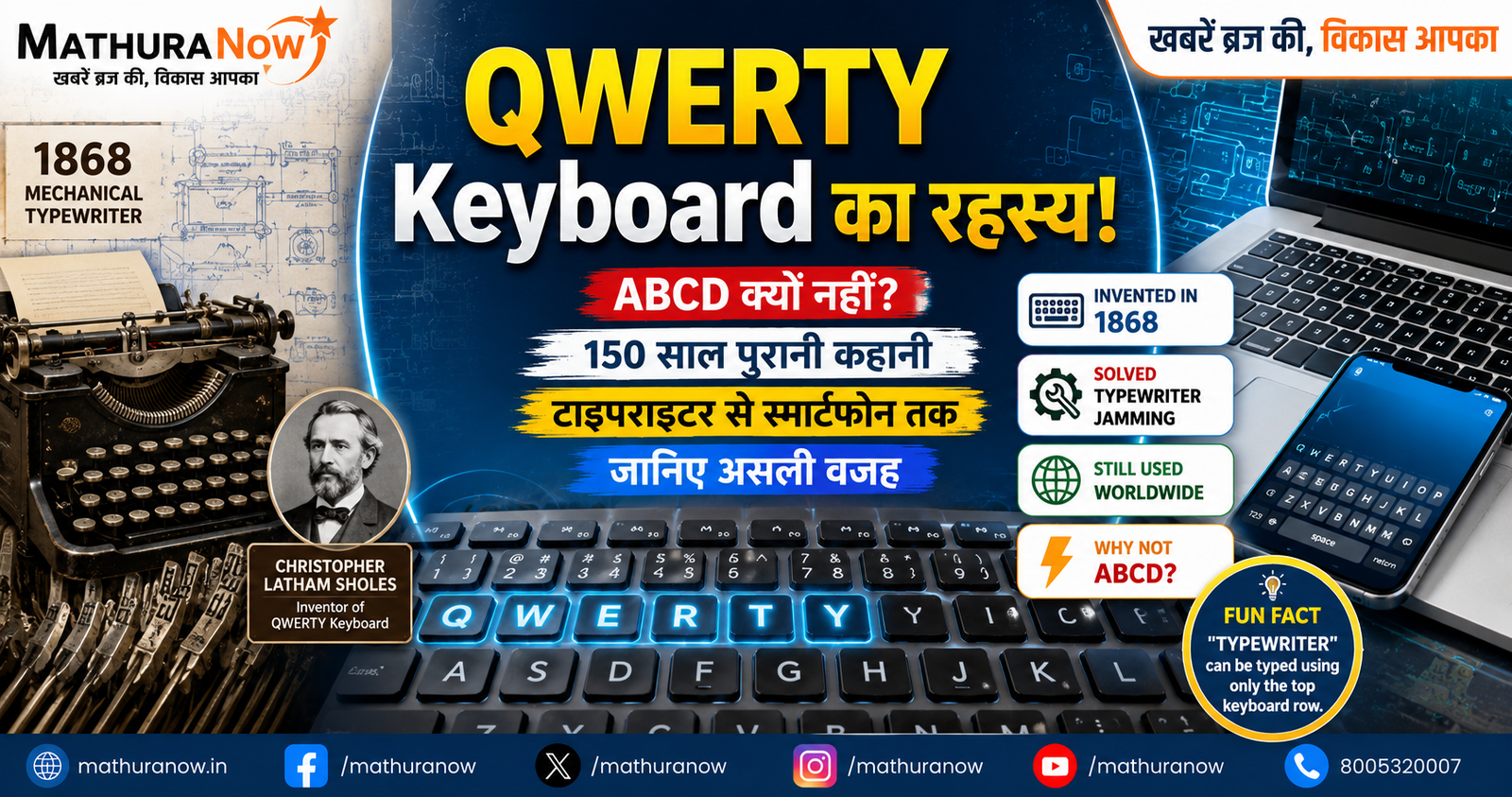
The QWERTY layout was invented in 1868 by an American mechanical engineer and newspaper editor named Christopher Latham Sholes. Alongside his co-inventors Samuel W. Soule and Carlos Glidden, Sholes created the first commercially viable typewriter and secured its patent.
The Original ‘A-B-C-D’ Failure
Initially, Sholes designed the typewriter keys in a straightforward alphabetical sequence: A, B, C, D… resembling a piano. However, as soon as early typists began using it, a severe technical flaw emerged.
The Mechanical Logic: Why Was the Alphabetical Order Ditched?
The transition from the standard alphabet layout to QWERTY was driven entirely by physical necessity, not human comfort.
Also Read: India Census 2027: House Listing and Self-Enumeration Process Begins Across Uttar Pradesh
- The Jamming Problem: Early mechanical typewriters used long metal typebars for each character. When a key was pressed, the bar swung up to strike an inked ribbon against the paper. When keys were arranged alphabetically, commonly paired English letters (like T-H, S-E, or A-N) sat right next to each other. When users typed rapidly, these adjacent metal bars would swing up simultaneously, collide, and jam the machine.
- The ‘Slowing Down’ Myth vs. Reality: To prevent constant jamming, Sholes spent months rearranging the letters. He deliberately separated the most frequently used letter pairs across different areas of the layout. While this technically forced the mechanical bars to take turns without colliding, it also slightly slowed the typist down just enough to keep the machine running smoothly.
- How it Got the Name: The name holds no hidden acronym or formula. When Sholes finalized the layout to minimize jamming, the first six letters on the top left row of the keys simply spelled out Q-W-E-R-T-Y. The design became the global standard by 1873 when it was mass-produced by E. Remington and Sons.
Why Haven’t We Changed It in the Digital Age?
Today, our smartphones, tablets, and computers use digital glass displays and electronic switches. There are no physical metal bars to jam. Yet, we still use the QWERTY system. Why?
1. Muscle Memory
By the time personal computers arrived in the late 20th century, millions of professionals worldwide had spent decades perfecting their touch-typing on QWERTY typewriters. Their fingers possessed deep muscle memory. Changing the standard layout would have brought global business productivity to a grinding halt, forcing everyone to relearn how to type from scratch.
2. The Failure of Faster Alternatives
Better alternatives were attempted. In 1936, Dr. August Dvorak introduced the Dvorak Simplified Keyboard. It placed all the most common vowels and consonants on the home row, cutting finger travel distance significantly and increasing typing speeds by roughly 20-30%. Despite its clear efficiency, the general public refused to break their old habits, and the layout failed to capture the market.
Also Read: Meta Taught Reels, Google Built Utility: Who Wins the AI Race?
3. The Network Effect
Computer manufacturers knew that if they shipped hardware featuring an unconventional keyboard layout, consumers simply wouldn’t buy it. QWERTY remained the default factory standard for computers, which seamlessly transitioned onto the touchscreens of the smartphone era.
Fun Fact: Take a look at the very top row of your keyboard. You can actually spell out the word “TYPEWRITER” entirely using just that single row! Sholes configured this intentionally so that early salespeople could quickly demonstrate the device to buyers without hunting for letters across rows.
The next time you type out a message, remember that your modern, high-tech device is still bound to the physical constraints and stubborn habits born out of an 1860s engineering bottleneck.
Your first comment on any article never needs an account. If an author replies and you want to keep the conversation going, a free account keeps things trustworthy. Log in or sign up.